Volvo Doubles Down on Nvidia: Autonomous Driving Partnership Upgraded, Expanding from Pure EVs to Full Lineup

Volvo expands Nvidia partnership, upgrading autonomous driving computing across its full lineup.
Volvo announced it is expanding its nearly decade-long partnership with Nvidia, upgrading its autonomous driving system's computing power to a more advanced platform and extending the collaboration from pure EVs to more powertrain types. This reflects Volvo's shift toward emphasizing "electrification" over "pure electrification" amid slowing global EV demand, with autonomous driving capabilities needing to cover a broader product line. For Nvidia, it's another example of automotive business expansion that could influence Geely family brands. The article analyzes industry trends including software-defined vehicles and supply chain lock-in, plus Volvo's trade-off between in-house development and procuring mature solutions.
Volvo's partnership with Nvidia is entering a new phase. The Swedish automaker announced it is expanding its nearly decade-long collaboration with Nvidia, upgrading the computing foundation of its autonomous driving system to Nvidia's more advanced platform — and this partnership is no longer limited to pure electric vehicles.
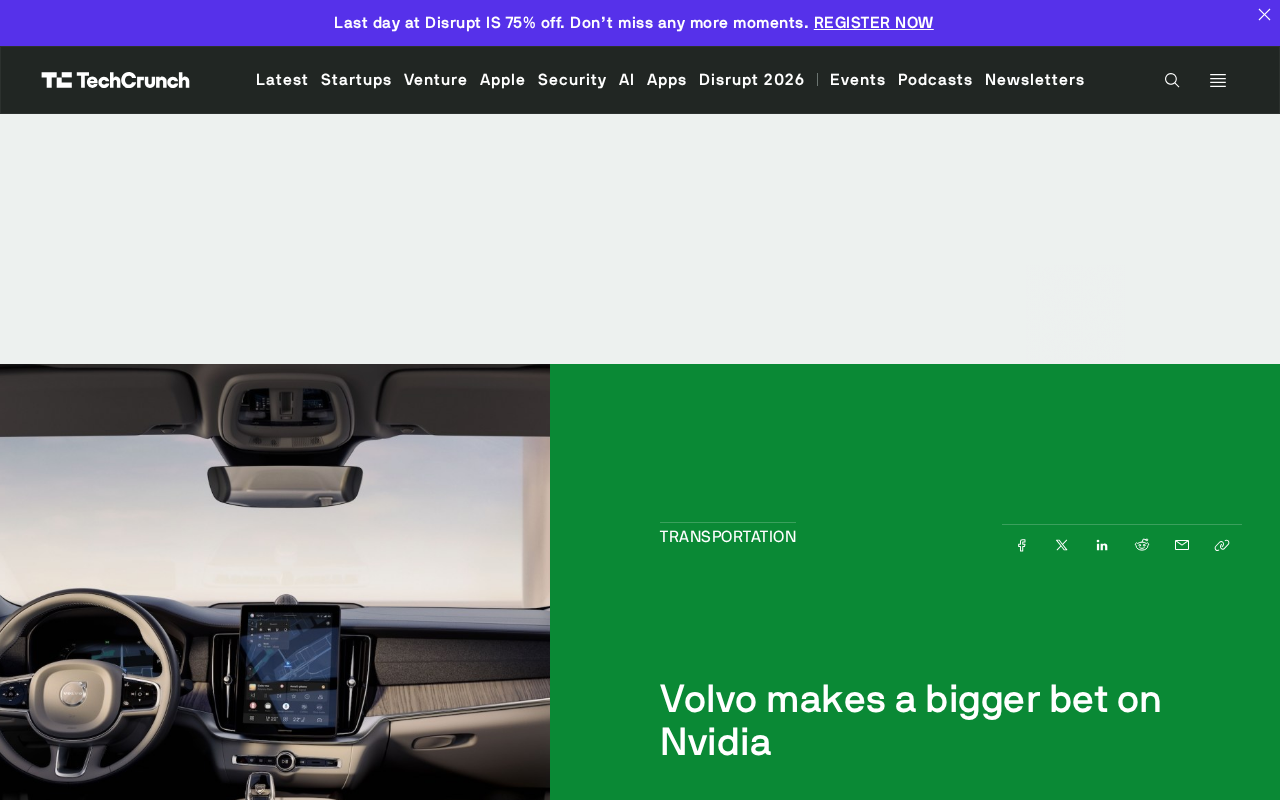
From Pure EV Exclusive to Full Lineup Coverage
Volvo's collaboration with Nvidia dates back nearly a decade. At the time, the partnership focused primarily on autonomous driving capabilities for pure electric vehicles, with Nvidia's Drive platform providing computing power for Volvo's electrified flagship models.
The core change in this expansion lies in the broadening of coverage. Volvo has explicitly stated that the new collaboration will "extend beyond battery electric vehicles," meaning Volvo models equipped with Nvidia's autonomous driving platform will span more powertrain types. For an automaker transitioning toward full electrification but still reliant on hybrids and combustion-engine vehicles to maintain market share in the near term, this adjustment carries practical significance.
Why Volvo Needs More Computing Power
One of the core challenges of autonomous driving systems is processing massive amounts of data from multiple sensors — cameras, radar, LiDAR — under tight constraints on onboard power consumption and cost. Nvidia's Drive platform series is designed precisely for this scenario.
Volvo's decision to expand its partnership with Nvidia reflects several industry trends:
- Software-defined vehicles becoming consensus: Automakers increasingly rely on high-performance computing platforms to support OTA upgrades and feature iteration. The model of pre-installed hardware with paid software is being adopted by more brands.
- Diverging pace of autonomous driving deployment: L2+ assisted driving has reached mass production, but L3 and above still faces both regulatory and technical barriers. Automakers need to maintain computing redundancy to quickly follow suit when regulations open up.
- Deepening supply chain lock-in: Choosing Nvidia means accepting its software and hardware ecosystem, including the CUDA toolchain and Orin/Thor series chips. This lock-in can accelerate development but also creates dependence on a single supplier.
Nvidia Drive Platform and Orin/Thor Chips
Nvidia Drive is a computing platform series designed specifically for autonomous driving, centered on scalable automotive-grade SoCs (System-on-Chips). The previous-generation Orin chip delivers approximately 254 TOPS (trillion operations per second) per unit and is a mainstream choice for L2+ to L3 autonomous driving. The new-generation Thor chip targets central computing architecture, with single-chip computing power exceeding 1,000 TOPS, capable of simultaneously handling autonomous driving, cabin entertainment, and in-vehicle AI assistant tasks. When automakers adopt the Drive platform, it means their electrical/electronic architecture shifts from distributed ECUs to central computing — reducing wiring and weight while continuously unlocking computing potential through OTA. Volvo's upgrade of its computing foundation is precisely aimed at maintaining system redundancy and upgradeability amid exploding sensor data volumes and accelerating feature iteration.
Nvidia Scores Another Win in Automotive
For Nvidia, Volvo's increased commitment is yet another example of its automotive business continuing to expand. While automotive revenue accounts for a modest share of Nvidia's total revenue, its growth potential is repeatedly cited by capital markets.
What makes Volvo unique is that it belongs to Zhejiang Geely Holding Group, sharing some technology resources with brands like Polestar and Lotus. Volvo's expanded partnership with Nvidia could have a demonstration effect on autonomous driving strategy choices across the entire Geely family of brands.
On the other hand, Nvidia also faces competition in the automotive space. Qualcomm dominates the cabin chip market, Mobileye has deep expertise in ADAS vision solutions, and Tesla has chosen to develop its own FSD chip. Nvidia's advantage lies in the scalability of its platform and synergy on the AI training side — automakers can train models in data centers using Nvidia GPUs, then deploy them to the vehicle-side Drive platform.
CUDA Toolchain Synergy and Lock-in Risk
CUDA is Nvidia's parallel computing platform and programming model, and has become the industry standard in AI training. When automakers use Nvidia GPUs in data centers to train autonomous driving models, they naturally depend on the CUDA ecosystem, and deploying models to the vehicle-side Drive platform enables software-hardware co-optimization. This "cloud training, vehicle inference" closed loop is Nvidia's unique advantage in the automotive space. However, it also creates vendor lock-in: once core algorithms are developed based on CUDA and Drive, migrating to Qualcomm, Mobileye, or self-developed chips becomes extremely costly, including code rewriting, toolchain rebuilding, and team retraining. Therefore, Volvo's expanded partnership is not just a computing upgrade — it also means deeper binding to the Nvidia ecosystem in its autonomous driving tech stack, which may affect its future bargaining power and flexibility in technology roadmaps.
The Practical Considerations Behind the Partnership Upgrade
Volvo's expansion of this partnership is not merely a technical upgrade — there are also market-level considerations.
Global EV demand growth has slowed, and multiple automakers have adjusted their full-electrification timelines. Volvo's previously set "full electrification by 2030" target has also loosened under market pressure, shifting emphasis to "electrification" rather than "pure electrification." Against this backdrop, autonomous driving capabilities are no longer just a selling point for EVs — they need to cover a broader product line to enhance competitiveness across the entire lineup.
Safety has long been Volvo's brand label. The reliability of autonomous driving systems directly affects the value of this label. Choosing to deepen its partnership with Nvidia is, to some extent, a trade-off Volvo has made between "in-house development" and "procuring mature solutions" — handing the computing platform to Nvidia while focusing its own efforts on perception algorithms, feature definition, and user experience.
Whether this division of labor can translate into product advantages in a fiercely competitive market remains to be seen, depending on the specific models and feature deployment pace Volvo announces next.
Software-Defined Vehicles and the Hardware Pre-Installation Model
Software-defined vehicles (SDV) refer to vehicles whose features and experiences are primarily implemented and iterated through software, rather than being fixed at the factory. The typical business model is "hardware pre-installation, software payment": automakers install high-computing-power chips and sensors at the factory, but some features are unlocked through OTA or subscription fees. This model requires the computing platform to have sufficient redundancy to support software upgrades over the coming years. Volvo's deepened partnership with Nvidia is precisely aimed at ensuring its entire lineup has this upgradeable computing foundation. For consumers, this means vehicles can gain new features over their lifecycle; for automakers, it creates ongoing service revenue but also entails higher upfront hardware costs and user acceptance risk.
One-line Summary
Volvo expands its Nvidia partnership, upgrading autonomous driving computing and covering its full lineup.
Paragraph Summary
Volvo announced it is expanding its nearly decade-long partnership with Nvidia, upgrading its autonomous driving system's computing power to a more advanced platform and extending the collaboration from pure EVs to more powertrain types. This adjustment reflects that amid slowing global EV demand, Volvo is shifting emphasis to "electrification" rather than "pure electrification," with autonomous driving capabilities needing to cover a broader product line to boost competitiveness. For Nvidia, this is another example of its automotive business expansion and could have a demonstration effect on Geely family brands. The article also analyzes industry trends such as software-defined vehicles and deepening supply chain lock-in, as well as Volvo's trade-off between in-house development and procuring mature solutions.
Related articles

Build an AI Super Employee System at Zero Cost: A Full Breakdown of Automated Agent Workflows
A deep breakdown of the AI super employee system demoed on Bilibili: agent orchestration, digital human voiceovers, map and enterprise lead generation, 24/7 customer service, and legal modules. We analyze the business logic and compliance risks behind zero-cost signup to help entrepreneurs judge the real ROI of this AI digital employee system.

The Essential Difference Between Chatbots and AI Agents: Crossing from Conversation to Execution
What's the difference between a chatbot and an AI agent? Based on the MCP series on the Learn Tech channel, this article uses examples like booking flights and summarizing notes to explain: a chatbot only gives answers, while an agent actually completes tasks through a think-act-observe loop. It breaks down the four core components—model, tools, memory, and goal—as well as MCP's role as a bridge, and discusses agents' applicable boundaries and permission risks.

Free GitHub Repo: 342 Hours of AI Courses, from Math to MCP Servers
A free GitHub repo offers 342 hours of AI courses: 523 lessons across 20 phases, from math fundamentals to agent building and MCP servers. Nearly 100,000 learners have started.