Volvo Teams Up with Nvidia: Point-to-Point Hands-Off Driving by 2030

Volvo plans to launch a Level 2++ point-to-point hands-off driving feature based on Nvidia's platform before 2030.
Volvo announced it will launch a point-to-point hands-off driving feature before 2030, rated Level 2++, built on Nvidia's autonomous driving technology stack, with capabilities similar to Tesla FSD Supervised. The system allows drivers to take their hands off the wheel but requires them to remain attentive, and can perform continuous operations such as highway on-ramp merging, lane keeping, and automatic lane changes. Volvo, controlled by China's Geely and designed in Sweden, chose a mature third-party platform rather than in-house development to shorten development cycles. Deployment challenges include regulatory differences across Europe, the U.S., and China, communicating user responsibility boundaries, and accumulating real-world road test data. The first model and markets have not yet been announced.
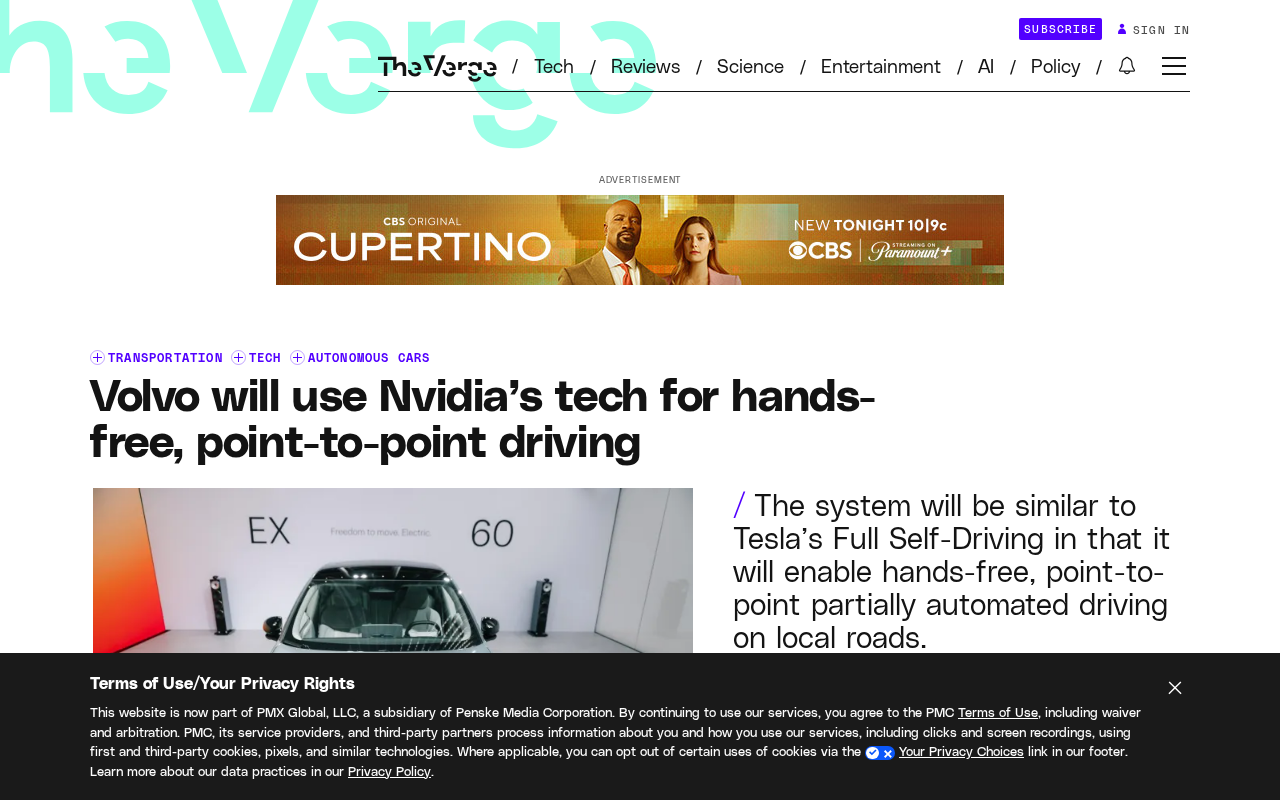
Volvo Cars recently announced plans to launch a point-to-point hands-off driving feature by 2030, built on Nvidia's latest autonomous driving technology stack. The Swedish-designed automaker, which is controlled by Chinese capital, said on Thursday that it will adopt Nvidia's autonomous driving platform to power a new partially automated driving system with capabilities similar to Tesla's Full Self-Driving (Supervised).
Volvo defines this point-to-point system as Level 2++, meaning the driver must still remain attentive, but the vehicle can complete continuous driving operations from start to finish under certain conditions, including highway on-ramp merging, lane keeping, and automatic lane changes.
From Level 2+ to Level 2++: The Gradual Path to Hands-Off Driving
The Level 2++ system Volvo unveiled is essentially a further upgrade built on existing advanced driver assistance systems (ADAS). Similar to Tesla's FSD (Supervised), it allows drivers to take their hands off the wheel, but their eyes and attention must remain on the road.
This strategy reflects a common choice among automakers today when it comes to deploying autonomous driving: rather than pursuing a one-step leap to L4/L5, they gradually accumulate data and user trust through intermediate states like L2+ and L2++. Volvo has not announced which specific model will debut the feature, but it has clearly anchored the timeline to before 2030.
You may not have noticed, but Volvo emphasizes that this system is "point-to-point," meaning it can cover the complete route from origin to destination, not just single-lane assistance on highways. This means the system needs to handle more complex urban road conditions and intersection scenarios.
SAE (Society of Automotive Engineers) J3016 standard classifies driving automation into six levels, from L0 to L5. L0 is no automation, L1 is single-feature assistance (such as adaptive cruise control or lane keeping, but not both), and L2 is combined driver assistance, which can control both steering and speed simultaneously, but the driver must monitor at all times. L3 is conditional automation, where the system can fully take over in specific scenarios, and the driver does not need to continuously monitor but must take over when the system requests. L4 and L5 correspond to high automation and full automation, respectively. The terms L2+ and L2++ are not official SAE definitions, but rather marketing terms used by automakers to describe expanded capabilities beyond L2, typically referring to systems that are closer to L3 but still legally classified as L2. This means that no matter how capable the system is, the responsible party remains the driver.
Nvidia's Autonomous Driving Stack Scores Another Win
Nvidia's autonomous driving technology stack has become a common choice for multiple automakers. Volvo's adoption of its solution continues Nvidia's momentum in expanding across automotive AI chips and autonomous driving software platforms.
Nvidia's DRIVE platform provides a complete toolchain from chips and sensor fusion to planning and control, on which automakers can build customized development. Volvo's choice of Nvidia reflects both its recognition of Nvidia's computing power reserves and its global compliance needs — Nvidia's solutions are more easily able to meet regulatory requirements in different regions.
However, Volvo did not disclose which generation of the DRIVE platform it will use, nor whether it will integrate Nvidia's solution with its own existing safety technologies. Given that Volvo has long used safety as its core brand label, how it defines safety redundancy in hands-off driving scenarios will be a key focus going forward.
NVIDIA DRIVE is Nvidia's end-to-end computing platform for autonomous driving, including automotive AI chips such as Orin and Thor, the DriveOS operating system, DriveWorks middleware, and upper-layer software stacks for perception, mapping, and planning. Automakers can either purchase only chips or adopt the entire hardware and software solution. A single Orin chip delivers approximately 254 TOPS, while Thor is designed for central computing architectures with computing power exceeding 1000 TOPS, supporting multi-domain integration. Nvidia's advantages lie in its scalable computing power and mature development toolchain, but if automakers rely too heavily on its software stack, they may be constrained in data closed-loop and differentiated experiences. This is also why some automakers have turned to in-house development or adopted solutions from Mobileye or Qualcomm.
Technology Path Under Chinese Capital and Swedish Design
Volvo is currently controlled by China's Geely, but its R&D and design remain centered in Gothenburg, Sweden. This cross-cultural background makes its technology path different from both the conservatism of traditional European automakers and the aggressiveness of some Chinese EV startups.
Choosing Nvidia rather than developing its own chips or adopting Chinese supplier solutions indicates that Volvo prefers to leverage mature third-party platforms for its autonomous driving core technology in order to shorten development cycles. This contrasts with some other brands under the Geely Group (such as Zeekr and Lynk & Co), which partially use Mobileye or in-house solutions.
From an industry perspective, Volvo's entry further validates Nvidia's key position in the autonomous driving supply chain. As more automakers market L2++ as a selling point, competition among Nvidia, Mobileye, and Qualcomm will focus more on the specific scenario of "hands off but eyes on."
The Significance and Challenges of the 2030 Timeline
Setting point-to-point hands-off driving for launch before 2030 gives Volvo a window of about four years. This timeline is broadly in sync with the advanced intelligent driving plans announced by most automakers, but Volvo has not provided a more detailed OTA rollout schedule.
The challenge is that an L2++ system requires a large amount of real-world road test data and regulatory approval. Europe and China have different regulatory attitudes toward hands-off driving, and Volvo needs to satisfy both. In addition, how to clearly communicate the responsibility boundaries of a "supervised" version to users and avoid misuse is a common issue facing all automakers promoting L2++.
Volvo has not yet announced which model will first carry the system, nor whether it will launch simultaneously in the Chinese and U.S. markets. Given its global sales structure, China and Europe are likely to be the first markets for deployment.
ETA (estimated time of arrival) and responsibility boundaries are key non-technical factors in the deployment of L2++. Current regulations across countries differ significantly regarding permission for "hands-off driving": Europe's UN R157 regulation only allows L3 hands-off driving in specific highway scenarios, while China is gradually opening up through documents such as the "Management Specifications for Road Testing and Demonstration Application of Intelligent Connected Vehicles," but L2++ still requires the driver to remain responsible at all times. Automakers typically use driver monitoring systems (DMS) to detect gaze and attention, and if the driver is distracted, the system gradually degrades or disengages. In addition, OTA rollout schedules are affected by certification processes in different regions, and the same feature may launch in different markets months or even years apart.
One-line Summary
Volvo plans to launch a Level 2++ point-to-point hands-off driving feature based on Nvidia's platform before 2030.
Paragraph Summary
Volvo announced it will launch a point-to-point hands-off driving feature before 2030, rated Level 2++, built on Nvidia's autonomous driving technology stack, with capabilities similar to Tesla FSD Supervised. The system allows drivers to take their hands off the wheel but requires them to remain attentive, and can perform continuous operations such as highway on-ramp merging, lane keeping, and automatic lane changes. Volvo, controlled by China's Geely and designed in Sweden, chose a mature third-party platform rather than in-house development to shorten development cycles. Deployment challenges include regulatory differences across Europe, the U.S., and China, communicating user responsibility boundaries, and accumulating real-world road test data. The first model and markets have not yet been announced.
Related articles

Cursor AI Programming in Practice: Build a Student Management System from Scratch in 30 Minutes
A Bilibili creator demonstrates Cursor AI programming: generating a student management system in 30 minutes with natural language. Details on Agent mode, Claude selection, prompt techniques, and thresholds.

Top 20 AI Coding Tools Ranking: From Rock-Solid to Lackluster, a Scored Matrix
Bilibili creator releases top 20 AI coding tools ranking, tiered T0–T4 from rock-solid to lackluster, with Claude Code and Codex tied at T0. This article details the scoring dimensions (capability, reliability, robustness, durability, cost, domestic availability) and tool performances to help developers choose the right AI coding assistant.

Vibe Coding Systematic Tutorial: Master AI-Assisted Programming from Zero
A three-month Vibe Coding tutorial from a Bilibili creator covering Codex, ClaudeCode, and Cursor, from core logic to commercial project practice for beginners.