Voyager 1 Reaches One-Light-Day Milestone: Farthest Human-Made Object Sets New Record
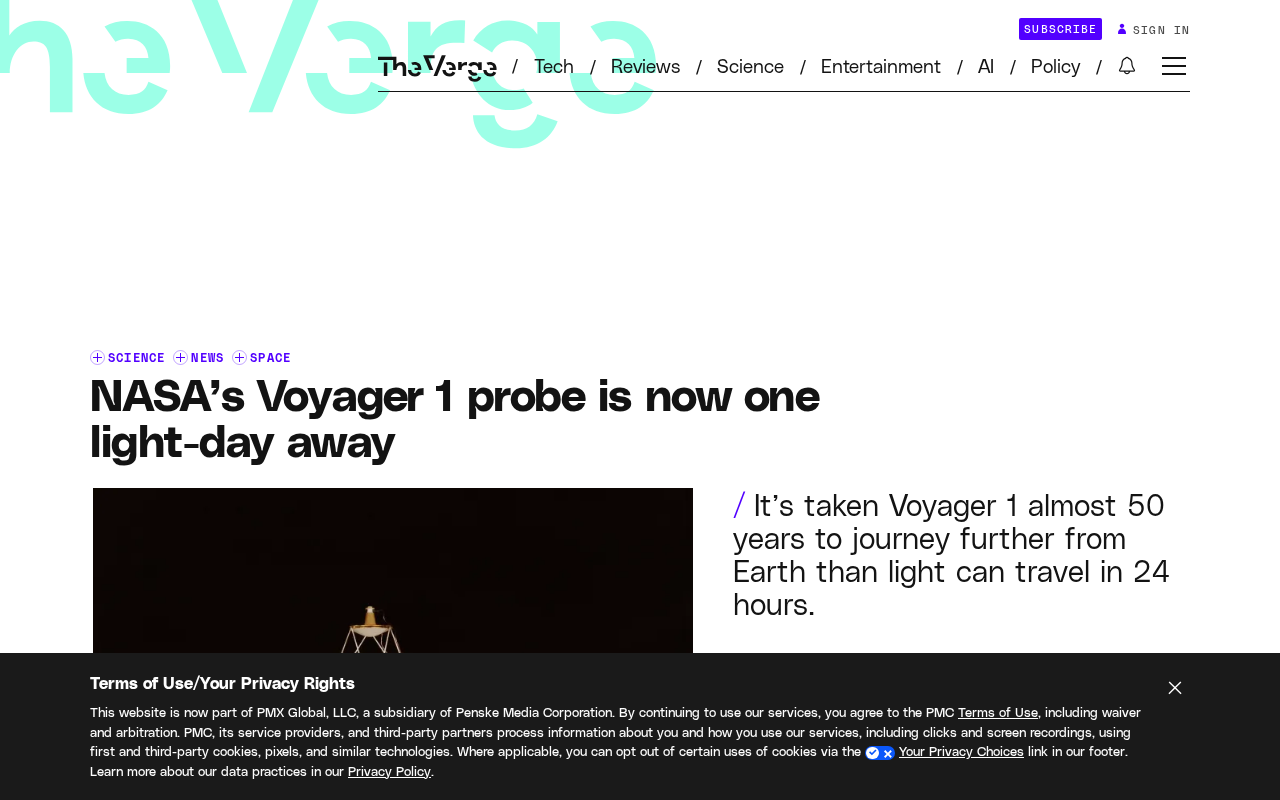
Voyager 1 reaches the one-light-day milestone from Earth, becoming the first human-made object to achieve this distance.
NASA's Voyager 1 probe has reached the one-light-day milestone at about 16.094 billion miles from Earth, becoming the first human-made object to achieve this distance. This means radio signals take about one day one-way and two days round-trip, requiring the ground control team to adopt asynchronous communication and plan commands in advance. Launched in the 1970s, Voyager 1 used gravity assists to fly by Jupiter and Saturn before crossing the heliopause into interstellar space. It is still moving away from the Sun at about 17 km/s, but its nuclear power source is declining yearly, some instruments have been shut down, and it is expected to operate for several more years. Multiple sources confirm the event with no major discrepancies.
Beyond One Light-Day: Voyager 1's Deep Space Milestone
According to NASA, the Voyager 1 probe has officially reached the milestone of being one light-day from Earth after decades of traversing space. The moment was recorded at 5:16 AM EDT on Wednesday, with the probe currently about 16.094 billion miles from Earth. NASA's assessment: "Very, very far."
A light-day is the distance light travels in one day, and Voyager 1 has become the first human-made object to reach this distance. This is not just a breakthrough in distance—it also means radio signals from Earth now take about a day to reach the probe, and the probe's response takes another day to return. This communication delay itself marks a new phase in deep space exploration.
Two Days for a Round Trip: The Engineering Challenges Behind Communication Delay
The most direct impact of the one-light-day distance is communication. Previously, Voyager 1's signal round-trip time was already dozens of hours; now a one-way trip takes about a day, and a round trip takes two days. This means the ground control team cannot perform real-time operations—any command sent and confirmed must be planned in advance, and the margin for error is greatly reduced.
According to NASA, Voyager 1 is equipped with a 3.7-meter high-gain antenna and maintains contact with Earth through the Deep Space Network. Although signal strength attenuates with the square of distance, the large antennas of the Deep Space Network can still capture extremely faint signals. Engineers must precisely calculate transmission and reception windows to ensure data is not lost. This communication mode is completely different from low-Earth-orbit missions—it's more like "message-style" asynchronous communication.
Deep Space Network (DSN) is NASA's global antenna network used to communicate with deep space probes, consisting of three deep space communications complexes located in Goldstone, California, USA; Madrid, Spain; and Canberra, Australia. Each facility is equipped with large parabolic antennas, the largest of which is 70 meters in diameter. This global layout ensures that no matter how Earth rotates, there is always a station with line-of-sight contact with the probe. The signals received by the Deep Space Network are extremely faint—for example, Voyager 1 transmits only about 20 watts of power, and by the time the signal reaches Earth, its strength has attenuated to many decimal places of zero. To capture these signals, the Deep Space Network uses high-sensitivity receivers, low-noise amplifiers, and signal processing technology. In addition, the Deep Space Network is responsible for sending uplink commands; because the signal round trip takes two days, all commands must be scheduled and confirmed in advance.
From Planetary Tour to Interstellar Space: A Review of Voyager 1's Journey
Voyager 1 was launched in the 1970s, with its initial mission to fly by Jupiter and Saturn. It used planetary gravity assist to accelerate, and after completing its planetary exploration, its speed was sufficient to escape the Sun's gravitational pull and enter interstellar space. According to NASA confirmation, Voyager 1 crossed the heliopause several years ago, becoming the first human-made object to enter interstellar space.
Along the way, Voyager 1 has returned a wealth of valuable data, including details of Jupiter's Great Red Spot, the structure of Saturn's rings, and direct measurements of the interaction between the solar wind and the interstellar medium. Today, it is still moving away from the Sun at about 17 kilometers per second, continuing toward the unknown deep space.
Gravity Assist is the key mechanism that enabled Voyager 1 to fly out of the solar system. When the probe flies by a planet, it interacts gravitationally with the planet, thereby changing speed and direction without consuming additional fuel. Specifically, when the probe passes behind a planet, the planet's gravity "slings" it away, giving it a speed increase relative to the Sun. Voyager 1 used the gravity assists of Jupiter and Saturn to boost its speed to escape velocity sufficient to break free from the Sun's gravitational pull. The core of this technology lies in precisely calculating the trajectory to ensure the probe approaches the planet at the right time and angle to maximize the speed gain. Without gravity assists, with the rocket technology of the time, it would have been almost impossible for the probe to reach such high speeds, let alone enter interstellar space.
Heliopause is the boundary between the solar system and interstellar space. The solar wind blows outward from the Sun, forming a huge bubble-like region called the heliosphere. The heliopause is the boundary where the pressure of the solar wind and the interstellar medium reach equilibrium; crossing it means officially entering interstellar space. Voyager 1 crossed the heliopause in 2012, becoming the first human-made object to enter interstellar space. This boundary is not fixed but fluctuates with the solar activity cycle. After crossing the heliopause, parameters such as plasma density and cosmic ray flux measured by the probe change significantly; these data are crucial for understanding the physical processes at the edge of the solar system.
Multi-Source Verification: Fact-Checking the One-Light-Day Event
The news of Voyager 1 reaching the one-light-day distance has been corroborated by multiple independent sources. According to NASA's official release and reports from multiple tech media outlets, this milestone was officially achieved at 5:16 AM EDT on Wednesday, with distance values consistently pointing to about 16.094 billion miles. There are no factual discrepancies between sources, and the consensus is clear: Voyager 1 is currently the farthest human-made object from Earth and has crossed the one-light-day threshold.
Interestingly, some reports discuss this event in connection with Voyager 1's launch year and the time it crossed into interstellar space, but these specific years are not explicitly given in the original material, so this article presents them only with qualitative descriptions such as "decades" and "several years ago." For Voyager 1's exact launch date and the precise time it entered interstellar space, it is recommended to consult NASA's official mission page for authoritative information.
Scientific Significance and Future Outlook
The distance of one light-day is an unimaginable scale for humanity. Light takes only about 8 minutes to travel from the Sun to Earth, while Voyager 1 has already flown beyond the distance light travels in a day. This marks the first time a human probe has entered the "light-day" scale of deep space, providing an important distance reference for future interstellar exploration.
As Voyager 1 continues to fly, the power output of its nuclear power source (radioisotope thermoelectric generator) decreases year by year, and some instruments have been gradually shut down to save energy. According to previous NASA disclosures, the probe is expected to continue operating for several more years but will eventually lose contact with Earth when its power runs out. Even so, the interstellar space data it collected before falling completely silent will continue to be transmitted back and enrich humanity's understanding of the edge of the solar system.
Voyager 1's journey is not only an engineering feat but also a symbol of humanity's spirit of exploration. The Golden Record it carries records the sounds and images of Earth; even if it one day loses contact with Earth, it will continue to journey alone and steadfastly through the Milky Way as an emissary of human civilization.
Radioisotope Thermoelectric Generator (RTG) is the main power source for Voyager 1. It uses the heat generated by the decay of radioactive isotopes such as plutonium-238, converting it into electricity through thermocouples. The advantages of RTGs are long life and high reliability; they do not rely on solar energy and are suitable for deep space missions far from the Sun. However, as the isotopes decay, their output power decreases by about 4 watts per year. Voyager 1's RTG had a power output of about 470 watts at launch, which has now significantly decreased. To extend the mission's life, engineers have had to gradually shut down some instruments, prioritizing the operation of critical scientific data and communication systems. It is estimated that by the 2030s, the RTG's power will be insufficient to operate any instruments, and the probe will fall completely silent.
One-line Summary
Voyager 1 reaches the one-light-day milestone from Earth, becoming the first human-made object to achieve this distance.
Paragraph Summary
NASA's Voyager 1 probe has reached the one-light-day milestone at about 16.094 billion miles from Earth, becoming the first human-made object to achieve this distance. This event means radio signals take about one day one-way and two days round-trip, requiring the ground control team to adopt asynchronous communication and plan commands in advance. Voyager 1 was launched in the 1970s and used gravity assists to fly by Jupiter and Saturn before crossing the heliopause into interstellar space. It is still moving away from the Sun at about 17 km/s, but its nuclear power source is declining yearly, some instruments have been shut down, and it is expected to operate for several more years. Multiple sources confirm the event with no major discrepancies.
Related articles

@ai-sdk/harness-fx 1.0.107 Released: MCP Dependency Upgrade, Patch Update
@ai-sdk/harness-fx 1.0.107 released, updating dependency @ai-sdk/mcp to 2.0.103. Learn about this patch update, its impact on AI SDK developers, and upgrade advice.

What Happened to Silicon Valley? O'Reilly Long-Form Piece Sparks Heated Debate on Hacker News
O'Reilly Radar's "What Happened to Silicon Valley?" earned 302 points and 153 comments on Hacker News, sparking debate on the valley's innovation ecosystem and culture.

After Maduro's Arrest, Where Does Venezuela Go From Here?
After Maduro's capture by U.S. forces and detention in Brooklyn, Venezuela faces a power vacuum, no election date, and a geopolitical struggle over its oil.