VR Teleoperation Robotics: A Practical Guide to Swapping Left/Right Controller Data and Aligning Coordinate Systems

A practical guide to fixing left-right controller swap and coordinate alignment issues in VR robot teleoperation with MuJoCo.
When using Pico 4 Ultra and XRoboToolkit to drive MuJoCo simulations for robot teleoperation, left-right controller confusion is a common pitfall caused by mismatched indices and coordinate system chirality. This guide explains how to programmatically swap controller mappings, mirror position vectors, and apply correct quaternion transformations to fix the issue cleanly.
Background: Left-Right Confusion When Mapping VR Controllers to Robots
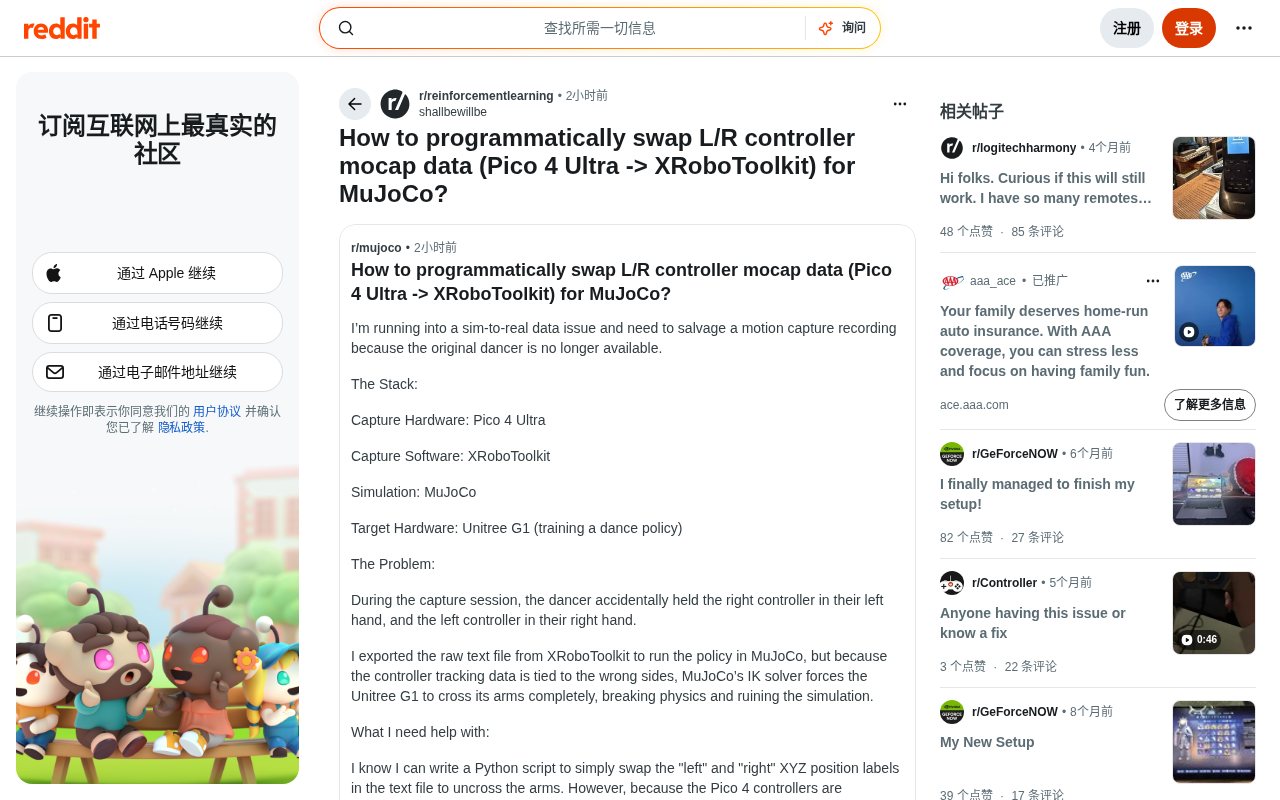
As Embodied AI and robot teleoperation rapidly advance, more developers are turning to consumer-grade VR devices to collect human motion data for training or directly controlling robots. A developer recently raised a question on Reddit that sounds like a minor detail but is actually a classic engineering challenge: when using a Pico 4 Ultra headset with XRoboToolkit to capture controller motion capture (mocap) data and drive a MuJoCo simulation, how do you programmatically swap the left and right controller data mappings?
This question highlights a recurring pain point in VR teleoperation pipelines: when controller pose data is fed into a physics simulator, the correspondence between left and right hands, axis orientations, and rotation quaternions can all be off — causing the robot's arms to mirror each other incorrectly.
Tech Stack Breakdown: Pico 4 Ultra + XRoboToolkit + MuJoCo
Three Components, Three Roles
To understand this problem, you first need to break down the three core components in the data pipeline.
Pico 4 Ultra is a consumer mixed-reality headset from ByteDance, equipped with dual 6DoF controllers. It captures the position and orientation of the user's hands in real space, serving as the raw input source for teleoperation. 6DoF (Six Degrees of Freedom) refers to a complete description of motion in 3D space: three translational degrees (displacement along X/Y/Z axes) plus three rotational degrees (Pitch, Yaw, Roll). Consumer VR controllers typically fuse IMU (Inertial Measurement Unit) data with optical or electromagnetic tracking to continuously estimate the full pose of each controller with millisecond-level latency — the hardware foundation for real-time teleoperation.
XRoboToolkit is a middleware toolkit that bridges VR devices and robotic systems. It converts controller poses captured by the Pico into formats consumable by robots or simulators, typically streaming position vectors and rotation quaternions in real time.
MuJoCo (Multi-Joint dynamics with Contact) is one of the most widely used physics simulation engines in robotics research, maintained by DeepMind and open-sourced in 2021. Its key strengths are efficient contact dynamics solving and accurate joint constraint simulation, making it the go-to environment for training robot policies in reinforcement learning and imitation learning. MuJoCo's mocap body mechanism lets developers bind external motion capture data directly to virtual objects in the simulation, enabling real-time control of robot end-effectors.
What mocap Data Actually Is
In MuJoCo, a mocap body is a special rigid body that is not subject to physics dynamics — its position (mocap_pos) and orientation (mocap_quat) are set directly by an external program. During teleoperation, each frame's controller pose is written into the corresponding mocap body, and the robot arm then tracks these target points via inverse kinematics or impedance control.
Rotation data is transmitted as quaternions rather than Euler angles. A quaternion q = (w, x, y, z) represents a 3D rotation using four real numbers, avoiding the gimbal lock problem of Euler angles and supporting smooth interpolation. This is the standard rotation representation in robotics and VR — but precisely because of its abstract nature, sign errors introduced during coordinate frame conversions can be extremely unintuitive to debug.
Root Causes and Solutions for the Left-Right Swap Problem
Why Left-Right Confusion Happens
The need to swap left and right controller data typically arises from several situations:
- The controller indices output by XRoboToolkit don't match the mocap body definition order in MuJoCo
- The VR space and simulation space have different coordinate system chirality (e.g., one is right-handed and the other left-handed), causing a mirror flip
- Operator preference or robot configuration requires swapping left and right
Coordinate system chirality is the deeper root cause of these issues. In a right-handed coordinate system, the positive X, Y, and Z axes satisfy the right-hand rule. However, graphics engines like OpenGL and Unity have historically different axis conventions from robotics frameworks like ROS and MuJoCo. When data crosses these boundaries, flipping the direction of one axis produces a mirror effect in space — manifesting directly as a left-right swap.
Key Steps for a Programmatic Fix
From an engineering standpoint, the cleanest approach is to perform explicit remapping in an intermediate layer before data is written to MuJoCo.
Step 1: Identify the source indices. Determine which field in the XRoboToolkit output stream corresponds to the left controller and which to the right. This is usually clearly specified in the SDK documentation or data structure definitions.
Step 2: Swap the assignment targets. When writing poses to data.mocap_pos and data.mocap_quat, write data originally destined for the left-hand mocap body into the right-hand body's index, and vice versa. In MuJoCo's Python bindings, you can retrieve the corresponding mocap index via model.body(name).mocapid.
Step 3: Handle coordinate system mirroring. Simply swapping indices is often not enough. If the left and right hands have a mirror relationship, you also need to negate one axis of the position vector (usually the X axis) and apply the corresponding mirror transformation to the quaternion. Quaternion mirroring follows strict mathematical rules: for a mirror about the YZ plane (normal along X), negate the X component of the position vector. The corresponding quaternion transform negates the imaginary components parallel to the mirror plane — specifically, if q = (w, x, y, z), the mirrored quaternion is q' = (w, -x, y, z) (for a YZ-plane mirror). Importantly, the mirrored quaternion must be renormalized to eliminate small floating-point errors.
Implementation Notes
In practice, it's recommended to encapsulate the remapping logic in a dedicated function: take the raw left and right poses as input, output the swapped and corrected data, then write everything to the simulation in one pass. This makes debugging easier and allows quick adjustments when coordinate conventions change. Also, always keep quaternions normalized throughout transmission and transformation to avoid pose drift or numerical instability in the simulation.
Broader Implications: Standardizing the Teleoperation Data Pipeline
While this specific problem may seem small, it reflects a widespread pain point in the Embodied AI field — the lack of a unified standard for teleoperation data pipelines. From consumer VR devices to professional simulation engines, there are countless device-specific coordinate conventions, index orderings, and data formats in between. Developers often spend considerable time debugging these "glue layer" issues.
With the rise of VLA (Vision-Language-Action) models and imitation learning, collecting high-quality human demonstration data via VR has become one of the dominant paradigms. VLA models unify visual perception, language understanding, and action generation within a single model framework, and their training relies heavily on large-scale, high-quality human manipulation demonstrations. VR teleoperation is currently the most cost-effective way to collect this kind of data: compared to professional motion capture suits, consumer headsets cost two orders of magnitude less while still providing 6DoF hand trajectories with sufficient accuracy. Open-source tools like XRoboToolkit exist specifically to lower the barrier to this workflow. But the recurring nature of left-right swap and coordinate alignment issues shows that the community still needs more mature abstraction layers and better documentation to hide underlying device differences.
For developers building similar teleoperation systems, these lessons are worth crystallizing into reusable adapter modules. Cleanly separating the "data acquisition," "coordinate transformation," and "simulation driving" layers not only elegantly solves the left-right swap problem, but also lays the groundwork for easily switching between different VR devices or simulation environments in the future.
Key Takeaways
Related articles

Network Doctor: An Open-Source Terminal Tool for Network Fault Diagnosis
Network Doctor is an open-source terminal network diagnostic tool that integrates ping, dig, curl, and traceroute, automatically detecting connectivity in stages and outputting fault conclusions in natural language.

LangChain Guardrails Explained: Building Safe and Controllable AI Agents
A detailed guide to LangChain Guardrails covering layered ecosystem architecture, middleware implementation, deterministic and model-driven protection for building production-grade secure AI Agents.

Deep Dive into Microsoft's AI Security Tools: Does Performance Really Surpass the Competition?
Microsoft launches enterprise AI security tools claiming superior performance. This deep analysis examines core capabilities, ecosystem advantages, and risks to guide enterprise security decisions.