VTF900: A 900-Subject Visible-Thermal Face Recognition Benchmark Released
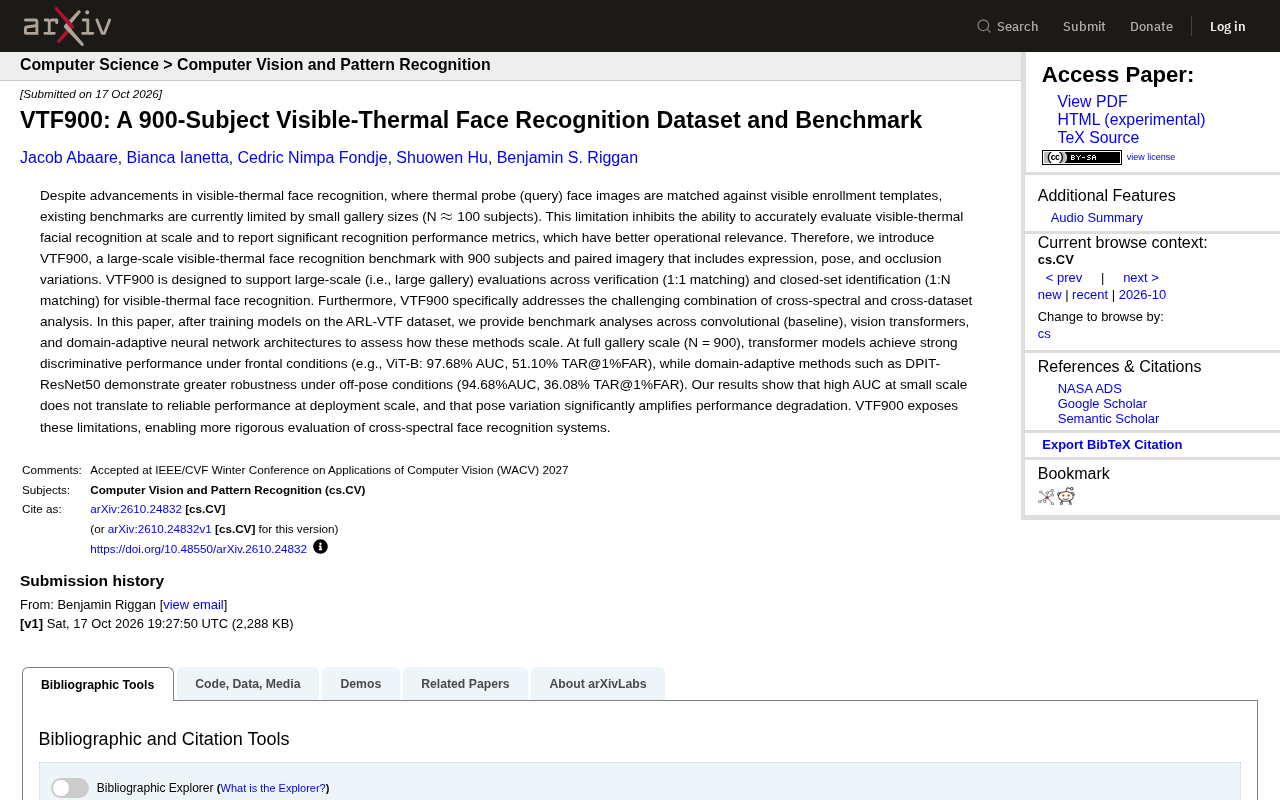
VTF900 expands the cross-spectral face recognition benchmark gallery to 900 subjects, revealing that small-scale AUC does not represent deployment performance.
The VTF900 dataset raises the evaluation gallery for visible-thermal face recognition from about 100 to 900 subjects, supporting large-scale evaluation of 1:1 verification and 1:N closed-set identification while stacking the combined challenges of cross-spectral and cross-dataset settings. Researchers trained convolutional networks, vision Transformers, and domain adaptation models on ARL-VTF and evaluated them on VTF900. Results show that ViT-B performs best under frontal conditions (97.68% AUC, 51.10% TAR@1%FAR), while DPIT-ResNet50 is more robust under non-frontal poses (94.68% AUC, 36.08% TAR@1%FAR). The core conclusion is that high AUC at small scale does not translate into reliable performance at deployment scale, pose variation significantly amplifies performance decay, and previous model rankings based on hundred-subject galleries may be substantially reordered at the 900-subject scale.
Title
VTF900: A 900-Subject Visible-Thermal Face Recognition Benchmark Released
Meta Description
VTF900 is a visible-thermal face recognition dataset and benchmark with 900 subjects, supporting large-scale evaluation of 1:1 verification and 1:N identification. The benchmark shows that small-scale high AUC does not translate to deployment performance; ViT-B reaches 97.68% AUC under frontal conditions, while domain adaptation methods are more robust under non-frontal poses.
Article Content
Cross-spectral face recognition has long been constrained by the small scale of evaluation datasets—most benchmarks have a gallery of only about 100 subjects, leaving a hard-to-quantify gap between "small-scale high accuracy" and "real-world deployment performance." The newly released VTF900 dataset pushes this number to 900 subjects and systematically reveals the real differences between model architectures under large-scale evaluation.
Why a Larger-Scale Cross-Spectral Benchmark Is Needed
The typical scenario for visible-thermal face recognition is: using thermal infrared images as probes and comparing them against visible-light enrollment templates. This setup has clear value in nighttime security and identity verification under no-light conditions, but the gallery size of existing benchmarks (N ≈ 100 subjects) severely limits the credibility of evaluation.
The problem with small galleries is not just insufficient statistical power. When the candidate set is only on the order of a hundred people, differences between models tend to be compressed, and top-ranked solutions may not maintain their advantage in actual deployment. The authors of VTF900 explicitly point out that this limitation makes it difficult to "accurately evaluate visible-thermal face recognition at scale and report operationally relevant performance metrics." VTF900 is therefore designed to support large-scale evaluation of both the verification task (1:1 matching) and the closed-set identification task (1:N matching), and specifically targets the combined challenge of cross-spectral and cross-dataset analysis.
Cross-spectral face recognition—the "spectral" in this term refers to imaging bands. Visible (VIS) cameras capture reflected light at 400–700 nm and depend on ambient illumination; thermal infrared (LWIR, typically 8–14 μm) cameras capture spontaneous human radiation and do not depend on lighting. The two have different imaging mechanisms, and the same identity exhibits significantly different texture and contrast distributions across the two modalities, causing models trained on visible light to suffer sharp performance drops when applied directly to thermal images. The core challenge of cross-spectral recognition is learning modality-invariant identity representations, with common approaches including modality alignment losses, generative cross-modal translation, and domain adaptation.
Dataset Composition and Test Design
VTF900 contains paired imagery of 900 subjects, covering variations in expression, pose, and occlusion. These variation dimensions were not chosen arbitrarily—pose and occlusion are precisely the most common sources of failure for cross-spectral recognition in real-world scenarios.
In the experimental design, the researchers trained models on the ARL-VTF dataset and then conducted benchmark analysis on VTF900, covering convolutional networks (baseline), vision Transformers, and domain-adaptive neural network architectures. This "train on dataset A, evaluate at scale on dataset B" cross-dataset setting is closer to deployment reality than evaluation on the same source and distribution.
ARL-VTF is a visible-thermal face dataset released by the U.S. Army Research Laboratory (ARL) and is a commonly used training and evaluation resource in the cross-spectral recognition field, but its gallery size is also on the order of a hundred subjects. The VTF900 experiments adopt a cross-dataset protocol of "train on ARL-VTF, evaluate on VTF900," aiming to test model generalization to unseen subjects and different acquisition conditions. This setting is stricter than splitting training/test within the same dataset, because the two datasets differ in sensors, environments, and population distributions, allowing a more realistic reflection of domain shift issues during deployment.
Key Finding: Small-Scale AUC Does Not Equal Deployment Usability
Results at full gallery scale (N=900) show a clear architectural divergence. Under frontal conditions, Transformer-based models stand out, with ViT-B achieving 97.68% AUC and 51.10% TAR@1%FAR. But under non-frontal poses, domain adaptation methods show greater resilience, with DPIT-ResNet50 achieving 94.68% AUC and 36.08% TAR@1%FAR.
More noteworthy is the authors' conclusive judgment: high AUC at small scale does not translate into reliable performance at deployment scale, and pose variation significantly amplifies performance decay. This means that model rankings previously derived from hundred-subject galleries may undergo substantial reordering at the 900-subject scale. The gap between 51.10% and 36.08% on a metric like TAR@1%FAR corresponds, in a real access control or surveillance system, to the difference between usable and unusable.
AUC (Area Under the ROC Curve) measures the probability that, across all "same-person/different-person" comparison pairs, the model ranks same-person pairs ahead of different-person pairs, with values from 0–1, closer to 1 being better. It characterizes global ranking ability and is independent of any specific threshold. TAR@1%FAR is the true acceptance rate (TAR) at a fixed false acceptance rate (FAR) of 1%, directly corresponding to "what proportion of targets the system can recognize at an acceptable false alarm level," and is closer to operational metrics such as access control and surveillance. The two focus on different things: high AUC indicates good overall discriminability, but low TAR@1%FAR may mean insufficient usability under strict false alarm constraints—which is one reason the article emphasizes that small-scale AUC cannot represent deployment performance.
Practical Significance for Cross-Spectral Recognition Research
The value of VTF900 lies not in topping some leaderboard number, but in providing a stress-test environment that exposes failure modes. It stacks the two difficulties of "cross-spectral" and "cross-dataset" while raising gallery size by nearly an order of magnitude, allowing researchers to observe performance decay curves as scale changes.
For engineering practice, this benchmark suggests that model selection logic needs adjustment: Transformer architectures can be prioritized for frontal scenarios, while domain adaptation approaches should be favored in open environments with frequent pose variation. For academic research, a public benchmark at the 900-subject scale fills the gap in large-scale evaluation for cross-spectral recognition, giving subsequent methods a reference frame closer to operational metrics.
The complete benchmark analysis of the dataset is provided in the paper, covering verification and identification results of three architecture categories at full gallery scale, providing new infrastructure for rigorous evaluation of cross-spectral face recognition systems.
One-line Summary
VTF900 expands the cross-spectral face recognition benchmark gallery to 900 subjects, revealing that small-scale AUC does not represent deployment performance.
Paragraph Summary
The VTF900 dataset raises the evaluation gallery for visible-thermal face recognition from about 100 to 900 subjects, supporting large-scale evaluation of 1:1 verification and 1:N closed-set identification while stacking the combined challenges of cross-spectral and cross-dataset settings. Researchers trained convolutional networks, vision Transformers, and domain adaptation models on ARL-VTF and evaluated them on VTF900. Results show that ViT-B performs best under frontal conditions (97.68% AUC, 51.10% TAR@1%FAR), while DPIT-ResNet50 is more robust under non-frontal poses (94.68% AUC, 36.08% TAR@1%FAR). The core conclusion is that high AUC at small scale does not translate into reliable performance at deployment scale, pose variation significantly amplifies performance decay, and previous model rankings based on hundred-subject galleries may be substantially reordered at the 900-subject scale.
Related articles

Uber Deploys ChatGPT Work Company-Wide: AI in the Workplace Enters the Scaled Implementation Phase
Uber deploys ChatGPT Work to 30,000+ employees, extending it from engineering to all roles. We analyze its expert-engineer pairing, end-to-end automation, and questions of AI control and power concentration—insights for scaling AI in the workplace.

Shift at Midnight Hands-On: When "ID Verification" Becomes Alien Hunting
Shift at Midnight blends ID verification with horror survival in a four-player co-op game. We break down its inspection mechanics and chaotic humor.

Zelensky Recounts the Outbreak of War: I Need Ammunition, Not a Ride
Zelensky recalls the first day of war in a YouTube interview: farewell to family, rejecting Biden's evacuation offer with "I need ammunition, not a ride," and how Bucha shaped his stance on compromise and peace talks.