Wabi: The AI Messaging App That Builds Its Own Apps

Replika's founder launches Wabi, an AI messenger that builds apps on the fly to complete tasks for you and your friends.
Wabi is a new messaging product by Replika founder Eugenia Kuyda that embeds AI Agent capabilities directly into chat: when a need arises in conversation, Wabi doesn't just record it — it dynamically generates a mini-app and completes the task, an approach it calls "apps that make apps." Positioned as the "OS for the agent era," it aims to be a unified platform for handling everyday tasks like ordering food, scheduling, and coordinating hangouts, while emphasizing shared social experiences with friends. It launched on Product Hunt with 73 upvotes (18th for the day). Key challenges include the reliability of AI-generated task execution, the high bar for migrating users away from established platforms, and the bilateral growth requirements of its social network model.
When Instant Messaging Meets AI Agents
In a world where messaging apps have become largely indistinguishable from one another, a new product called Wabi is attempting to redefine what "chat" can mean. Its ambitions are considerable — it's not just a tool for talking with friends, but an agent platform that can proactively "build apps and get things done."
In the team's own words, Wabi is "a new kind of messenger that creates apps and completes tasks for you and your friends." The team has set an even loftier target: building the "operating system for the age of agents" — software that adapts to your life, handles tasks on your behalf, and frees up more time for the people and things that actually matter.
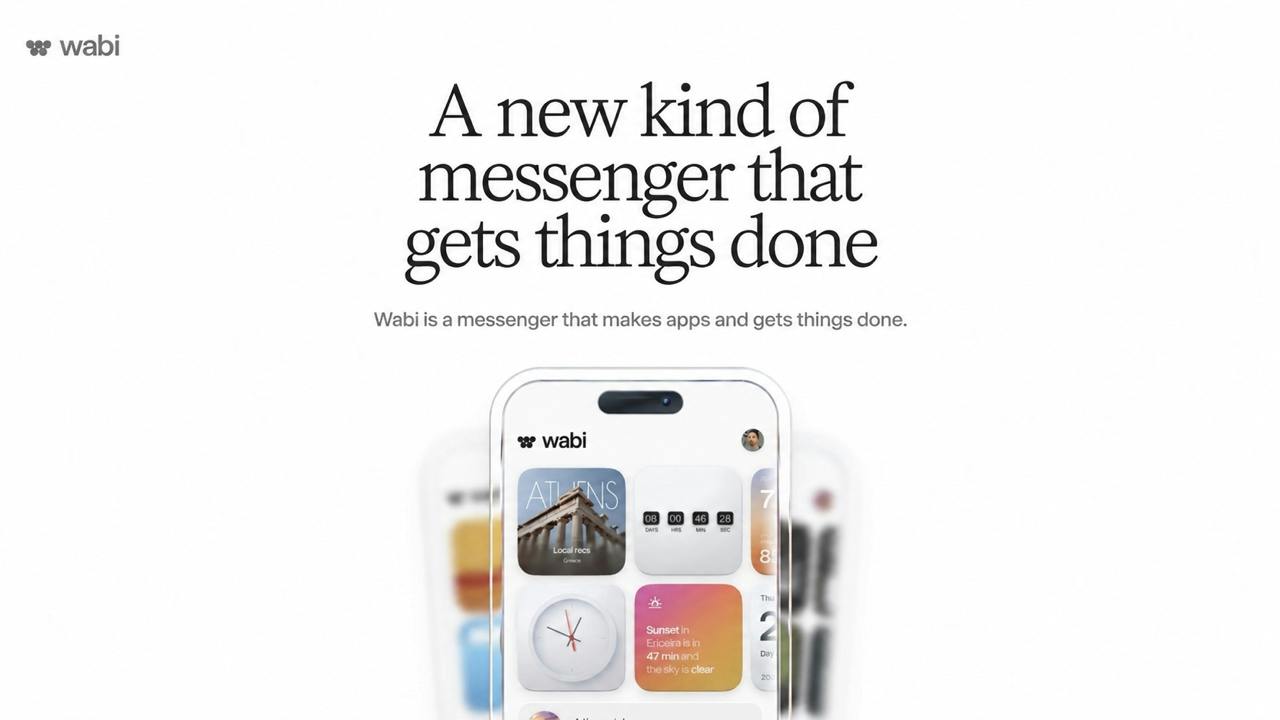
The product currently has 73 upvotes on Product Hunt, ranking 18th on the day of launch, spanning three categories: Task Management, Messaging, and Robots. That combination alone says a lot about its product philosophy.
The Paradigm Shift from "Chatting" to "Getting Things Done"
Traditional messaging apps are built around information exchange: you send a message, someone receives it, end of story. Wabi wants to embed execution capability directly into the conversation flow. In other words, when a need arises during a chat, Wabi doesn't just log it — it tries to fulfill it on the spot, even generating a bespoke mini-app to do so.
This "apps that make apps" philosophy is a defining trend in the current AI Agent wave. As large models gain the ability to generate code and orchestrate tasks, software no longer requires developers to pre-build every feature. Instead, tools can be dynamically created based on the user's real-time intent. Wabi packages this capability inside the highest-frequency use case imaginable — chat — and that's what sets it apart from a generic AI assistant.
The "Operating System" Metaphor
Wabi calls itself the "OS for the agent era," a framing worth unpacking. It implies not just another standalone app, but a foundational platform that hosts all kinds of tasks. In this vision, users no longer need to hop between different apps to order food, arrange travel, or coordinate a get-together with friends — instead, a single conversational interface lets an agent orchestrate everything.
That said, "operating system" is a grand narrative that gets invoked frequently and is exceptionally hard to deliver on. Whether this vision holds up depends entirely on how reliably Wabi's agents can execute tasks and how broadly they can cover real-world scenarios. Based on publicly available information, this remains more of a product vision statement than a proven capability.
The fundamental difference between an AI Agent and a standard LLM conversation lies in the ability to act. Traditional conversational models only generate text responses, whereas an Agent framework also grants the model the ability to call external tools, execute multi-step tasks, and even dynamically write and run code. The leading Agent technical approaches in the industry today include: task decomposition via Function Calling, the ReAct (Reasoning + Acting loop) framework, and multi-agent collaborative architectures. "Apps that make apps" refers to an Agent understanding a user's intent and instantly generating a runnable mini-program or workflow — rather than invoking a pre-written, fixed function. This dynamic generation is its key advantage, but it also introduces stability concerns: whether the generated code logic is correct, and whether it contains security vulnerabilities, are difficult to fully anticipate before execution. This is the technical root of the "execution reliability" challenge discussed later in this article.
The Founder's Background and What It Signals
Wabi's maker is Eugenia Kuyda — a well-known name in the industry. She previously founded Replika, an emotionally-oriented AI companion app, accumulating deep experience in the space of "humans building relationships with AI."
The pivot from companion AI to "an agent that gets things done" reflects a further evolution in her thinking about AI's value proposition: AI shouldn't just provide emotional value — it should become a practical helper in everyday life. By combining "agents" with "social" — emphasizing doing things "for you and your friends" — Wabi in many ways continues her long-standing focus on human connection, only now repositioning AI from a conversational partner to a collaborative tool.
Replika was founded by Kuyda in 2017 and is one of the largest AI companion apps in the world by user count, with over 10 million registered users. The product allows users to engage in deep conversations with a customizable AI persona, even simulating friendships or romantic relationships. Replika's core technical strengths lie in long-term memory management, emotional tone modeling, and user retention mechanisms — all highly relevant to what Wabi needs: understanding user intent and sustaining collaboration within a conversation flow. Kuyda also navigated a major product crisis during her time at Replika: in early 2023, Replika rolled back intimate interaction features under regulatory pressure, triggering a severe user backlash. That episode gave her a far more direct understanding of the boundaries of emotional dependency between users and AI than most founders ever encounter. This experience likely shapes how she's designing Wabi — positioning AI as a "tool that does things" rather than an "emotional object to be relied upon," thereby reducing similar ethical and regulatory risks.
Opportunities and Open Questions
The picture Wabi paints is exciting, but it also leaves plenty of questions unanswered:
- Execution reliability: AI's ability to autonomously generate apps and complete tasks remains inconsistent. Success rates on complex tasks, error handling, and security boundaries are all hard technical challenges.
- Habit migration: Convincing users to leave established platforms like WhatsApp or iMessage requires a powerfully differentiated value proposition — not just "it has an AI feature now."
- Social network effects: The product emphasizes doing things "with your friends," which means it needs bilateral growth. No matter how capable the agent is, it can't deliver social value if none of your friends are on it.
Based on early Product Hunt feedback, 73 upvotes and an 18th-place ranking is a decent but unremarkable result — enough to signal genuine interest, but far from viral. For an early-stage product with grand ambitions, the real test lies ahead in actual user experience.
Conclusion
Wabi represents a clear trajectory in AI product evolution: from "answering questions" to "solving problems," from standalone assistant to a collaborative platform woven into the fabric of daily life. It delivers agent capabilities through the ultra-high-frequency entry point of instant messaging, and it's led by a founder with a proven track record. Both are meaningful advantages.
But "the operating system for the agent era" is ultimately a check that still needs to be cashed. Whether it can genuinely deliver on "just say the word and it gets done" — and persuade users to move their social relationships onto the platform — still needs time and product execution to prove. For practitioners and users watching AI Agent deployments closely, Wabi is well worth keeping an eye on.
Related articles

Free Unlimited Claude Code Solution: Agnes AI + CC Switch Setup Guide
No paid subscription needed — pair the free AI platform Agnes AI with the open-source tool CC Switch to provide a backend for Claude Code, enabling unlimited free calls to text, image, and video models. This guide covers the full setup, test results, and usage boundaries.

A Complete Zero-Cost Guide to Getting Started with Claude Code for Beginners in China
A beginner's guide to Claude Code for users in China: two installation methods (command line and IDE plugin), full configuration steps for replacing the official API with the free domestic LongCat model, and a hands-on demo of building a small tool with natural language, plus tips.

When the NSA Gets Involved: The AI Supply Chain Crisis Behind Open-Source CVEs and API Key Hijacking
Multiple open-source projects disclosed severe CVEs in one day, PHP flaws alarmed the FBI, and Railway and OpenCode were breached with API keys stolen. This article breaks down the vulnerability window, AI-accelerated exploitation, and the AI supply chain crisis behind the API key black market, with a developer defense checklist.