Walmart's Flipkart Enters India's Food Delivery Market, Challenging Zomato and Swiggy

Flipkart internally tests food delivery service, aiming to challenge the Zomato-Swiggy duopoly.
Walmart-owned Indian e-commerce giant Flipkart is quietly entering food delivery, having opened its service to thousands of employees for testing ahead of a public launch. India's food delivery market is dominated by the Zomato-Swiggy duopoly, but incremental space remains. Flipkart's entry logic is to reuse its massive user base, mature payment system, and logistics network, while leveraging Walmart's global supply chain experience. However, the two-sided market nature and instant delivery requirements pose significant challenges — Flipkart must simultaneously activate restaurant supply and consumer demand and build an instant capacity system completely different from e-commerce parcel delivery. This move is both defensive and a proactive search for a second growth curve, with success hinging on finding a sustainable balance among delivery experience, merchant ecosystem, and user subsidies.
From E-commerce Giant to Food Delivery Newcomer: Flipkart's Ambitions Go Beyond the Shopping Cart
Walmart-owned Indian e-commerce giant Flipkart is quietly setting its sights on a new battlefield — food delivery. According to foreign media reports, Flipkart has opened its food delivery service to thousands of employees for testing, preparing for an upcoming public launch. This move signals that the company, which competes fiercely with Amazon in India's e-commerce market, is attempting to extend its reach into the local life services sector long dominated by Zomato and Swiggy.
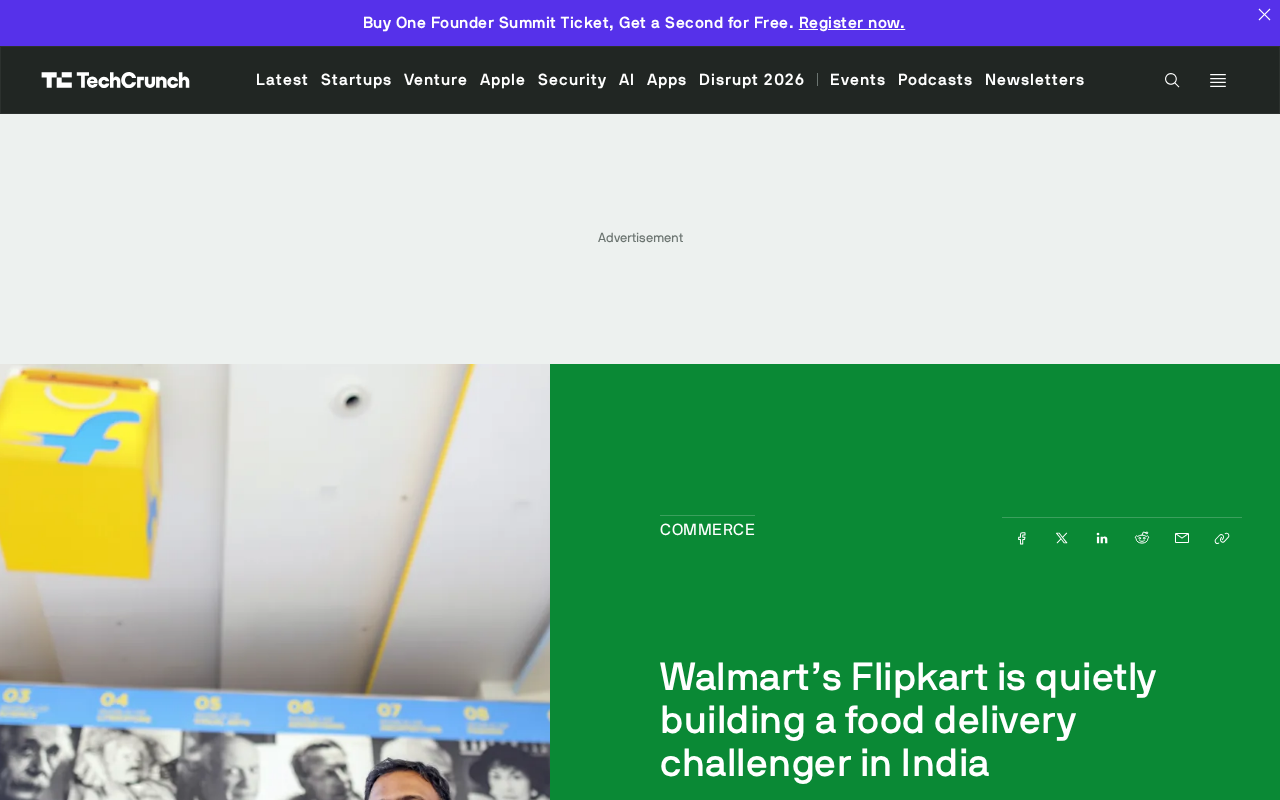
Flipkart was founded in 2007 and is one of India's largest homegrown e-commerce platforms. It started with books and later expanded to all product categories. In 2018, Walmart acquired approximately 77% controlling stake for about $16 billion, making it one of the largest M&A deals in global retail history. Flipkart competes head-on with Amazon in India's e-commerce market, boasting hundreds of millions of registered users, its self-built payment tool PhonePe (later spun off), and the extensive logistics network Ekart. Its expansion into food delivery aligns with the global trend of e-commerce platforms penetrating local life services — Amazon attempted food delivery in the US, and Meituan expanded from group buying to food delivery and in-store services.
Internal Testing First, Official Debut Countdown Begins
Flipkart's strategy this time is a typical "silent launch" — first opening the food delivery service internally to employees, gathering feedback and refining the experience through real-world scenarios, then gradually opening to the public. This gradual approach reduces initial operational risks and allows the team to validate key aspects such as delivery timeliness, merchant partnerships, and user experience in a controlled environment.
According to the original report, Flipkart has opened the service to thousands of employees. This scale is sufficient to generate meaningful test data without attracting excessive market attention before the official launch. For a company accustomed to the rhythm of e-commerce mega-sales, food delivery's high-frequency, real-time nature represents a completely different operational logic — internal testing is a necessary step to bridge this gap.
The Landscape and Opportunities of India's Food Delivery Market
India's food delivery market has long been dominated by the Zomato-Swiggy duopoly, with both platforms having built deep moats in user mindshare, merchant resources, and delivery networks. However, the market is far from saturated — with accelerating urbanization and the spread of digital payments, more and more Indian consumers are getting used to ordering food via their phones, and the market's incremental space remains considerable.
Flipkart's entry logic is not hard to understand: it has a massive user base, a mature payment system, and a logistics network — assets that can be reused in the food delivery business. More importantly, Walmart's global supply chain and retail experience may provide differentiated support for Flipkart's exploration in the food sector. However, food delivery places extremely high demands on instant delivery capabilities, and Flipkart needs to prove it can compete with existing players on this dimension.
Two-sided Market is a key economic concept for understanding competition in the food delivery industry. It refers to a platform connecting two distinct user groups simultaneously — here, restaurants (supply side) and consumers (demand side) — where one side's willingness to participate depends on the other side's scale. The core challenge for food delivery platforms is the "chicken-and-egg" problem: without enough restaurants, consumers won't order; without enough orders, restaurants won't join. Therefore, platforms typically need to first leverage subsidies and incentives to activate the supply side, then attract the demand side with abundant choices, creating a positive feedback loop. This also explains why new entrants often require significant capital investment, and once a leader establishes scale advantages, it becomes significantly harder for latecomers to catch up. Flipkart faces precisely such a market where Zomato and Swiggy have already locked in two-sided network effects.
The Challenger's Strengths and Weaknesses
In terms of advantages, Flipkart's brand recognition and user trust are its biggest chips. Indian consumers have already completed numerous transactions on Flipkart, and the conversion cost of transferring that trust to food delivery scenarios is relatively low. Additionally, Flipkart's penetration in tier-2 and tier-3 cities may provide its food delivery business with opportunities in lower-tier markets that Zomato and Swiggy have not yet fully covered.
But the weaknesses are equally evident. Food delivery is a typical two-sided market that requires attracting enough restaurants and consumers simultaneously to form a positive cycle. Zomato and Swiggy have accumulated years of experience in this regard, and Flipkart needs to offer convincing merchant policies to activate the supply side. Meanwhile, recruiting and managing delivery riders is also a heavy asset investment, and economies of scale will be hard to achieve in the short term.
Quick Commerce / Instant Delivery is fundamentally different from standard e-commerce logistics. Traditional e-commerce fulfillment cycles are measured in days and can rely on warehousing and batch delivery to optimize costs; food delivery requires completing the entire process from restaurant pickup to user delivery within 30-40 minutes of ordering, with highly dispersed orders and high time sensitivity. This requires a completely different capacity scheduling system: real-time matching of riders with orders, dynamic route planning, and coping with weather and traffic fluctuations. Flipkart's existing logistics network mainly serves warehouse-to-consumer parcel delivery and cannot be directly reused for food delivery scenarios. Therefore, it needs to build or acquire instant delivery capabilities from scratch, which is also a key area being validated during its internal testing phase.
The Long Game in Local Life Services
Flipkart's entry into food delivery is essentially a signal that the value of India's local life services market is being reassessed. E-commerce platforms extending into high-frequency local services has precedents globally — Amazon attempted food delivery in the US, and Meituan expanded from group buying to food delivery and in-store services. Flipkart's move is both a defensive positioning and a proactive strike to find a second growth curve beyond e-commerce.
The outcome of this competition will not be revealed in the short term. For consumers, one more player means more choices and potentially more subsidy benefits; for Zomato and Swiggy, a challenger backed by Walmart is clearly not to be underestimated. Whether Flipkart can carve out a gap in the duopoly landscape depends on whether it can find a sustainable balance among delivery experience, merchant ecosystem, and user subsidies.
This article is based on foreign media reports about Flipkart's internal testing. The official launch date and coverage scope have not been announced, and further developments remain to be seen.
One-line Summary
Flipkart internally tests food delivery service, aiming to challenge the Zomato-Swiggy duopoly.
Paragraph Summary
Walmart-owned Indian e-commerce giant Flipkart is quietly entering the food delivery sector, having opened its food delivery service to thousands of employees for testing in preparation for a public launch. India's food delivery market has long been dominated by the Zomato-Swiggy duopoly, but incremental market space remains considerable. Flipkart's entry logic lies in reusing its massive user base, mature payment system, and logistics network, while leveraging Walmart's global supply chain experience for differentiation. However, the two-sided market nature of food delivery and instant delivery requirements pose significant challenges — Flipkart needs to simultaneously activate restaurant supply and consumer demand, and build an instant capacity system completely different from e-commerce parcel delivery. This move is both a defensive positioning and a proactive strike to find a second growth curve beyond e-commerce, with the outcome depending on whether it can find a sustainable balance among delivery experience, merchant ecosystem, and user subsidies.
Related articles

Build an AI Super Employee System at Zero Cost: A Full Breakdown of Automated Agent Workflows
A deep breakdown of the AI super employee system demoed on Bilibili: agent orchestration, digital human voiceovers, map and enterprise lead generation, 24/7 customer service, and legal modules. We analyze the business logic and compliance risks behind zero-cost signup to help entrepreneurs judge the real ROI of this AI digital employee system.

The Essential Difference Between Chatbots and AI Agents: Crossing from Conversation to Execution
What's the difference between a chatbot and an AI agent? Based on the MCP series on the Learn Tech channel, this article uses examples like booking flights and summarizing notes to explain: a chatbot only gives answers, while an agent actually completes tasks through a think-act-observe loop. It breaks down the four core components—model, tools, memory, and goal—as well as MCP's role as a bridge, and discusses agents' applicable boundaries and permission risks.

Free GitHub Repo: 342 Hours of AI Courses, from Math to MCP Servers
A free GitHub repo offers 342 hours of AI courses: 523 lessons across 20 phases, from math fundamentals to agent building and MCP servers. Nearly 100,000 learners have started.