Want to Switch Careers but Equipment Is Too Expensive? Hacker News Discusses Low-Cost Retraining Paths

Retraining faces expensive equipment barriers; shared usage rights and alternatives can break through.
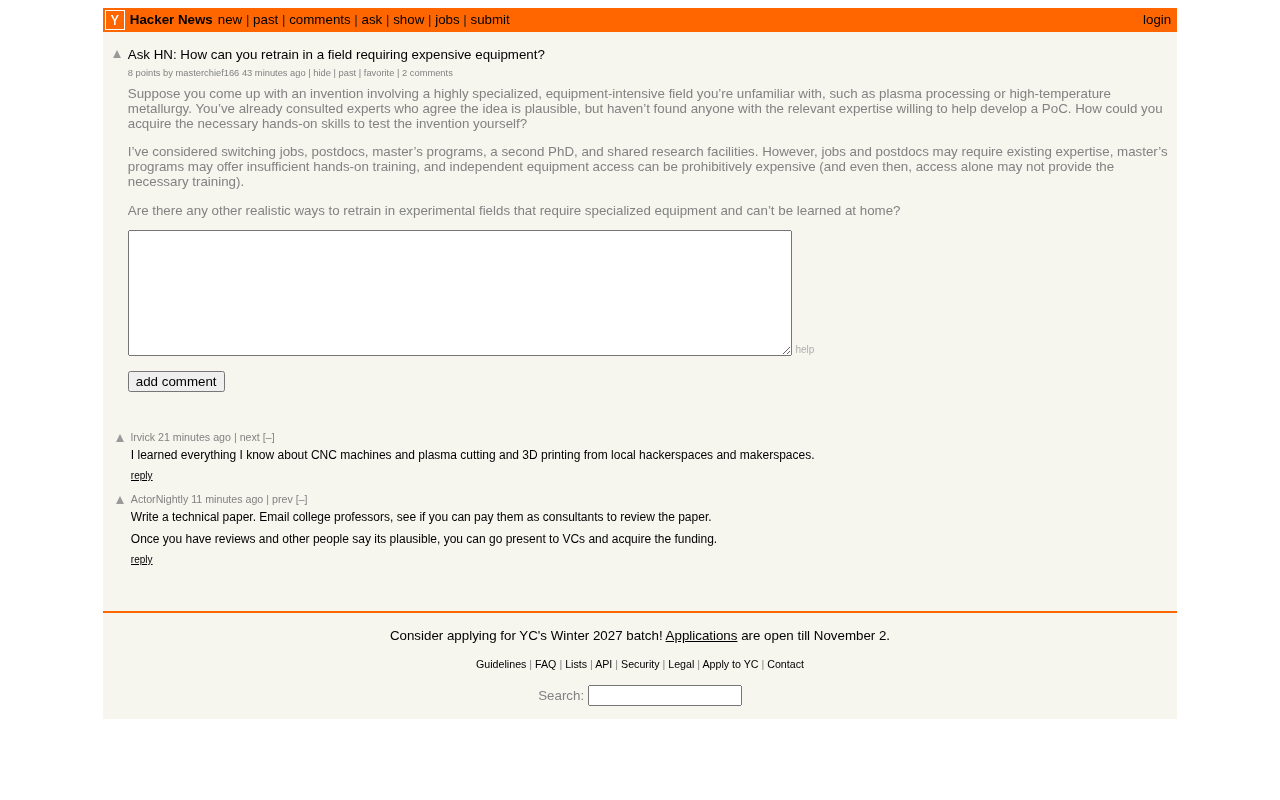
The article centers on a Hacker News question about how to retrain in fields requiring expensive equipment, noting that equipment cost is a major obstacle to career transitions but not unsolvable. The core idea is to transform "owning equipment" into "obtaining the right to use equipment," listing four feasible paths: leveraging makerspaces and Fab Labs to share equipment, seeking employer sponsorship or apprenticeships, remotely operating real equipment through cloud labs, and first building foundations with simulation software and open-source hardware. It also notes that the original discussion contains limited information, that feasibility depends heavily on local resources and industry differences, and that shared platforms lowering equipment barriers present product opportunities.
In today's fast-paced technological change, retraining has become a required course for many professionals to stay competitive. However, when the target field requires expensive equipment, the learning barrier rises sharply. A Hacker News user's question, "How can you retrain in a field requiring expensive equipment?", sparked a small but pointed discussion.
The Core Problem: How Equipment Costs Hinder Career Transitions
The questioner did not specify a field, but the condition "expensive equipment" immediately brings to mind areas such as biological experiments, film and television production, precision manufacturing, and hardware development. What these fields share is that the learning process relies heavily on physical tools, and the cost of personally purchasing or maintaining equipment far exceeds the expense of ordinary online courses or books.
The implicit consensus in the discussion is that self-study alone can hardly bypass the equipment barrier, but it is not unsolvable. The key is to transform "owning equipment" into "obtaining the right to use equipment," and to redefine the starting point of the learning path.
Feasible Retraining Paths
1. Leverage Community and Makerspaces
Public libraries, makerspaces, and Fab Labs offer the possibility of sharing expensive equipment. 3D printers, laser cutters, CNC machines, and even basic biological experiment equipment are often open on a membership or pay-per-use basis. For retrainees, this means they can complete introductory projects at a lower cost and build a portfolio.
A makerspace is a community workshop that provides shared tools and equipment, usually operated on a membership basis, where members can pay to use expensive equipment such as 3D printers, laser cutters, CNC machines, and electronics workbenches, and participate in workshops and collaborative projects. Fab Lab originated from the Center for Bits and Atoms at MIT and is a global network of standardized makerspaces that emphasizes digital fabrication and personal production. Both lower the physical barrier to hardware entrepreneurship and retraining, and are especially suitable for engineering, design, and manufacturing fields that require hands-on practice. For career changers, membership fees are usually far lower than the cost of purchasing equipment, and community guidance can help them get started quickly.
2. Seek Employer Sponsorship or Apprenticeships
Some companies are willing to provide equipment usage time and training resources for employees transferring internally, especially in manufacturing, medical technology, and post-production film companies. Another path is apprenticeship, exchanging work for learning opportunities, with equipment covered by the employer.
Apprenticeship is a training model that combines paid on-the-job training with classroom learning, commonly found in manufacturing, construction, healthcare, and information technology. During an apprenticeship, trainees use company equipment to complete real work under the guidance of an employer while gradually mastering skills; equipment costs and training fees are mostly borne by the employer. This model is especially mature in Europe (such as the German dual system) and has seen a revival in the North American tech industry in recent years. For fields with expensive equipment, apprenticeships provide a path of "trading work for learning," gaining both experience and income, but opportunities are unevenly distributed, requiring proactive efforts to find partner companies or industry programs.
3. Remote Operation and Cloud Labs
The emerging cloud lab model allows users to remotely control real experimental equipment on an hourly basis. Commercial attempts have already been made in biotechnology and chemistry; although the fees are not low, the barrier is much lower than building one's own lab. Remote access to FPGAs and cloud-based EDA tools in hardware development follow a similar approach.
A cloud lab is a service model that lets users remotely operate real experimental equipment via the internet, usually billed by usage time. Users can book instruments online, upload experimental plans, and observe and operate equipment through cameras and remote control software. It is suitable for fields such as biology, chemistry, and materials that require precision instruments. Similarly, remote FPGA access allows developers to use field-programmable gate array hardware online for verification, while cloud EDA tools provide remote computing resources for chip design. These models turn equipment ownership into usage rights, significantly lowering the barrier for individuals to access expensive experimental conditions, but they depend on network stability and the service provider's coverage.
4. Start with Low-Cost Alternatives
Before touching expensive equipment, first build foundational knowledge using simulation software, open-source hardware, or simplified models. For example, learning robot operation can start with a ROS simulation environment, and learning film cinematography can start with smartphone-based composition training. This cannot fully replace real equipment experience, but it can significantly shorten the subsequent learning curve.
The ROS simulation environment is a commonly used software tool in robotics that can simulate sensors, actuators, and motion control in a virtual environment, allowing learners to practice algorithm development and system integration without a physical robot. Open-source hardware (such as Arduino and Raspberry Pi) provides programmable physical computing platforms at extremely low cost, suitable for introductory electronics and embedded systems. Although simulation software and open-source hardware cannot fully replace real equipment experience, they help build foundational knowledge, validate concepts, and accumulate work, thereby shortening the time needed to get up to speed when later accessing expensive equipment. This is a commonly used stepwise strategy in retraining.
Disagreements and Limitations in the Discussion
Because the original post had only two comments, public information is limited and cannot form multi-source cross-validation. The existing discussion leans more toward framing the problem than providing specific answers, lacking detailed case studies for any particular industry. Some views implicitly assume that "equipment cost is a screening mechanism," believing that the high barrier itself filters out less determined career changers, but this has not been fully argued.
Another dimension not explored is regional difference: the prevalence of makerspaces and the accessibility of cloud labs vary greatly across regions, and the feasibility of these paths depends heavily on local resources.
Implications for Retrainees
Expensive equipment should not be a reason to give up on a career change, but strategies need to be adjusted: shift from "learn first, then do" to "learn while doing," and actively seek resource leverage. Community resources, employer support, and remote access are the three main levers. At the same time, clearly recognizing which skills can be learned at low cost and which must rely on real equipment helps in creating a more realistic roadmap.
For tech professionals, this discussion also points to product opportunities: shared platforms, simulation tools, and remote experiment services that lower the barrier to using expensive equipment still have considerable room for innovation.
One-line Summary
Retraining hits expensive equipment barriers; sharing usage rights and alternatives can break through.
Paragraph Summary
The article centers on a Hacker News question about "how to retrain in a field requiring expensive equipment," pointing out that equipment cost is a major obstacle to career transitions but not an unsolvable one. The core idea is to transform "owning equipment" into "obtaining the right to use equipment," and it lists four feasible paths: leveraging makerspaces and Fab Labs to share equipment, seeking employer sponsorship or apprenticeships, remotely operating real equipment through cloud labs, and first building foundations with simulation software and open-source hardware. The article also notes that the original discussion contains limited information, that the feasibility of these paths depends heavily on local resources and industry differences, and that shared platforms lowering the barrier to equipment use present product opportunities.
Related articles

Big Tech AI Engineering Interview: Full-Chain Observability from Frontend Monitoring to Agents
From PerformanceObserver metrics collection and onerror/unhandledrejection exception capture, to RAG pipeline reranking and context compression for token cost control, to designing a full-site AI full-chain observability system benchmarked against LangSmith and Sentry—breaking down the three progressive layers of big tech AI engineering interviews.

WorkBuddy Step-by-Step Guide: Build Your Own AI Agent Work Assistant
WorkBuddy step-by-step guide: starting from the limits of chat models like Doubao, learn to build your own AI Agent work assistant for batch local file processing and automation—no programming required.

Building a Local Knowledge Base with LangChain-Chatchat + DeepSeek on Windows
This article, based on a Bilibili tutorial, details the full workflow of building a local knowledge base on Windows using LangChain-Chatchat and DeepSeek, including Anaconda environment setup, Ollama model management, mirror acceleration, and common error solutions, helping you quickly implement RAG Q&A.