Wayfinder Skill Hands-On: A New Paradigm for AI-Planned Decision Maps for Large Projects

Wayfinder skill transforms vague project ideas into executable roadmaps via decision tickets and fog of war.
A deep hands-on review of the Wayfinder skill, which uses decision tickets, parallel multi-conversation workflows, and a fog of war mechanism to systematically decompose large, ambiguous project concepts into clear implementation roadmaps. Tested with a puzzle platformer game concept using GPT-5.6 Terra, the skill produces handoff documents directly consumable by coding agents.
From "Interrogate Me" to "Wayfinder": The Evolution of AI Planning
A few weeks ago, a Bilibili content creator used the Maple Clocks platform to try the popular skill "Interrogate Me" — a planning tool that helps clarify requirements by continuously asking users questions within a conversation. Around the same time, renowned developer Matt Pocock released an advanced skill called Wayfinder.
As the name suggests, Wayfinder addresses scenarios like this: you have a big project, a vague idea, you roughly know where the destination is, but the path to get there is shrouded in fog. Its core purpose is "finding direction."
Unlike "Interrogate Me," which fires off rapid questions in a single conversation, Wayfinder's mechanism is far more complex. It breaks the entire workflow into multiple independent conversations, advancing them in parallel through "Decision Tickets," and ultimately consolidates all conclusions together. The Decision Ticket concept draws from Issue Tracking systems in software engineering (like Jira, Linear, GitHub Issues). In traditional agile development, a complex project is decomposed into multiple independently trackable tickets, each with a clear status, owner, and acceptance criteria. Wayfinder transplants this engineering practice into AI planning scenarios, turning each pending decision into an independent, trackable work unit rather than letting it drown in the context of one lengthy conversation. This structured approach also solves the common "context forgetting" problem in LLM conversations — when conversations get too long, models tend to lose early information, but splitting into independent tickets keeps each conversation's context window lean.
This is essentially still a planning skill — it doesn't actually write code, but first draws a complete "decision map" for the project.
Test Project: Using AI to Plan a Puzzle Platformer
In this hands-on test, the creator attempted to plan a puzzle side-scrolling platformer tentatively named Token Burn. The core concept is quite clever: the player has an AI agent companion that can be assigned tasks, collaborates on puzzles, and progresses through levels. The agent has models and skills, and can even create sub-agents — but running the agent consumes tokens. Each level has a fixed token budget, and this resource constraint itself becomes part of the puzzle.
The art style was set to "high-quality pixel art," similar to late-era SNES Mega Man or modern indie games. The ultimate goal is release on platforms like Steam, with early versions being browser-based.
The test used the Hermes Agent desktop app with GPT-5.6 Terra as the model. The rationale for choosing Terra over Soul is crucial: this isn't a pure coding project but primarily research and planning. Terra is faster and sufficiently capable for this type of task; Soul excels at actual coding but would be unnecessarily slow here. Within the GPT-5.6 series, Terra and Soul represent different optimization directions — Terra is positioned as a general reasoning and research model, excelling at information synthesis, option comparison, and document generation with faster response times; Soul is deeply optimized for code generation and execution, handling complex programming logic, debugging, and refactoring tasks, but with higher response latency due to deeper reasoning chains. This division reflects an important trend in AI model development: shifting from "one model does everything" toward selecting the most suitable specialized model for different task phases.

The reason for choosing the desktop app over a pure TUI interface is also practical: Wayfinder opens multiple conversations, and the desktop client lets you see all conversations' progress simultaneously, making management more intuitive.
Decision Tickets and the "Fog of War" Mechanism Explained
Wayfinder's operational flow has a distinctly engineered feel. After installing the skill, the user describes the project vision in natural language, and the system enters a questioning phase similar to "Interrogate Me."
Topic-Segmented Questioning Phase
In the test, Wayfinder first confirmed the process's ultimate goal: producing a "deliverable complete vertical slice specification and implementation roadmap," explicitly stating that no actual game development would occur during the planning phase. It then began asking questions covering target player experience, control schemes, technical delivery paths, token economy models, vertical slice content scope, and other key decisions.
You might not have noticed several planning trade-offs:
- Player experience: Chose a "balanced hybrid" between action platforming and AI-curious players
- Interaction interface: Adopted a curated-command "prompt builder" rather than a full chat box
- Technical path: Desktop-first, browser version follows, no large engines like Unity/Godot (since the game doesn't involve 3D)
- Token economy: Fixed budget per level, reset on retry
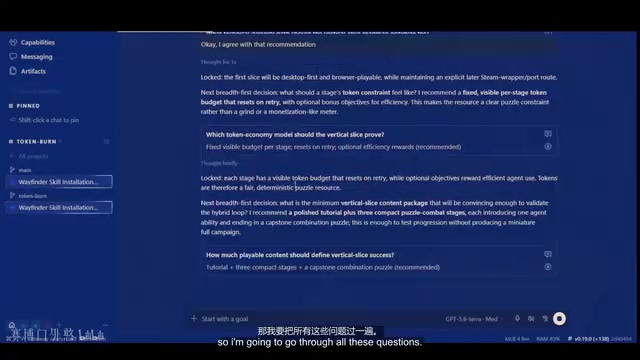
Since no GitHub or other issue tracking system was configured, Wayfinder automatically enabled a local markdown fallback, recording all decision tickets as a set of markdown files in the wayfinder directory. This means the tool can run locally even without a cloud-based tracker.
Multi-Conversation Parallel Execution and Ticket Types
Wayfinder draws a "decision map" and creates tickets for different questions. Several ticket types appeared in the test:
- Research: e.g., "Choose browser-first engine," "Steam migration architecture," "Art production"
- Prototype: e.g., "Tutorial to capstone stage progression"
- Interrogate: e.g., "Define player movement," "Define companion ability ladder"
- Task: Work requiring manual human completion, such as API registration
The system launches AFK (away-from-keyboard) research tickets in parallel to automatically complete investigations, while interrogate tickets require user responses in independent conversations. AFK research tickets represent an emerging model of human-AI asynchronous collaboration. Traditional AI conversation is synchronous — the user asks, waits for an answer, then asks again. Wayfinder allows AI agents to autonomously execute research tasks without user participation (e.g., comparing different game engines' pros and cons, investigating Steam publishing technical requirements), writing results to local files. This is similar to a project manager assigning research tasks to team members and then moving on to other work, dramatically improving human time utilization.
The experience highlight here: users can switch between multiple conversations — while answering questions in Conversation A, Conversation B is processing and generating the next batch of questions, significantly reducing idle waiting time.
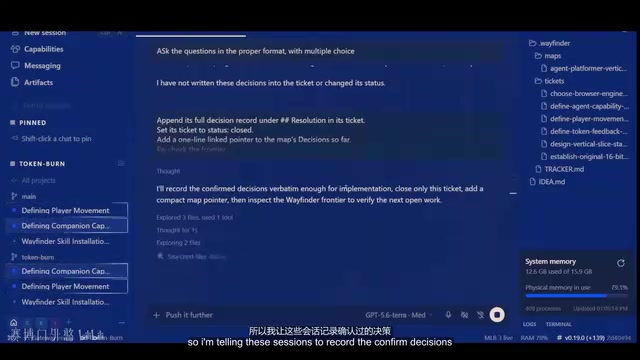
However, the question volume remains substantial. In the test, one companion abilities ticket asked 64 questions, with the entire process accumulating over 30 questions (compared to "Interrogate Me," which once asked 70+ in a single session). As each ticket is completed, its decisions are recorded in markdown files and linked back to update the main map.
Fog of War: The Core Logic for Deciding When to Open a Ticket
Wayfinder introduces an inspiring concept — Fog of War. It distinguishes which areas on the map are already clear and which still require decisions.
Fog of War originally comes from real-time strategy games (like StarCraft and Age of Empires): unexplored areas on the map are covered in darkness, and players can only see information within their units' line of sight. Applying this concept to project planning carries profound cognitive significance — it acknowledges a reality: in early project stages, numerous issues exist in a state of "unknown unknowns," and forcing decisions on these ambiguous areas not only wastes effort but may produce misleading false certainty. This aligns with the "Last Responsible Moment" principle in agile development: defer decisions until the moment of maximum information, rather than trying to foresee everything at project kickoff.
The judgment logic is clear: only when a problem is sufficiently defined and can be clearly articulated is it worth opening a ticket. If you can't even clearly describe the problem itself, it means "the time isn't right" — it should remain in the fog, unaddressed for now.
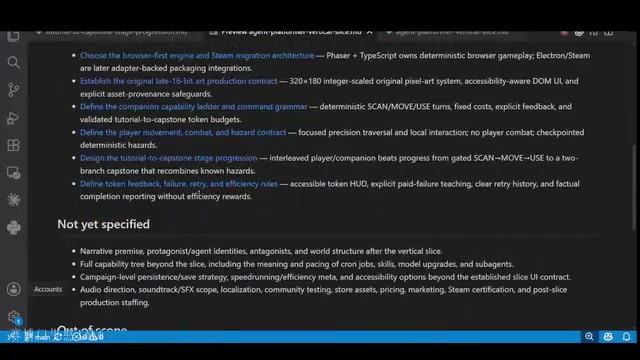
In this test, content beyond the "minimum vertical slice" scope (such as campaign monetization, Steam publishing details) was explicitly marked as "post-slice material" with no new tickets opened — because the current focus is solely on the demo version. Vertical Slice is one of the core methodologies in game development: unlike a "horizontal slice" (getting all systems to 50% completion), a vertical slice requires selecting a small cross-section of the game and polishing it from art, code, design, audio, to interaction to near-final quality. This approach exposes technical and design risks earliest, provides the team with a tangible quality benchmark, and serves as the best vehicle for demonstrating project potential to investors or publishers. By explicitly locking the vertical slice scope and marking other content as "post-slice," Wayfinder effectively prevents planning from expanding infinitely.
Final Deliverable: A Handoff Document Directly Consumable by Coding Agents
Once all key decisions on the map are resolved and the fog has cleared, Wayfinder enters its wrap-up phase. It opens a brand new conversation, loads the "Wayfinder Writing Plan" skill, reads all markdown decision files and prototypes, and generates an implementation handoff document.
This document is where the entire process's value is concentrated:
- Clear purpose and scope, with out-of-scope items locked down
- All contracts (agreements) derived from repeated questioning and research
- Recommended project structure
- An implementation roadmap using Test-Driven Development (TDD) and incremental execution
Test-Driven Development carries additional strategic significance in AI-assisted coding scenarios. When coding agents (like Cursor, Claude Code) automatically generate code based on planning documents, pre-defined test cases provide clear acceptance criteria — agents can automatically run tests to verify whether their output is correct, forming a "generate-test-fix" automated loop. AI coding without TDD often requires manual line-by-line review, but with a test suite, much verification work can be automated. This also explains why Wayfinder's handoff document specifically emphasizes a TDD roadmap: it's not just good engineering practice, but critical infrastructure enabling subsequent AI coding agents to autonomously verify output correctness.
The significance: a coding agent can execute directly from this document without any further research — all decisions have been finalized, theoretically "getting it basically right in one shot." When the roadmap fully satisfies the map's destination, Wayfinder's work is declared complete, and the subsequent building is handed off to coding agents.
Usage Experience Assessment and Applicable Scenarios
As a first attempt, the creator gave Wayfinder a quite positive evaluation. Compared to conducting a lengthy "interrogation" in a single conversation, Wayfinder's advantages are clear:
- Clearer structure: Splitting different topics into independent conversations avoids the chaos of one ultra-long session
- Intelligent scheduling: Can automatically identify questions to ask, dispatch sub-agents for research, and build the decision map
- Rich media: Can generate not just charts and reports, but also prototypes and other deliverables
- Suited for large, ambiguous projects: When you have a rough idea but lack clarity, Wayfinder helps you progressively find the path to your destination
The creator admitted he "probably didn't use it as fully as others might," but was impressed by its "plan first, then process tickets phase by phase" approach. He also previewed that he'd next try using Grok 4.5 (or the upcoming 4.6) in the Hermes Agent to actually build this game, recording a live development video.
For any developer who needs to systematically advance a large project starting from a vague concept, Wayfinder offers a worthwhile AI-assisted planning paradigm: making "uncertainty" explicit as fog of war, only materializing into executable tickets when problems are clear, and ultimately converging into a handoff document directly consumable by coding agents.
Key Takeaways
Related articles

Free Unlimited Claude Code Solution: Agnes AI + CC Switch Setup Guide
No paid subscription needed — pair the free AI platform Agnes AI with the open-source tool CC Switch to provide a backend for Claude Code, enabling unlimited free calls to text, image, and video models. This guide covers the full setup, test results, and usage boundaries.

A Complete Zero-Cost Guide to Getting Started with Claude Code for Beginners in China
A beginner's guide to Claude Code for users in China: two installation methods (command line and IDE plugin), full configuration steps for replacing the official API with the free domestic LongCat model, and a hands-on demo of building a small tool with natural language, plus tips.

When the NSA Gets Involved: The AI Supply Chain Crisis Behind Open-Source CVEs and API Key Hijacking
Multiple open-source projects disclosed severe CVEs in one day, PHP flaws alarmed the FBI, and Railway and OpenCode were breached with API keys stolen. This article breaks down the vulnerability window, AI-accelerated exploitation, and the AI supply chain crisis behind the API key black market, with a developer defense checklist.