Waymo Suspends Highway Autonomous Driving Services Nationwide: Behind the California DMV Order
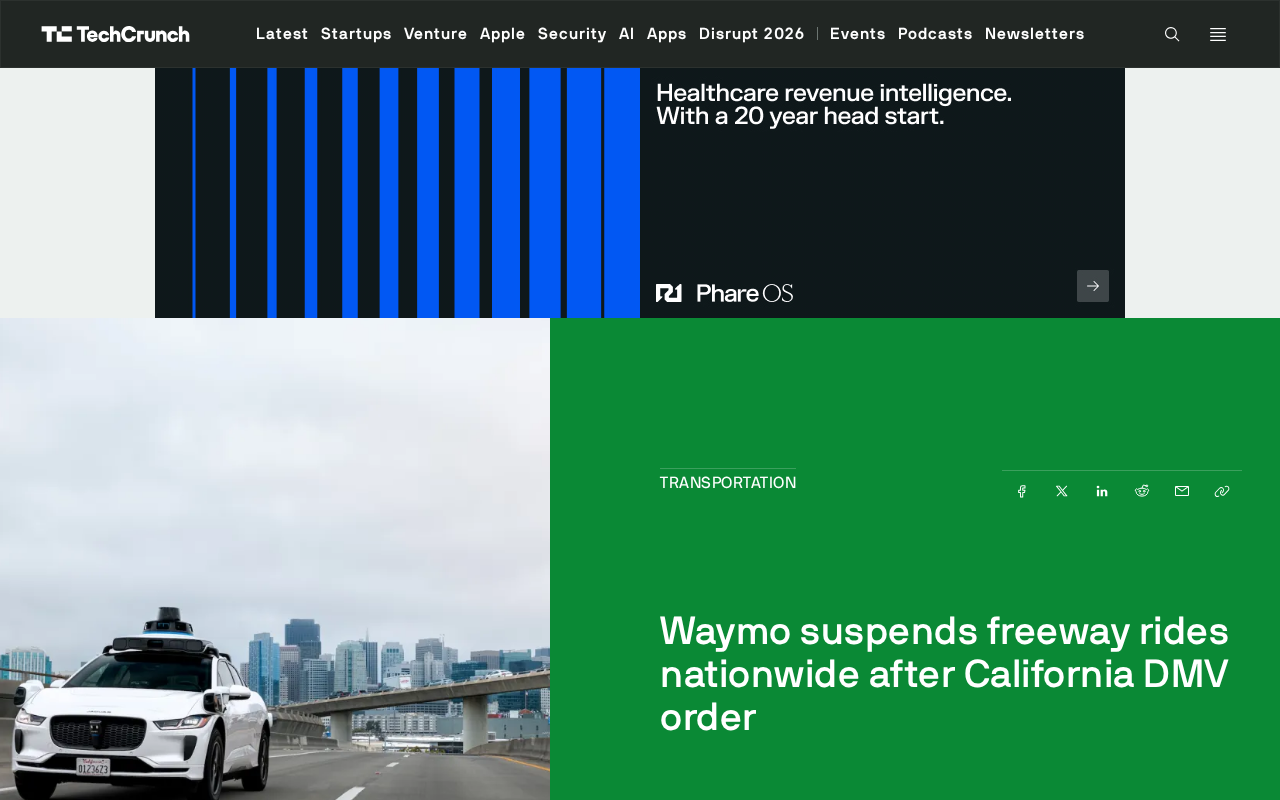
California DMV restricts Waymo's highway operations after several incidents; Waymo suspends autonomous passenger services on highways nationwide.
After several incidents, the California DMV issued an operating restriction order against Waymo, which then announced a nationwide suspension of autonomous passenger services on highways. The incident highlights the high-risk nature of highway scenarios—high speeds and short reaction windows—and shows that localized regulatory restrictions can trigger company-wide adjustments. As a benchmark for autonomous driving commercialization, Waymo's suspension is prompting the industry to reassess regulatory approval stability. Restoring services depends on whether Waymo can prove that incidents have been properly addressed and system reliability has substantially improved, testing whether a trust-based collaborative model can be built between companies and regulators.
Autonomous driving commercialization has hit another regulatory cold snap. A single operating restriction order from the California Department of Motor Vehicles (DMV) has forced Waymo to suspend autonomous passenger services on highways across the entire United States. The decision stems from multiple incidents and once again brings the tension between autonomous driving safety and regulation to the forefront.

California DMV Steps In: The Origins of the Operating Restriction Order
The California DMV is the primary regulatory body for autonomous vehicle testing and deployment in the state. According to the original report, the DMV issued an operating restriction against Waymo following several incidents. The specific terms of the restriction order were not disclosed in detail, but its immediate consequence is clear: Waymo must stop providing autonomous passenger services on highways.
What makes this regulatory action particularly notable is its "nationwide" impact. Waymo does not operate only in California, but the company chose to suspend autonomous services on highway segments across the entire country, indicating that its technology stack and operating strategy are highly unified across states—a localized regulatory restriction was enough to trigger a global adjustment.
The California DMV's regulatory authority over autonomous driving derives from the state-level legal system rather than a unified federal standard. This means that U.S. states have different admission conditions, data reporting requirements, and operating restrictions for autonomous vehicle testing and deployment. A company operating in multiple states must satisfy local regulatory requirements one by one, but once restricted in a key state, it will often proactively tighten services in other regions out of consideration for technology stack uniformity and brand reputation. This "state-level regulation, nationwide response" model is an important institutional backdrop for understanding Waymo's nationwide suspension.
What Happened: Multiple Incidents Trigger Regulation
The original information explicitly states that the DMV's decision came "following several incidents." The source material does not disclose the specific nature, timing, or severity of the incidents, but the phrase "several" suggests this was not an isolated malfunction—it drew regulatory attention to the system's reliability in highway scenarios.
Highways are one of the most commercially valuable yet challenging scenarios for autonomous driving: high speeds, short reaction windows, and complex merging and exiting. Once a system exhibits repetitive problems in this scenario, it is not surprising that regulators take conservative measures. Waymo's choice to cooperate rather than confront also reflects its emphasis on regulatory relationships.
Highway scenarios typically correspond to higher levels of automation in autonomous driving classifications, where the system must independently perform lane keeping, following, lane changing, and ramp merging at high speeds, with safety drivers potentially not intervening or intervening only for extremely brief periods. Compared with urban roads, highway scenarios offer less margin for error: a single misjudgment at 100 km/h may leave only seconds of reaction time. When assessing such scenarios, regulators often focus on whether incidents exhibit repetitive patterns rather than the severity of a single accident—this is the technical logic behind why "several incidents" were sufficient to trigger a restriction order.
Chain Reactions from the Nationwide Suspension
A "nationwide" suspension means that Waymo's highway services outside California are also affected. For a company expanding its autonomous driving footprint, this is not only a loss of operating revenue but also a test of public confidence.
From an industry perspective, Waymo has always been a benchmark for autonomous driving commercialization. The suspension of its highway services will prompt other players and investors to reassess regulatory risk: beyond technical capability, the stability of regulatory approval is equally a key variable in the pace of commercialization.
The revenue model for autonomous driving commercialization relies heavily on continuous operating mileage and passenger volume. Highway segments, with longer single trips and higher revenue per unit time, are typically a key component of operating economics. Suspending highway services not only directly reduces revenue but also affects the expectations of Waymo's partners, including automakers and mobility platforms. For investors, the stability of regulatory approval is regarded as a risk factor on par with technological maturity, and any regional restriction may be amplified as a signal of a slowdown in nationwide expansion.
The Old Problem of Regulation and Innovation
This incident continues an old theme in the autonomous driving industry: regulators need to find a balance between encouraging innovation and ensuring safety. The DMV's action shows that when evidence points to safety concerns, regulators will prioritize restriction over waiting.
For Waymo, the key to restoring highway services lies in proving to the DMV that the relevant incidents have been properly addressed and that system reliability has substantially improved. This process may involve technical fixes, adjustments to operating procedures, and more transparent data disclosure. The subsequent developments will test whether autonomous driving companies and regulators can establish a trust-based collaborative model.
Frequently Asked Questions
Is Waymo suspending all autonomous driving services? No. According to the original report, the suspension covers autonomous passenger services on highways, not all operations.
Why does the California DMV have the authority to restrict Waymo? The California DMV is responsible for regulating autonomous vehicle testing and deployment in the state, and operating restrictions are one of its regulatory tools.
What impact does this have on other autonomous driving companies? The incident highlights that the stability of regulatory approval is an important variable for commercialization, and other companies may adjust the pace of their highway scenario deployments accordingly.
One-line Summary
After several incidents, the California DMV restricted Waymo's highway operations, and Waymo immediately suspended autonomous passenger services on highways nationwide.
Paragraph Summary
Following several incidents, the California DMV issued an operating restriction order against Waymo, and Waymo subsequently announced a nationwide suspension of autonomous passenger services on highways. The incident underscores the high-risk characteristics of highway scenarios—high speeds and short reaction windows—and demonstrates that localized regulatory restrictions can trigger company-wide adjustments. As a benchmark for autonomous driving commercialization, Waymo's suspension is prompting the industry to reassess regulatory approval stability as a key variable. Restoring services depends on whether Waymo can prove to regulators that the incidents have been properly addressed and that system reliability has substantially improved; subsequent developments will test whether a trust-based collaborative model can be established between companies and regulators.
Related articles

No Coding Required: He Shipped an App Store App by 'Cutting Features' and Nitpicking with AI
A game designer with zero frontend/backend skills shipped a dual-platform App Store app with AI—not via one-click generation, but by cutting scope and nitpicking like a demanding client.
What Is Harness Engineering? From Concept Origins to Enterprise-Level Agent Implementation
What is Harness Engineering? This article traces the concept's origins and analyzes enterprise-level Agent requirements for tool call fault tolerance, data security, tenant isolation, and memory gaps.

Coze in Practice: A Three-Tier Agent Classification and a Multi-Agent Collaboration Guide
A Bilibili tutorial breaks down the multi-agent collaboration toolchain into three categories: building platforms like Coze Studio and Dify, Agent software like Claude Code, and development frameworks like LangChain—plus a Coze demo of industry templates, three-platform interoperability, local Agent integration, and the trade-offs of credit consumption.