WebHarbor: Training GUI Agents with 153 Realistic Website Environments

WebHarbor offers reproducible evaluation and RL training environments for GUI agents with 153 Dockerized simulated websites and 3,518 tasks.
WebHarbor is a GUI agent testing and training suite from aiming-lab featuring 153 executable, Dockerized realistic website environments and 3,518 tasks, emphasizing multi-step and post-login workflows. Built through task-driven human-agent collaboration, it evolves with new tasks while human reviewers ensure visual fidelity and functional correctness. RL-trained Qwen 4B-level agents generalize to unseen tasks and perform competitively on four benchmarks.
GUI agents can't be truly usable without a stable, reproducible, and realistic web environment. But reality falls short: evaluating directly on live websites means content changes, access restrictions, and logged-in workflows that are nearly impossible to cover; and existing synthetic training environments often lack both functional depth and visual fidelity.
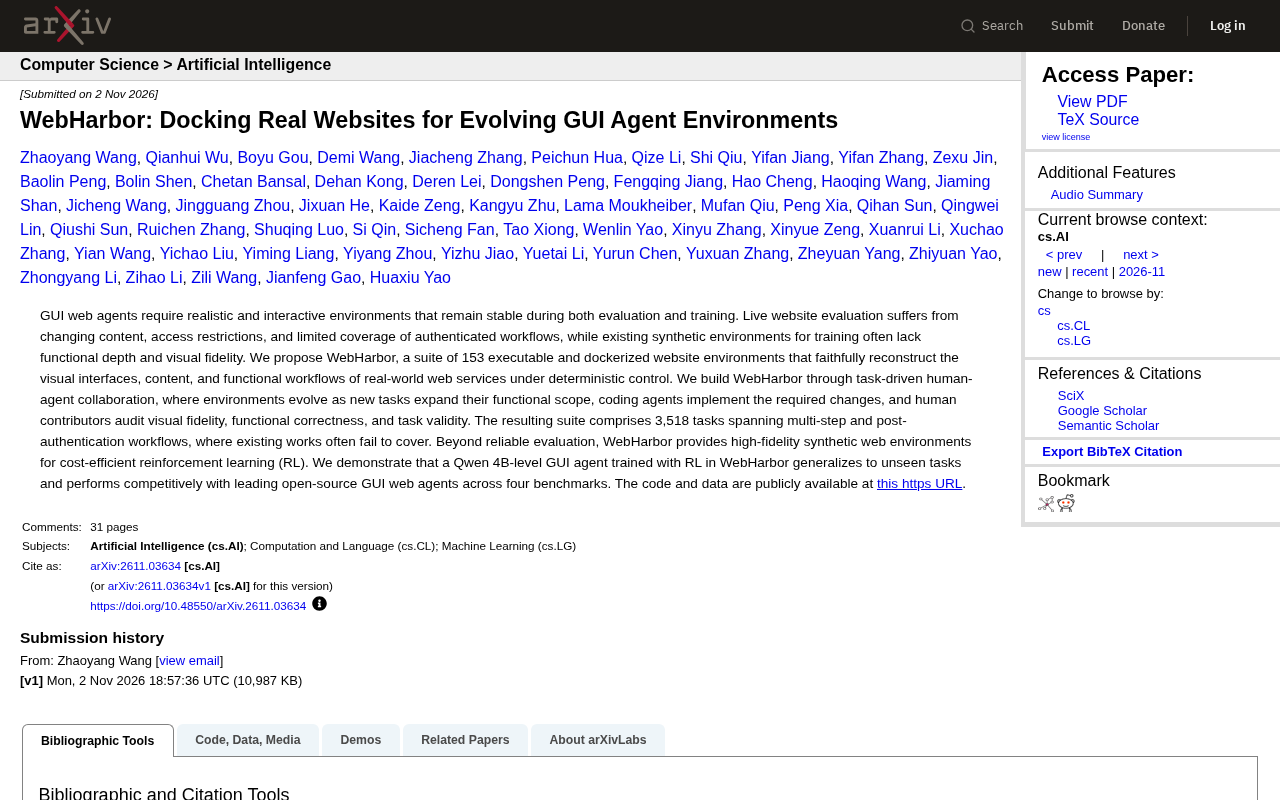
To address this tension, a research team from aiming-lab proposes WebHarbor—a testing and training suite of 153 executable, Dockerized website environments, designed to "dock" the visual interfaces, content, and functional workflows of real websites into a deterministic, controllable sandbox. The paper and code are publicly available on GitHub (aiming-lab/WebHarbor).
Why "Simulated Websites" Instead of "Real Websites"
The Triple Dilemma of Live Evaluation
Evaluating GUI agents on real websites is the most intuitive and tempting approach, but the research team points out three critical flaws: content changes make results irreproducible; access restrictions make some pages or APIs unreachable; and post-login workflows have extremely limited coverage. In other words, it's very hard to reproduce yesterday's evaluation results with today's web pages.
The Shortcomings of Synthetic Environments
The other path is to build custom synthetic environments, but existing work generally lacks functional depth and visual fidelity—pages look plausible, but the workflows break when you click through, or there's an obvious visual gap from real products. Skills learned by agents in such environments often degrade when transferred to real web pages.
WebHarbor positions itself right between the two: it aims for real-website-level functionality and visuals while maintaining sandbox-level controllability and stability.
GUI agents refer to agents that can observe graphical user interfaces (screenshots or page structure) like a human and perform clicks, typing, scrolling, and other actions to complete tasks. Unlike traditional automation that relies on structured APIs, GUI agents directly operate on pixels and interface elements, so their capabilities depend heavily on the realism of training and evaluation environments—layout, interaction feedback, and state transitions all affect policy learning. This explains why environment fidelity has become a core bottleneck in the field: action sequences learned in distorted environments tend to fail when transferred to real web pages due to differences in element positions, loading timing, or workflow branches.
Visual fidelity refers to how closely a synthetic environment matches a real product in page layout, color schemes, fonts, component styles, and rendering details; functional depth refers to whether the environment fully implements a real website's business logic, including form validation, state persistence, multi-page navigation, and permission control. Both are essential: insufficient visual fidelity leads agents to learn visual grounding strategies that don't match real interfaces, while insufficient functional depth causes multi-step tasks to "break" midway, preventing agents from learning long-range dependencies and error recovery. Existing synthetic environments often compromise on one of these due to high construction costs, which is why WebHarbor emphasizes both.
How 153 Environments Were Built
WebHarbor's construction is not purely automated crawling but a task-driven human-agent collaboration process. Specifically:
- Environments continuously expand their functional boundaries as new tasks are added;
- Coding agents implement the required functional changes;
- Human contributors review visual fidelity, functional correctness, and task validity.
This three-party collaboration makes environments "living" systems that evolve with tasks rather than one-time frozen static snapshots. The resulting suite contains 3,518 tasks, many of which involve multi-step workflows and post-authentication processes—precisely the areas existing work often fails to cover.
Beyond Evaluation: WebHarbor as an RL Training Ground
In addition to providing a reliable evaluation benchmark, WebHarbor's more important value lies in offering high-fidelity synthetic web environments for cost-efficient reinforcement learning (RL) training.
The team conducted a compelling validation: training a Qwen 4B-level GUI agent with RL in WebHarbor. The resulting agent generalized to unseen tasks and performed competitively against leading open-source GUI web agents on four benchmarks. For a small-parameter model, this result suggests that the training value of high-quality simulated environments has been significantly underestimated.
This also offers an insight for the industry: rather than endlessly scaling model size, it's better to first solve the fidelity and controllability of training environments. The generalization ability of a 4B model trained in a good environment may be more practical than a larger model trained in a noisy one.
RL training of GUI agents typically follows an "interaction–feedback–update" loop: the agent executes action sequences in the environment, the environment returns new interface states, and a reward signal is given based on task completion, after which policy gradient algorithms update model parameters. Compared to supervised fine-tuning, RL enables models to learn long-horizon planning and error recovery through trial and error, but requires environments to be resettable, reproducible, and automatically scorable. Dockerized deterministic sandboxes satisfy these conditions: each task starts from the same initial state, avoiding reward noise from live website content drift, thereby providing stable training signals even for small-parameter models.
What It Means for the GUI Agent Ecosystem
WebHarbor's contribution is not just a dataset but a philosophy of environment as infrastructure. Dockerization means environments can be distributed to anyone and reproduced on any machine; the task-driven evolution mechanism means the suite can continuously absorb new tasks without starting over; and the human-agent collaborative review process strikes a balance between automation efficiency and human quality control.
Of course, 153 environments are still limited relative to the scale of the real internet, and environment evolution relies on sustained human review investment. But as dual-purpose infrastructure for both evaluation and training, WebHarbor offers a noteworthy new option for GUI agent research. The team has made the code and data public, and the community can continue to expand on this foundation.
Dockerized environments refer to packaging a website's runtime dependencies (web server, database, backend services, static assets, etc.) into container images, enabling the environment to start with identical configurations on any Docker-capable machine. For GUI agent research, this means evaluation results can be reproduced across labs, training environments can be distributed alongside code repositories, and multiple instances can be launched in parallel for large-scale rollouts. Compared to virtual machine images, containers are lighter and faster to start, but require additional handling of network isolation and state persistence—an engineering aspect that such environments must specifically design for.
One-line Summary
WebHarbor provides reproducible evaluation and RL training environments for GUI agents with 153 Dockerized simulated websites and 3,518 tasks.
Paragraph Summary
WebHarbor is a GUI agent testing and training suite proposed by aiming-lab, containing 153 executable, Dockerized realistic website simulation environments and 3,518 tasks, with emphasis on multi-step workflows and post-login processes. It addresses the irreproducibility of live evaluation, access restrictions, difficulty covering login flows, and the lack of functional depth and visual fidelity in existing synthetic environments. Environments are built through task-driven human-agent collaboration: coding agents implement functional changes while humans review visual fidelity, functional correctness, and task validity, with environments continuously evolving as new tasks are added. The team trained a Qwen 4B-level GUI agent with RL in WebHarbor, which demonstrated generalization to unseen tasks and performed competitively against leading open-source agents on four benchmarks. Code and data are publicly available, positioned as dual-purpose infrastructure for evaluation and training.
Related articles

9 AI Subscription Plans Compared: The Real Cost Per 100M Tokens Revealed
Bilibili creator tests 9 AI subscription plans from Volcano, Alibaba, Tencent, Baidu, Zhipu, Xiaomi, MiniMax and more, converting them all to real cost per 100M tokens, breaking down fixed-quota vs. three-tier coefficient billing and how caching, time-of-day discounts, and window limits affect actual quota.

Vibe Coding for Beginners: Expressing Intent Instead of Handwriting Code
What is Vibe Coding? A 137-episode Bilibili course defines it: the core is expressing intent, not writing code. This article analyzes Vibe Coding's productivity logic, target audience, and entry expectations to help beginners decide if it's worth learning.

LangChain Beginner's Guide: An Agent Development Roadmap from LangGraph to Deep Agents
Clarify the encapsulation relationship among LangChain, LangGraph, and Deep Agents, and master the learning path and selection logic for agent development frameworks—suitable for beginners in large model development.