WebMCP in Practice: Validating Enterprise AI POCs Without Rebuilding Your Backend

WebMCP lets AI Agents drive legacy web apps in the browser — no backend rebuilding needed for real POCs.
The biggest obstacle to enterprise AI POCs is often integration cost, not the AI itself. Through a bank loan approval case, this article explains how WebMCP differs from standard MCP: instead of building new server-side APIs, it exposes existing frontend capabilities as structured tools directly in the browser, reusing existing sessions, permissions, and the same-origin security model. An AI Agent automates data collection across CRM, credit risk, and loan origination systems while keeping the final decision with the human officer. The author notes WebMCP remains experimental with browser-dependency limitations and should be evaluated case by case.
When a CEO suddenly asks, "Can we quickly build an AI POC on top of our existing systems to see if it actually delivers value?" — that's a scenario many enterprise AI architects face in real life. You either spend significant time and cost wiring up complex APIs, or you stitch together a demo with mock data. Neither option is ideal. In a YouTube video, the channel "Murali the AI guy" used a fictional bank loan approval scenario to demonstrate how WebMCP — a new approach — lets AI Agents drive existing enterprise applications without rebuilding the backend.
The Real Pain Point of Enterprise AI POCs: Integration, Not Intelligence
We talk endlessly about AI Agents, autonomous systems, and quantum computing — but the reality is that large enterprises still run a huge number of systems that are 20 or 30 years old. They're stable, secure, and compliant, carrying critical business processes every day. The problem is that while it may be technically feasible to introduce MCP into these environments, doing it right often means building new APIs, setting up integration layers, provisioning infrastructure, and navigating security, architecture, compliance, and approval processes.
For a POC that just wants to validate an idea, that's too high a price. And the business side wants AI now. The video's author highlights a key contradiction: many AI POCs are misleading precisely because they produce beautiful demos with mock data, neatly sidestepping the hardest part — can it actually work in a real enterprise environment?
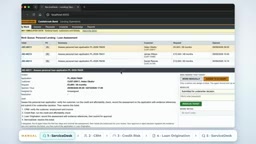
A Real Loan Approval Workflow
The video uses a bank loan officer's daily routine to illustrate the problem. A personal loan application comes in through a service desk and lands in the officer's hands. Before making a decision, the officer must gather and verify information across multiple enterprise systems: open the service desk ticket to understand who the customer is and how much they've applied for; switch to the CRM tool, copy the customer ID, search for the customer, and review their financial information; move to the credit risk system, enter the customer ID, loan amount, and term, and run credit and affordability checks; manually enter all that information into the loan origination system, complete the assessment, and save; then return to the service desk to update the outcome, add work notes, and close the ticket.
The entire process is just shuttling data between different systems — 15 to 20 minutes per application. If anything goes wrong or information is ambiguous, you have to backtrack and start over. The actual requirement is simple: automate the execution steps, but keep the final decision in the loan officer's hands.
Why Not Just Use MCP Directly?
Since MCP is designed specifically to connect enterprise applications, why not just build MCP servers for these legacy systems? The video's author gives a measured answer: MCP may well be part of the final architecture, and if it can be introduced straightforwardly, it should be.
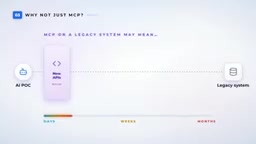
But on some legacy systems, introducing MCP could mean a full suite of new APIs, integration layers, infrastructure provisioning, and security, architecture, and compliance approval processes — all of which would seriously slow down a POC. His position is clear: don't let the target architecture block the POC, but don't let the POC lose touch with reality either. Validate the real end-to-end workflow using existing systems, then define the appropriate target architecture based on what the POC reveals — a recommendation that might ultimately include APIs, MCP servers, application modernization, or some combination. In other words, this isn't about avoiding MCP; it's about not making MCP implementation a prerequisite for validating the idea.
The Architectural Difference Between WebMCP and MCP
To understand what makes WebMCP clever, it helps to review how MCP works: the MCP architecture has an MCP client and an MCP server. The AI Agent talks to the MCP client, the client sends requests to the server, the server interacts with enterprise systems and executes actions, then returns results. The entire chain typically runs server-side.
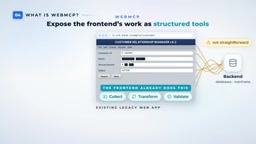
WebMCP operates on entirely different logic — there's no separate client-server architecture here. Its entry point is this: a legacy web application whose backend may not be easy to integrate with, but whose frontend has often already done the work of collecting, transforming, and validating backend data. Rather than rebuilding an integration layer for the AI Agent, WebMCP lets you expose those existing frontend capabilities and data transformation logic as structured tools, requiring minimal changes to the existing application.
Another important difference is where execution happens: MCP typically executes server-side, while WebMCP works client-side — in the browser, within that specific web application. This is both an advantage and a limitation: the application must be open in the user's browser for the relevant tools to be available. WebMCP is inherently bound to the web application layer.
How Does the Security Model Hold Up?
Security is unavoidable in enterprise contexts. WebMCP doesn't bypass the existing application's security mechanisms: users still log into the same application, use the same session, and the original permission and authorization controls remain in effect. By default, it follows the browser's same-origin security model. If another web application needs to consume these tools, they must be explicitly exposed to a trusted origin — meaning a random website cannot discover and call these WebMCP tools.
Background: MCP and WebMCP
MCP (Model Context Protocol) is an open protocol standard proposed and open-sourced by Anthropic in late 2024, designed to provide a unified communication interface between AI models and external tools and data sources. Its design philosophy is similar to the USB standard: regardless of whether the backend is a database, API, or file system, as long as an MCP server is implemented, AI Agents can call it through the same protocol. The standard MCP architecture requires deploying an "MCP server" process on the server side to receive instructions from AI clients and interact with actual systems — meaning server-side infrastructure is required, and corresponding interfaces must be opened within the enterprise network. For legacy systems, this often triggers data security reviews, network policy changes, and development resource investment. WebMCP moves this logic into the browser, using the web application's existing DOM operations, form submissions, and JavaScript logic as "tool implementations," bypassing the complexity of server-side integration.
Background: Browser Same-Origin Policy
The Same-Origin Policy is a foundational Web security mechanism: it stipulates that a webpage can only access resources that share the same protocol, domain, and port as itself — scripts from different origins cannot read each other's data or call each other's interfaces by default. WebMCP follows this model by default, meaning WebMCP tools are naturally confined to the page context of their corresponding web application, and third-party pages cannot detect or invoke these tools. When cross-origin tool consumption is needed, trusted origins must be explicitly declared — similar to configuring CORS (Cross-Origin Resource Sharing) policies — providing enterprises with an auditable permission boundary rather than an open tool discovery mechanism. This design is especially important in industries with strict security and compliance requirements, such as finance and healthcare, because it introduces no new network endpoints, doesn't alter existing authentication flows, and keeps audit logs and access controls under the original application's management.
Demo: AI Agent Takes Over Execution, Humans Retain the Decision
Back to the bank example: an AI Agent is positioned within the service desk application. The CRM, credit risk, and loan origination legacy systems each get WebMCP added, exposing only the capabilities the Agent needs — retrieve customer details, run credit checks, update loan applications.
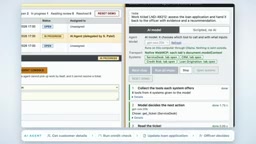
In practice, after the loan officer opens a case and reads the basic information, instead of manually jumping between systems, they click the AI Agent button. The interface lists the tasks that need to be completed for this case. Click "Run All Steps" and the Agent begins executing sequentially across the CRM, credit risk, and loan origination systems, logging the time taken at each step. Once everything is complete, it consolidates all findings at the top of the panel: the evidence gathered, the actions taken, the results returned from each system, and finally a recommendation from the LLM.
But crucially — the final decision remains with the loan officer. The officer reviews the evidence and recommendations, then decides to approve or reject. If anything failed or requires attention, the Agent flags it in red. Once satisfied, the officer clicks approve and the case closes automatically. What used to require a person to shuttle, check, and enter data across three systems is now executed by the Agent, while the human retains the final say. This is exactly what the POC aims to validate: reducing manual execution while maintaining human-in-the-loop.
Background: Human-in-the-Loop
Human-in-the-loop is an important principle in AI system design: it means retaining human review or decision-making at key nodes in an automated process, rather than letting the system run fully autonomously. In high-stakes business scenarios (such as loan approvals, medical diagnosis, and legal compliance), this principle is especially critical: AI handles high-frequency, repetitive tasks like information gathering, data validation, and pattern recognition, while humans focus on final judgments that require discernment, accountability, and ethical consideration. This division of labor not only reduces the compliance and liability risks of full automation, but also makes AI systems easier to get through internal approval — because their role is framed as a "decision support tool" rather than a "decision replacement." It's particularly well-suited for the POC stage: it demonstrates AI's real impact on efficiency while avoiding the risks of full autonomy before value has been validated.
A Realistic Assessment: WebMCP Is Still an Experimental Approach
The video's author closes with a notably measured take: he doesn't view WebMCP as a permanent solution, nor does he think it's right for every scenario. It needs to be evaluated case by case based on your needs and constraints. As an AI architect, your responsibility is to understand the requirements, validate the constraints, and choose the right building blocks.
He even directly cautions viewers: don't go back to clients and say "let's go with WebMCP" — it's still experimental and has clear limitations (such as requiring the web application to be open in a browser, and being bound to frontend capabilities). Before using it, understand where it actually fits.
For teams that want to quickly validate AI value without letting integration work derail the POC — and without kidding themselves with mock data — WebMCP offers a middle path worth evaluating.
Related articles

Felix Rieseberg Personal Homepage
Felix Rieseberg's personal homepage sparks attention on Hacker News. This article covers the Slack engineer's technical background, the rise and fall of nativefier, and the value of a developer homepage as a tech calling card.

@ai-sdk/vue 3.0.306 Patch Release Syncs with [email protected] Update
@ai-sdk/vue 3.0.306 released, synced with [email protected]. A routine patch release for the Vercel AI SDK ecosystem with no public API changes; the Vue adapter layer stays version-aligned with the core package.

Gemini 4 Argon API Launches: The Era of Million-Token Output Begins
Google launches Gemini 4 Argon with sparse MoE architecture, up to 1M output tokens, and a 68.90% Vals Index score, available across API, AI Studio, and the Gemini app.