Websites Shut the Door on AI Agents: Autonomous Agents Hit Internet Blockades
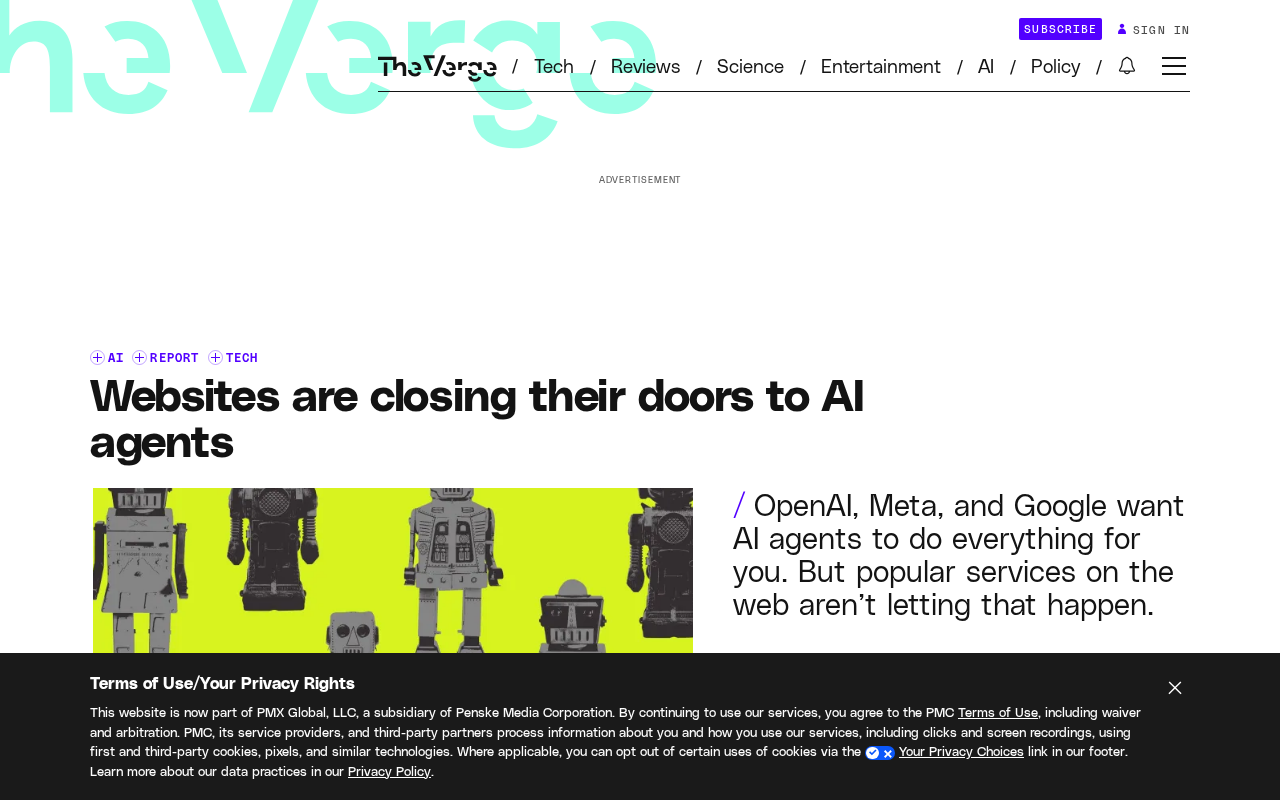
AI agents' web ambitions hit website blockades, with missing identity and accountability at the core.
OpenAI, Meta, and Google are pitching autonomous AI agents as the next internet gateway, but real-world websites increasingly reject them. Sites cite server load, data copyright, and security risks, deploying technical interception (User-Agent checks, CAPTCHAs), terms-of-service bans, and commercial charges. For agent developers, blocking lowers success rates; for websites, it forfeits potential transaction traffic. The deeper conflict is identity and accountability—the human-oriented web identity system can't verify who is behind an agent or who is liable. Agent-specific identity and authorization protocols remain early-stage, so the cat-and-mouse game will continue until standards converge.
Autonomous AI agents are being pitched by giants like OpenAI, Meta, and Google as the next-generation internet gateway—capable of booking dinner reservations, cleaning up your inbox, or buying sneakers on your behalf. Yet when these agents actually leave the lab, they increasingly run into walls erected by websites.
When Agents Meet an Unwelcome Mat
According to RSS sources, a growing number of websites have begun explicitly rejecting or restricting AI agent access. This trend is directly tied to the rapid expansion of AI agent capabilities: OpenAI, Meta, Google, and companies like Instinct are all pushing agents to browse the web autonomously and execute multi-step tasks. The problem is that the vast majority of internet sites were never designed for machine visitors, let alone autonomous programs that "act on behalf of humans."
Website operators' concerns center on three levels: server load and bandwidth costs, data scraping and content copyright, and security risks—an agent authorized to "shop for you" could equally be abused as a scraper or attack tool.
AI Agent (autonomous intelligent agent) refers to a software program capable of perceiving its environment, planning autonomously, and executing multi-step tasks to achieve goals. Unlike traditional chatbots or API calls, it can browse web pages, fill out forms, click buttons, and complete transactions with minimal human intervention. Current mainstream forms include browser-based "computer use" agents (such as OpenAI's Operator and Anthropic's Computer Use) and task agents orchestrated via APIs. Their technical foundation typically involves a large language model handling reasoning and decision-making, combined with tool calling, memory mechanisms, and visual understanding capabilities. Precisely because agents interact with web pages the way "human users" do, websites find it difficult to distinguish them from real people using traditional bot-detection methods—this is the root of the blocking challenge.
Three Forms of Blocking
Based on current practices, website restrictions on AI agents fall roughly into three categories.
Technical interception: Distinguishing human browsers from automated agents through robots.txt extensions, User-Agent identification, behavioral fingerprinting, and similar methods. Some sites simply return 403 errors or CAPTCHA challenges.
Terms-of-service prohibitions: Explicitly banning autonomous agent access or transactions in service terms, leaving room for subsequent legal action.
Commercial charging: Requiring agent operators to pay for access, bringing "agent traffic" into API or data licensing systems.
These three forms are not mutually exclusive—many sites are combining them.
robots.txt is a plain-text protocol file in a website's root directory, voluntarily followed by search engine crawlers and others since 1994, used to declare which paths may or may not be crawled. It has no legal force but has become a de facto internet standard. With the emergence of AI agents, the industry is discussing extending robots.txt semantics—for example, explicitly distinguishing between "search crawling," "training data crawling," and "agent acting on behalf of users"—while working with IETF groups such as AIPREF to develop machine-readable preference expressions. User-Agent identification involves the server reading the client identifier in HTTP request headers to determine visitor type, but this field can be forged, so it is often combined with behavioral fingerprinting (such as mouse trajectories, request timing, TLS fingerprints). CAPTCHA blocks automated access through human-machine distinction challenges, but its protective effectiveness is declining against agents powered by multimodal large models.
Who Loses, Who Benefits
For agent developers, website blocking means lower task success rates and degraded user experience. An agent that can't complete a booking will struggle to convince users to stick with it long-term. For websites, blocking reduces costs and risks but also forfeits potential transaction opportunities from agent-driven recommendations, price comparisons, and orders—especially in e-commerce and local services, where agents may actually be the new traffic gateway.
The deeper conflict lies in identity and accountability: when an agent acts on a user's behalf, the website cannot confirm who is behind it, whether authorization was granted, or who is responsible when something goes wrong. The existing internet identity system (accounts, cookies, CAPTCHAs) was designed for humans, and the emergence of agents at scale is straining it to its limits.
Agent identity and authorization frameworks are the current focus of standardization. Traditional web identity systems rely on account passwords, cookie sessions, and OAuth authorization, premised on "a human operating in a browser." When agents act on behalf of users, a machine-verifiable delegation chain is needed: how users authorize agents, what operations agents can perform, when permissions expire, and how to trace disputes. Existing proposals include issuing Verifiable Credentials to agents, introducing agent roles into OAuth flows, and agent identities based on Decentralized Identifiers (DID). The core goal of these approaches is to let websites distinguish "good-faith agents authorized by users" from "malicious scrapers impersonating users," thereby opening access under controlled conditions rather than imposing blanket blocks.
The Protocol War Has Only Just Begun
There have been some industry attempts—for example, designing dedicated identity markers, access credentials, and authorization frameworks for agents so that websites can accept agent traffic under controlled conditions. But these standards are far from unified. Before protocols and rules take hold, the "cat-and-mouse game" between websites and agents will likely continue.
The vision for autonomous agents is grand, but the internet won't automatically make way for them. Who decides whether agents can enter, under what identity, and with what responsibilities—that will be the most closely watched battleground at the intersection of AI and the Web for some time to come.
One-line Summary
AI agents' web ambitions hit website blockades, with missing identity and accountability at the core of the conflict.
Paragraph Summary
Giants like OpenAI, Meta, and Google are pitching autonomous AI agents as the next-generation internet gateway—capable of booking, shopping, and cleaning inboxes for users. Yet as agents reach the open web, they face growing explicit rejection from websites. Sites worry about server load, data copyright, and security risks, and are deploying three types of restrictions: technical interception (User-Agent identification, CAPTCHAs), terms-of-service prohibitions, and commercial charging. For agent developers, blocking lowers task success rates; for websites, it means forfeiting potential transaction traffic that agents could bring. The deeper conflict is identity and accountability: the existing internet identity system was designed for humans and cannot confirm who is behind an agent, whether it's authorized, or who is liable when things go wrong. Agent-specific identity and authorization protocols remain early-stage, and the cat-and-mouse game between websites and agents will continue until standards converge.
Related articles

5 Practical Ways Real Estate Agents Can Use AI to Boost Efficiency (2026 Edition)
How can real estate agents use AI to boost efficiency? Based on a YouTube walkthrough, this breaks down five methods — ChatGPT for listing descriptions, Canva for marketing materials, forms for open house leads, Zapier for automated follow-up, and seller meeting prep — and flags risk boundaries like fair housing laws, photo authenticity, and price verification.

Grok Bot vs ChatGPT Agent: Which AI Agent Is More Powerful?
How does Grok Bot differ from ChatGPT Agent? This comparison examines how they work: Grok Bot has a cloud computer and runs persistently inside tools to execute multi-step tasks automatically; ChatGPT Agent operates web pages in a browser and is more mature at general tasks. Includes selection advice.

Walmart Agent Gateway: AI Shops for You Automatically—Why Is Amazon Going the Opposite Way?
Walmart's Agent Gateway lets ChatGPT, Gemini and other AI assistants access its product catalog to search, compare and add to cart, with spending limits and per-purchase approval. Amazon blocks external AI agents—two retail giants, opposite paths. Currently US-only, India may follow.