What Biden Said to Zelensky: 'I Need Ammunition, Not a Ride'

Zelensky rejected Biden's evacuation offer and asked for ammunition instead of a ride—a defining decision-making moment in the war's early days.
The article centers on a widely circulated interview from the early days of the Russia-Ukraine conflict: according to a YouTube video, Biden was the first leader to call Zelensky and offer to help him and his family evacuate, and several European leaders subsequently made similar offers, while Zelensky responded, 'I need ammunition, not a ride.' The article notes that the video's claim that Kyiv was surrounded is closer to the tense atmosphere created by Western intelligence assessments and media portrayals than to a strict military encirclement; Biden's evacuation offer was based on intelligence judgments that Kyiv might fall quickly. Zelensky's refusal bet on the Ukrainian military's will to resist and the continuity of Western military aid. The line was distilled into a slogan in its circulation, simultaneously demonstrating resolve domestically, signaling to Russia that no government-in-exile would be established, and transforming the request to the West from humanitarian evacuation into military assistance. The author argues that its value lies in presenting a case of crisis communication under information asymmetry.
A Conversation Cited Again and Again
In the early days of the Russia-Ukraine conflict, Kyiv was encircled and Russian forces had advanced to the outskirts of the capital. An interview clip of Zelensky circulated on YouTube and other platforms, recounting a phone call he had with Biden at the time. According to the video, Biden was the first leader to call and ask whether Zelensky needed to be evacuated.

In the video, Zelensky recalls that Biden said on the call: "We are prepared to help you evacuate—Kyiv is surrounded, we are prepared to help you and your family." Several European leaders subsequently made similar offers. Zelensky's response later became a widely circulated line: "Give me weapons, help me defend the country. I need ammunition, not a ride."
This exchange has been quoted repeatedly not only because of its forceful wording, but because it encapsulates the decision-making logic of Ukraine's leadership in the war's early days: refusing to evacuate meant rejecting the premise of a collapsing regime, and it also meant signaling to the West that "we can still fight."
The "Encircled" Narrative and the Real Context of the Evacuation Offer
The phrase "Kyiv is surrounded" appears multiple times in the video. From a military standpoint, Russian forces did approach Kyiv from multiple directions in the early phase of the conflict, but they did not complete a strict encirclement. The "encirclement" in the video is closer to the tense atmosphere created by Western intelligence assessments and media portrayals at the time—roads were about to be cut off, and the evacuation window was closing.
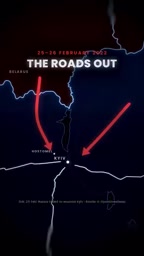
Biden's offer to evacuate was, in that context, a pragmatic arrangement based on intelligence. The American side feared that Kyiv would fall quickly and that Zelensky would be captured or go into exile, creating a political vacuum. By refusing to evacuate, Zelensky bet on the Ukrainian military's will to resist and on the continuity of Western military aid. According to the video, Biden was the "first" leader to call, a point Zelensky specifically emphasized to illustrate how quickly the U.S. responded in the early days of the crisis.
Encirclement in military terms means the attacking side completely cuts off the defender's ground escape routes, supply lines, and communications, forming a closed ring of encirclement. In February 2022, Russian forces moved south from the direction of Belarus and advanced from the northeast and east, at one point reaching Irpin and Bucha northwest of Kyiv and Brovary to the east, but they never closed off the passages south and west of Kyiv, nor did they cut the main supply route to Lviv in the west. Western military intelligence assessments therefore mostly used "approaching" and "threatening" rather than "encirclement." This distinction matters: a strict encirclement would mean the defenders could not receive external supplies and the evacuation window would be completely closed; at the time, however, Kyiv could still receive weapons and supplies via western highways, which objectively supported the feasibility of Zelensky's refusal to evacuate.
The Communicative Impact of "Ammunition, Not a Ride"
The line "I need ammunition, not a ride" was distilled into a slogan in its circulation, and its influence went beyond the interview itself. It accomplished three things at once: domestically, it demonstrated a determination not to flee; toward Russia, it signaled that no exile government would be established; toward the West, it transformed the request from "humanitarian evacuation" into "military assistance."

In terms of communicative effect, the line worked because it compressed complex aid negotiations into a quotable contrast: evacuation is a way out; ammunition is resistance. In the video, Zelensky also mentions that many European leaders later offered evacuation assistance, indicating that the offer was not unique to the U.S., but Biden's role as the "first" was singled out and became a footnote to U.S.-Ukraine relations.
A government-in-exile refers to a political entity that relocates to a foreign country after its home territory is occupied or faces collapse and continues to operate as the legitimate government. De Gaulle's Free France and the Polish government-in-exile during World War II are typical examples. For Ukraine, if Zelensky had evacuated and established a government-in-exile, Russia could immediately declare that the Ukrainian regime had collapsed, install a pro-Russian government, and characterize the Kyiv authorities as a "foreign force" in negotiations. By publicly refusing to evacuate, Zelensky essentially negated the premise of this political script and signaled to the West that the Kyiv government was still operating on its own territory, thereby maintaining its legitimacy as a recipient of aid.
Why This Conversation Is Still Discussed Today
The value of revisiting this interview lies not in reconstructing every detail of a phone call, but in the decision-making moment it presents under the information asymmetry of the war's early days. The U.S. side, based on intelligence judgments that "Kyiv could fall within days," proposed evacuation; the Ukrainian side, based on political survival and expectations of military aid, chose to stay. Both judgments had their own logic, and the latter turned out to be right.

This also explains why the conversation continues to be clipped and shared on platforms like YouTube: it is both a diplomatic anecdote and a case study in crisis communication—how, at a moment of extreme uncertainty, a leader can use a single sentence to reassure allies, deter adversaries, and secure resources at the same time. Zelensky's answer did not evade danger; it turned danger into leverage. That is probably the most thought-provoking aspect of this exchange.
One caveat: the information in this article comes mainly from the interview clip in the YouTube video and is a single-source oral recollection. The exact wording and details of the call may differ from other public reports.
One-line Summary
Zelensky rejected Biden's evacuation offer and asked for ammunition instead of a ride—a defining decision-making moment in the war's early days.
Paragraph Summary
The article centers on a widely circulated interview from the early days of the Russia-Ukraine conflict: according to a YouTube video, Biden was the first leader to call Zelensky and offer to help him and his family evacuate, and several European leaders subsequently made similar offers, while Zelensky responded, "I need ammunition, not a ride." The article notes that the video's claim that "Kyiv was surrounded" is closer to the tense atmosphere created by Western intelligence assessments and media portrayals at the time than to a strict military encirclement; Biden's evacuation offer was based on intelligence judgments that Kyiv might fall quickly. Zelensky's refusal bet on the Ukrainian military's will to resist and the continuity of Western military aid. The line was distilled into a slogan in its circulation, simultaneously demonstrating resolve domestically, signaling to Russia that no government-in-exile would be established, and transforming the request to the West from humanitarian evacuation into military assistance. The author argues that its value lies in presenting a case of crisis communication under information asymmetry, while cautioning that the source is a single oral recollection.
Related articles

Frontend to AI Agent Development: A Frontline Architect Explains Career Paths and Opportunities
A frontline AI architect explains the industry changes and practical paths for frontend developers transitioning to AI Agent development: why pure frontend jobs are disappearing, why Agent + full-stack has become mainstream in hiring, and three transformation routes—Agent development engineer, FDE, and remote contracting—along with corresponding learning strategies.

How to Choose an AI Agent Development Course: Five Pitfall-Avoidance Guidelines
A mechanical-engineering career changer's two-year pitfall-tested checklist for screening AI Agent development courses: complete delivery pipeline, resume-worthy projects, real development perspective, update frequency, and coaching feedback—with concrete judgment methods and pitfall-avoidance tips.

Coze AI Agent Building for Beginners: A Zero-Code AI Agent Development Guide
Coze, ByteDance's one-stop AI application development platform, supports zero-code drag-and-drop AI agent building. This article outlines Coze's core concepts, three advantages, differences between the domestic and international versions, and the distinction between agents and apps, helping beginners quickly get started with AI Agent development.