What Do Prediction Market Contracts Reveal at Listing? The Predictability of Trading Volume and Dispute Risk
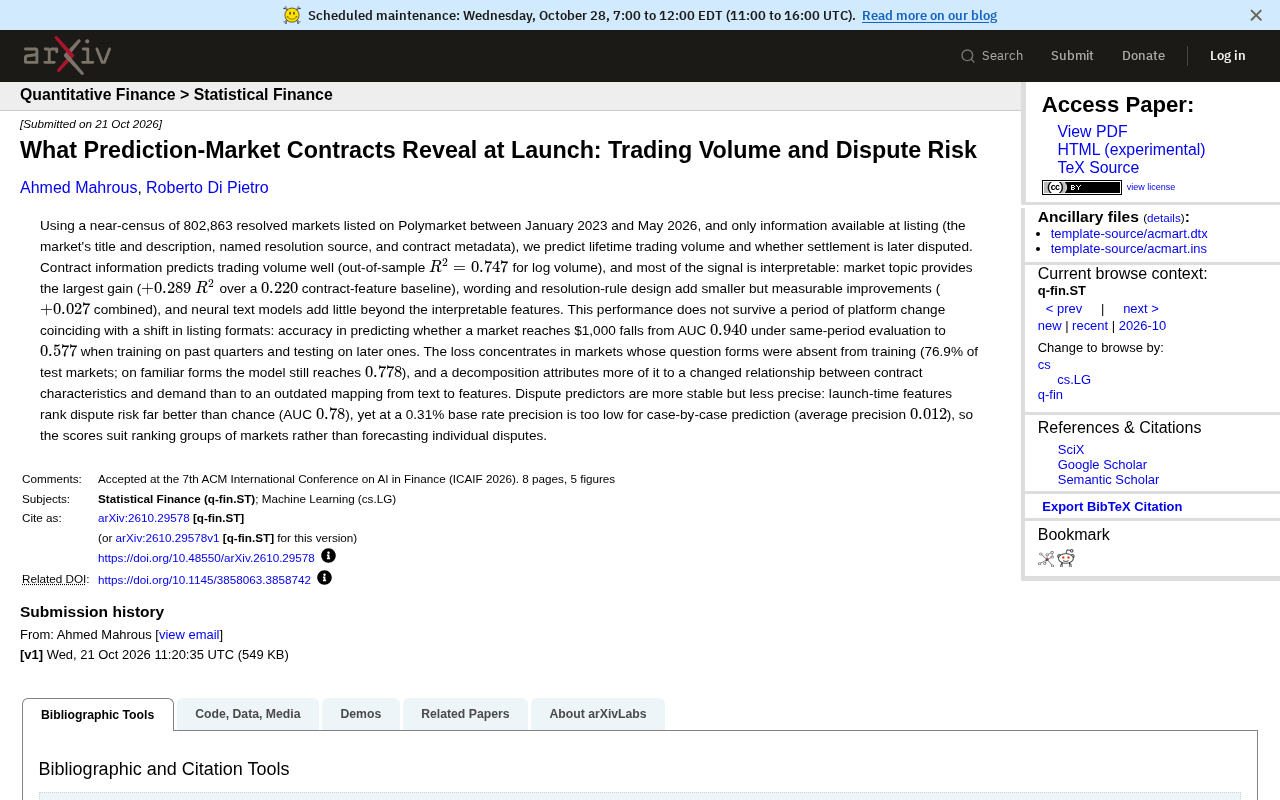
Listing-time contract information can predict trading volume, but platform format changes break models; dispute risk is only suitable for group ranking.
An empirical study of nearly 800,000 resolved Polymarket markets uses only listing-time titles, descriptions, resolution sources, and metadata to test whether trading volume and resolution disputes can be predicted. Contract information achieves an out-of-sample R² of 0.747 for log trading volume, with market topic contributing the most (+0.289), while a neural network text model adds little beyond interpretable features. However, after platform listing-format changes, the AUC for predicting a market reaching $1,000 in trading volume drops from 0.940 to 0.577, with losses concentrated in unseen question formats and driven mainly by changes in the relationship between contract features and demand. Dispute prediction has an AUC of 0.78 but an average precision of only 0.012 at a 0.31% base rate, making it suitable for group ranking rather than case-by-case early warning. The study highlights the importance of contract design and the need for continuous model re-evaluation as platforms change.
The core value of prediction markets lies in aggregating dispersed information through market prices, but a more fundamental question is often overlooked: using only the text and metadata available at the time a contract is listed, can we predict a market's fate—how much trading volume it will attract, and whether its resolution will be disputed? An empirical study based on nearly 800,000 resolved markets on Polymarket offers a nuanced and measured answer.
Study Design and Core Findings
The study uses near-complete data on 802,863 resolved markets on Polymarket between January 2023 and May 2026, and relies exclusively on information available at listing time: market titles and descriptions, designated resolution sources, and contract metadata. This "information isolation" design is crucial—it simulates the full set of information available to investors or platforms at the moment a contract goes live, avoiding the optimistic bias that comes from using later data.
The results show that contract information has substantial predictive power for trading volume, with an out-of-sample R² of 0.747 for log trading volume. Even more notably, most of this predictive power is interpretable: market topic contributes the most, adding 0.289 on top of the 0.220 baseline R² from contract features alone; wording and resolution-rule design add smaller but measurable increments, totaling +0.027; and a neural network text model contributes almost nothing beyond the interpretable features. In other words, a market's "lineage"—what it asks, how it asks it, and who adjudicates—already determines most of its popularity.
Out-of-sample R² is a core metric for measuring the predictive ability of regression models, referring to the coefficient of determination on data the model has not seen during training. Unlike in-sample R², it is not affected by overfitting and better reflects the model's true generalization ability. It is computed as 1 minus the ratio of the residual sum of squares to the total sum of squares on the test set, typically ranging from negative infinity to 1, with values closer to 1 indicating more accurate predictions. In data with right-skewed distributions such as trading volume, researchers often take the logarithm of trading volume to make the distribution closer to normal and compress the influence of extreme values; hence the paper reports out-of-sample R² for log trading volume. A value of 0.747 means the model can explain about 75% of the variation in log trading volume in the test set—a fairly high level given the constraint of using only listing-time information.
How Platform Changes Break the Model
Perhaps the most valuable finding of this study is the fragility of predictive performance. The authors point out that once the platform enters a period in which listing formats change, the model's contemporaneous accuracy cannot be sustained: the AUC for predicting whether a market will reach $1,000 in trading volume drops from 0.940 contemporaneously to 0.577 when trained on past quarters and tested on subsequent quarters. This decline is close to the midpoint between random guessing and perfect prediction, meaning the model essentially fails in the face of distribution shift.
The loss is not evenly distributed. In the test set, 76.9% of markets had question formats not seen in the training data, while on familiar question formats the model still achieved 0.778. Further decomposition shows that the loss stems more from changes in the relationship between contract features and demand than from outdated text-to-feature mappings. This suggests to platform designers and researchers alike: changes in contract format are not merely interface adjustments—they reshape the behavioral function of market participants.
AUC (Area Under the ROC Curve) is a common metric for evaluating the ranking ability of binary classification models, equal to the probability that the model scores a randomly drawn positive sample higher than a randomly drawn negative sample. An AUC of 0.5 corresponds to random guessing, and 1.0 indicates perfect ranking. In the paper, "whether a market reaches $1,000 in trading volume" is a binary classification problem; the drop in AUC from 0.940 to 0.577 indicates that the model's ranking ability in markets with new formats is close to random. Note that AUC only measures ranking quality and does not reflect the calibration of predicted probabilities; in high-threshold scenarios, it should be combined with metrics such as precision and recall for a comprehensive judgment.
Distribution shift refers to changes in the input data or in the relationship between inputs and outputs after a model is deployed, causing patterns learned during training to fail on new data. The platform's listing-format change in the paper is a typical mixed scenario of "concept drift" and "covariate drift": changes in question format alter the distribution of text features, while the mapping between contract features and trading demand is also reshaped. This explains why the model performs well in contemporaneous tests but degrades substantially in cross-period tests, and also shows that continuous monitoring and retraining are essential for predictive model operations.
Dispute Risk: Rankable, but Hard to Pin Down
For resolution disputes, listing-time features have significantly better-than-random ranking ability, with an AUC of 0.78. However, at an extremely low base rate of 0.31%, precision is far from sufficient to support case-by-case prediction, with an average precision of only 0.012. The authors phrase this with restraint: these scores are suitable for ranking groups of markets rather than predicting whether an individual market will be disputed.
This conclusion has direct implications for platform operations. Dispute prediction models should not be used as case-by-case "dispute early-warning systems" but are better suited as resource allocation tools—for example, identifying high-risk groups among a large number of newly listed markets and directing manual review resources toward those groups. The 0.31% base rate also means that any case-by-case warning will produce a large number of false positives, undermining user trust.
Base rate refers to the prior probability of a positive event occurring in the target population. In this paper, disputed markets account for only 0.31%, a typical highly imbalanced classification problem. Under this setting, even if the model has a high AUC, precision (the proportion of samples predicted as positive that are truly positive) will be dragged down by a large number of false positives. Average Precision (AP) comprehensively considers precision and recall at different thresholds and is more sensitive to imbalanced data than AUC; an average precision of 0.012 means that the vast majority of "high-risk" markets flagged by the model will not actually be disputed. Therefore, the value of such models lies in improving ranking efficiency—concentrating limited manual review resources on relatively higher-risk groups—rather than in giving deterministic judgments about individual markets.
Implications for the Prediction Market Ecosystem
Putting the three findings together reveals a clear practical thread. Contract design—especially topic selection and question wording—is the main driver of trading volume, and this driver can be captured through interpretable features without relying on black-box text models. However, predictive relationships fail as platform formats change, so models need continuous re-evaluation rather than one-time training for long-term use. Dispute risk is better suited to group-level ranking applications.
For teams building prediction market products, this means contract text before listing deserves more design effort; for the research community, this work reminds us that out-of-sample performance under distribution shift is the true test of a model's value, and that interpretability has irreplaceable operational value when predictive power is comparable.
(The study is based on complete data from a single platform; the transferability of its conclusions to other prediction markets still requires further validation.)
Related articles

LLaMA-Factory in Practice: A Complete No-Code Guide to Fine-Tuning Large Models
An introduction to LLaMA-Factory, the open-source fine-tuning tool: its 60.1K-star background, supported models and algorithms, local vs. cloud deployment, and CUDA setup steps.

Zeng Ming's Deep Retrospective: Why OpenAI May Not Be the Ultimate Winner — and Why the Corporate System Will Disappear
Zeng Ming's deep retrospective on the AI endgame: model companies are just infrastructure, OpenAI and Anthropic won't be the final winners; the next battle is the Agent entry point standard; the corporate system will disappear as AI restructures collaboration, and only mission-driven companies can survive the cycle.

OpenHands v1.28.0: OpenCode and PI Added as Built-in Agents, API Keys Requestable In-Conversation
OpenHands ships 5 releases in 21 days: v1.27.0 adds OpenCode and PI as built-in agents, v1.28.0 enables in-chat key requests. ACP integration, credential reuse, model list changes, and upgrade advice.