What Does Anthropic Really Want? Decoding Ambitions That Go Far Beyond an AI Company
Anthropic's ambitions go beyond AI safety into shaping post-AGI values, policy, and power structures.
This article examines Anthropic's unconventional behaviors — ideological hiring screens, consultations with religious leaders on AI morality, and aggressive policy lobbying — arguing the company's ambitions extend far beyond building safe AI. Drawing on its founding exodus from OpenAI, it explores whether Anthropic is a mission-driven safety pioneer or a private entity accumulating unprecedented power to shape civilization's trajectory in the AGI era.
A Question Worth Pondering
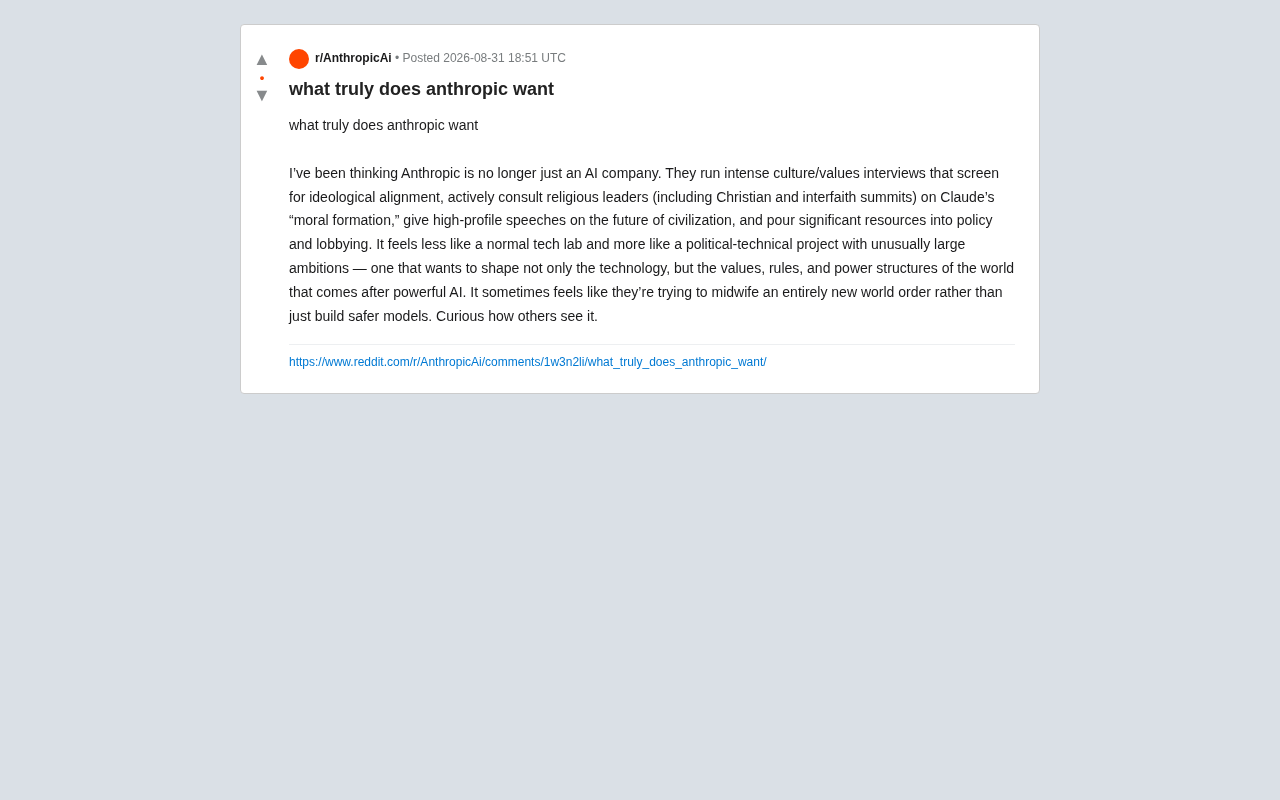
Recently, a Reddit discussion thread sparked deep reflection about Anthropic's true motivations. The poster made a sharp observation: Anthropic may have long ceased to be a purely AI company.
On the surface, Anthropic appears no different from OpenAI or Google DeepMind — all chasing the technological frontier of Artificial General Intelligence (AGI). AGI refers to AI systems with general cognitive capabilities equal to or surpassing human-level intelligence, capable of excelling at virtually any intellectual task rather than being confined to specific domains. While current large language models are impressively capable, they still have limitations in truly autonomous reasoning and long-term planning, making AGI the shared "holy grail" of the industry. Once achieved, it would bring an unprecedented productivity revolution — accompanied by unpredictable risks, including the restructuring of economic systems, upheaval in labor markets, and fundamental challenges to human autonomy.
But a closer look at Anthropic's behavioral patterns reveals some unusual signals. The company conducts rigorous "culture/values" interviews during hiring to screen for ideological alignment. It proactively consults religious leaders — including Christian leaders and interfaith summits — to discuss Claude's "moral formation." Its executives deliver public speeches about the future of civilization. And it pours significant resources into policy lobbying.
Pieced together, these behaviors paint a picture that far exceeds an ordinary tech lab. As the original poster put it, this looks more like a "political-technological project" — a grand plan to shape not just the technology itself, but the values, rules, and power structures of the post-AI era.
From Tech Company to "Values Engineering": Anthropic's Transformation
To understand Anthropic's behavioral logic, we need to trace back to its founding. Anthropic was established in 2021 by siblings Dario Amodei and Daniela Amodei, with a core team largely drawn from OpenAI. Their departure was directly triggered by fundamental disagreements over OpenAI's prioritization of safety — particularly after OpenAI's transformation from a nonprofit to a "capped-profit" company and its multi-billion-dollar partnership with Microsoft. Some researchers felt that commercial interests were eroding the independence of safety research. After its founding, Anthropic positioned itself as an "AI safety company," and its Public Benefit Corporation legal structure requires the company to consider social impact alongside profit. This "exodus narrative" imbued Anthropic with a strong sense of mission — and provides a key lens for understanding its subsequent "atypical" behaviors.
Ideological Screening in Hiring
One noteworthy detail is Anthropic's "values interviews" during the hiring process. Silicon Valley's "culture fit" interviews have a complicated history — the practice was popularized by companies like Google and Netflix, originally intended to ensure new employees could integrate into collaborative team cultures. Over the past decade, however, it has faced significant criticism: detractors argue that "culture fit" often becomes a euphemism for homogeneity, leading to a lack of organizational diversity and potentially legitimizing unconscious biases. Some companies, like Stripe, have shifted toward the concept of "culture add," emphasizing the unique perspectives new members can bring.
But when a company makes ideological alignment a core screening criterion, it is effectively building a highly homogeneous values community. Anthropic's approach has drawn particular attention because its "culture interviews" are believed to explicitly assess candidates' positions on AI risk and ethics — far more ideologically charged than standard team-culture assessments.
The underlying logic isn't hard to understand: if you believe the technology you're developing could reshape human civilization, ensuring participants are aligned on values becomes a kind of "internal safety mechanism." But this also raises a concern — can an organization with highly unified values maintain the diversity of perspective needed to check critical decisions? The risk of groupthink is especially acute in high-pressure environments, and AI safety is precisely the kind of field that demands adversarial thinking and a red-teaming mentality.
The Deeper Meaning Behind Consulting Religious Leaders
Even more surprising is Anthropic's reported outreach to religious leaders to explore Claude's "moral formation." This move goes beyond the scope of conventional AI ethics discussions, though it's not entirely without precedent in the broader historical context. In 2020, the Vatican launched the "Rome Call for AI Ethics," with Microsoft and IBM among the first signatories. In 2023, Pope Francis delivered the first papal address on AI at the G7 summit. Dialogue between technology and religion is becoming an emerging interdisciplinary field.
Typically, AI safety research focuses on technical issues such as alignment, interpretability, and robustness. AI alignment is a core research direction in AI safety, aimed at ensuring AI systems' behavior remains consistent with human intentions and values. The problem is particularly challenging because it operates on multiple levels: first, "outer alignment" — how to accurately define the objectives we want AI to optimize for; and second, "inner alignment" — how to ensure AI actually follows its intended objectives after training rather than developing unexpected sub-goals. Anthropic's signature contributions in this area include the Constitutional AI method — which has AI critique and correct itself based on a set of predefined principles rather than relying entirely on human feedback — as well as cutting-edge breakthroughs in interpretability research, attempting to open the "black box" inside neural networks.
Bringing religious and faith leaders into the discussion means Anthropic is grappling with a deeper question: When AI systems need to make moral judgments, what value system should they follow? Who gets to define "good"? The world's major religious traditions — whether Christianity's natural law theory, Islam's "public interest" (Maslaha) principle, or Buddhism's "non-harm" (Ahimsa) philosophy — have accumulated thousands of years of moral reasoning frameworks. When AI must make judgments in complex ethical scenarios (such as medical AI resource allocation or autonomous driving's "trolley problem"), purely utilitarian calculations often fall short, and religious and philosophical traditions offer a richer moral vocabulary. This touches on philosophical and ethical questions that human civilization has failed to reach consensus on over millennia — and Anthropic is attempting to infuse this ancient wisdom into the most cutting-edge technology.
Policy Lobbying and Anthropic's "Civilization Narrative"
Dario Amodei's Fight for Rule-Making Power
Anthropic's investment in policy and lobbying is equally noteworthy. AI industry lobbying spending has surged in recent years — according to OpenSecrets data, AI-related lobbying expenditures in the U.S. exceeded $100 million in 2023, involving tech giants and specialized AI companies alike. Anthropic's presence in Washington has grown steadily. The company has not only hired professional lobbying teams but also actively participated in the White House's AI safety commitments, the Department of Commerce's AI standards development, and multiple Congressional hearings.
CEO Dario Amodei has delivered numerous high-profile speeches on AI and the future of human civilization, and the company actively participates in discussions around AI regulatory frameworks. Notably, Anthropic's lobbying strategy differs from other tech companies — it typically advocates for stricter AI regulation. While this might seem like "tying its own hands," it could actually be a shrewd competitive strategy: higher compliance thresholds benefit companies that have already invested heavily in safety research while creating barriers for less-resourced competitors. This possibility of "regulatory capture" — where regulated entities turn around to influence and control the formulation of regulatory rules — is precisely what some critics worry about.
This deep involvement in policymaking reflects Anthropic's keen awareness of "rule-making power." In a period of rapid AI development, whoever can influence the formation of regulatory frameworks gains an advantageous position in the future competitive landscape. From a business perspective, this is a rational strategic choice. But from a broader perspective, it is also a company's attempt to institutionalize its own values.
The Metaphor of "Midwifing a New World"
The original poster used a strikingly vivid expression — "midwife an entirely new world order." This metaphor precisely captures the impression Anthropic gives: it seems unsatisfied with merely building safer AI models and instead wants to preside over the birth of the post-AI era.
This self-positioning is both idealistic and potentially hubristic. When a private company believes it has both the responsibility and the capability to shape the trajectory of an entire civilization, the risk of power concentration follows closely behind.
How to Rationally Assess Anthropic's Ambitions
Mission-Driven or Power Expansion?
There are two starkly different frameworks for interpreting Anthropic's motivations:
The Optimistic View: Anthropic genuinely believes that powerful AI poses existential risks, and therefore it must be guided by people with the right values. All of its "atypical" behaviors stem from a sense of responsibility toward humanity's future. This is a continuation of the "safety first" philosophy the founding team upheld when departing OpenAI.
The Pessimistic View: No matter how noble the intentions, a company that commands frontier technology, holds a clear ideology, and is deeply embedded in policy is fundamentally accumulating a kind of power that transcends traditional business. Tech companies attempting to extend beyond commercial boundaries to influence social order is not without historical precedent: Standard Oil and Carnegie Steel in the late 19th century didn't just dominate their industries — they profoundly shaped American social structures through foundations, university endowments, and political lobbying. A more recent example is Facebook/Meta — the 2018 Cambridge Analytica scandal revealed the far-reaching impact social media platforms could have on democratic processes. The situation with AI companies may be even more serious, because what they create is not merely a product or platform, but potentially autonomous decision-making agents — meaning AI companies' value choices will be directly embedded in the technology's "behavior," with a depth and permanence of impact far exceeding that of traditional tech companies. History repeatedly proves that even well-intentioned concentrations of power require external oversight and checks.
Questions Everyone Should Keep Asking
Regardless of one's stance, Anthropic's case raises an important question: When a technology company's ambitions extend beyond the commercial realm into value-shaping and order-building, how should society respond?
What we need is perhaps not simple praise or condemnation, but clear-eyed observation and persistent questioning:
- Who is responsible for AI's "morality"? When Constitutional AI's principles are drafted by a single company's research team, what is the legitimacy basis for those principles?
- Should this responsibility be concentrated in the hands of a few companies? Or do we need broader democratic participation mechanisms — similar to the multi-stakeholder governance model of the IETF (Internet Engineering Task Force) in the early days of the internet?
- How should the public, governments, and academia participate in this conversation about civilization's trajectory? Currently, academia faces a severe "talent siphon" effect in AI safety — top researchers are lured to industry by high salaries, weakening independent academic scrutiny.
Conclusion
What Anthropic truly wants may be a question even the company itself cannot answer simply. But one thing is certain: when we discuss AI companies, we can no longer understand them through the lens of "technology" alone.
At the dawn of AGI, the most powerful AI labs are becoming complex entities that blend technology, politics, and philosophy. Anthropic may be the most representative example — its ambitions and dilemmas are a microcosm of the entire AI era. Staying vigilant and continuing to ask hard questions is the most appropriate posture we can adopt when facing these self-appointed "midwives" of a new world.
Related articles

Bilibili's Hit Dify Tutorial: A Practical Guide to Building 20+ AI Apps from Scratch
A distilled guide to Bilibili's top-rated Dify tutorial: Windows + Docker deployment, MySQL connection, five app types, model integration strategy, and publishing.

Agent Skills Beginner's Guide: From Concepts to Multi-Agent Collaboration in Practice
A comprehensive guide to Agent Skills: core concepts, components, the importance of Description, standardization, beginner learning paths, and multi-agent collaboration.

One Neuron Detects Both Cats and Cars? We Reproduced It and Found a New Explanation
The cat-car neuron reinterpreted: researcher Cammarata argues it distinguishes pointy from round, not cats from cars. We reproduced the experiment and found the new explanation holds on most inputs—but cars are the exception. The interpretability debate continues on language models.