What If You Selected the Wrong Paper Type on the ARR Author Form? Impact and Solutions
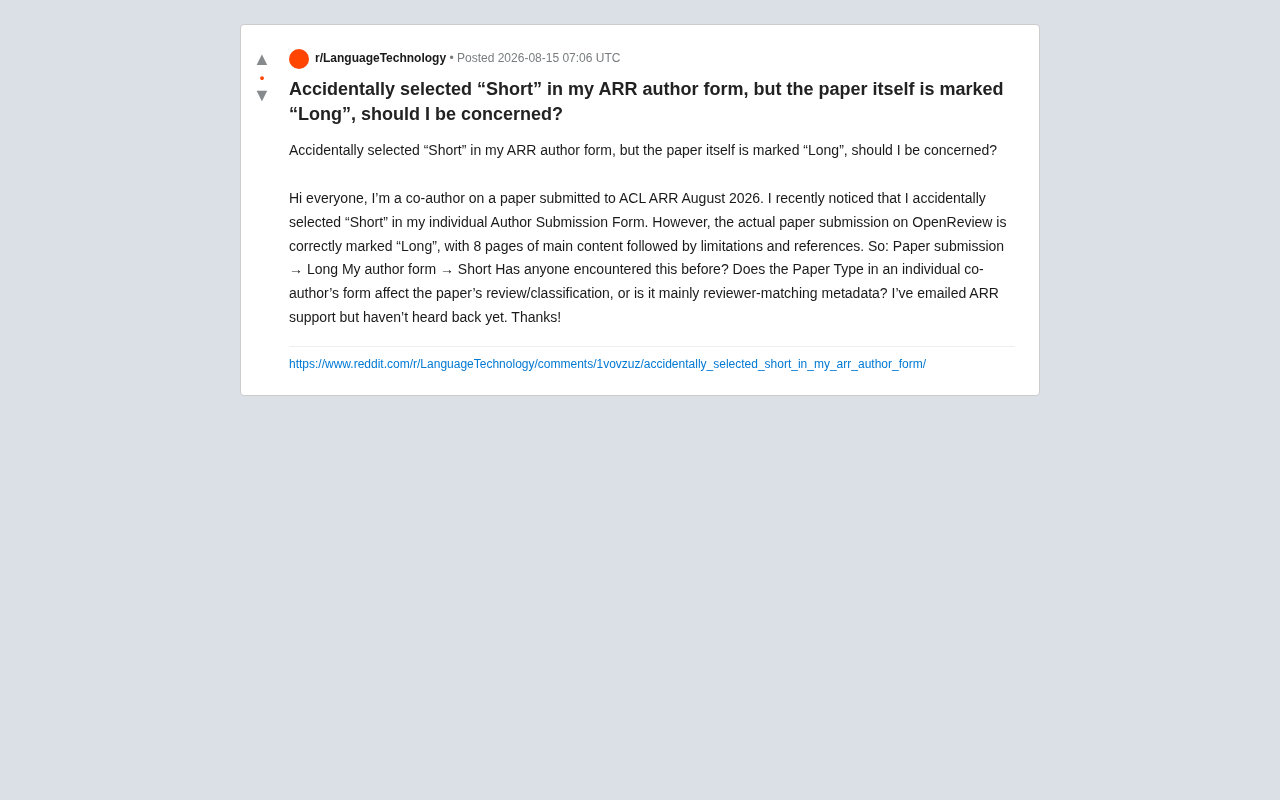
Mismatched Paper Type on ARR Author Form vs. submission likely won't affect review—here's why and how to fix it.
When a co-author accidentally selects 'Short' on their ARR Author Submission Form while the paper is correctly submitted as 'Long,' the impact is minimal. ARR's system relies on paper-level metadata as the authoritative source for classification, page validation, and reviewer assignment. The author form serves auxiliary purposes like conflict of interest and reviewer matching. To be safe, correct the form if still editable, confirm paper-level settings with the corresponding author, and maintain communication records with ARR support.
A Common ARR Submission Anxiety
For researchers submitting to top NLP conferences like ACL Rolling Review (ARR), filling out tedious forms on the OpenReview platform is an unavoidable part of the process. ACL Rolling Review is a rolling review mechanism for the natural language processing field that officially launched in 2021, led by the Association for Computational Linguistics (ACL). Before ARR, top conferences like ACL, EMNLP, and NAACL each organized their own independent review processes, leading to fragmented review resources, heavy reviewer burdens, and the need to restart the entire submission process after rejection. ARR's core philosophy is to decouple reviewing from conferences: authors can submit papers at fixed monthly deadlines to receive reviews, then choose to "commit" their review results to a specific conference. The system runs on the OpenReview platform, an open-source academic peer review platform developed by institutions including the University of Massachusetts Amherst, supporting flexible form configuration, double-blind review, and open discussion features.
Recently, a Reddit user shared their experience: as a co-author of a paper submitted to ACL ARR, they accidentally selected "Short" for the Paper Type field when filling out their individual Author Submission Form, while the actual paper submission was correctly marked as "Long."
The paper has 8 pages of main content, followed by a Limitations section and References, fully meeting long paper format requirements. This left the author in a dilemma:
- Paper Submission → Long
- My Author Form → Short
They emailed ARR technical support but received no reply, so they turned to the community for help: does the Paper Type field in an individual author form actually affect the paper's review and classification? Or is it merely metadata used for reviewer matching?
Understanding ARR's Two-Form System
To answer this question, we first need to understand the "two sets of information" that exist in the ARR submission process. The OpenReview platform uses a multi-layered information architecture: at the top level is Venue (conference/journal) configuration, defining submission types, review processes, and deadlines; below that is the Submission level, where each paper has its own metadata record; and further down are individual participant forms. The advantage of this layered design is clear separation of responsibilities and easy data consistency maintenance, but it also introduces field redundancy and user confusion.
Paper-Level Metadata (Authoritative Information)
On OpenReview, a paper's core attributes (such as title, abstract, Paper Type long/short, research track, etc.) are filled in uniformly by the corresponding author or submitter at the Submission level. This is the authoritative information source that determines how the paper is classified, assigned for review, and subject to page limits. When the system performs automated processing (such as format checking, area assignment, reviewer matching), it primarily relies on this layer of data.
For ACL-series conferences, long and short papers have clear distinctions:
- Long Paper: Typically allows 8 pages of main content
- Short Paper: Typically 4 pages of main content
Notably, long and short papers differ not just in page count but represent different academic contribution positioning. Long papers typically require a complete research narrative, including thorough related work surveys, detailed experimental design, multi-dimensional ablation studies, and in-depth analysis and discussion. Short papers are positioned to report preliminary but valuable research findings, negative results, system demonstrations, or focused technical contributions. The review criteria also differ: long paper reviews emphasize innovation depth and completeness, while short paper reviews focus more on novelty of ideas and conciseness of presentation. After acceptance, the two categories may also differ in presentation format (oral presentation vs. poster) and citation impact.
Review standards, page count validation, and final post-acceptance category classification are all based on this paper-level Paper Type.
Author-Level Forms (Auxiliary Information)
The Author Submission Form that each co-author must independently fill out primarily collects author-level personal information, such as:
- Conflict of Interest
- Research experience
- Reviewer commitment
The "Reviewer Commitment" mechanism that ARR has promoted in recent years has given author forms a significant role in matching review resources. This mechanism is an important attempt by the academic community to address the reviewer shortage problem: at least a certain number of members from each submitting paper's author team need to register as potential reviewers for the current or subsequent rounds. The background to this policy is the explosive growth in NLP submissions—ACL 2023 received over 4,000 submissions, while the growth of qualified reviewers has fallen far behind paper volumes. By binding submission rights to review obligations, ARR aims to establish a reciprocal academic ecosystem. The relevant fields in the author form (such as research expertise, available review time, etc.) serve precisely this matching mechanism, helping Action Editors assign papers to reviewers with relevant expertise.
Under this design, even if a field like Paper Type appears in the author form, its role is closer to redundant auxiliary information or reference metadata for reviewer matching, rather than a critical switch determining the paper's fate.
Selecting the Wrong Paper Type Most Likely Doesn't Warrant Excessive Worry
Considering ARR's actual operational mechanism, this author's situation most likely will not substantively affect the paper's review, for the following reasons:
Reason 1: Authoritative Information Follows the Paper Level
When the system performs page count validation, track assignment, and review organization, it reads the Paper Type at the Submission level. Since the paper itself is correctly marked as Long, and the main content page count (8 pages) meets long paper specifications, it will enter the review process as a long paper.
Reason 2: Author Form Fields Are Mostly Auxiliary in Nature
A single co-author's type selection in their form typically does not override or overwrite the paper's official classification. Such inconsistencies are not uncommon in ARR's backend. Large academic conference Program Committees typically consist of multiple layers including Program Chairs, Senior Area Chairs, Area Chairs, and Action Editors. For ACL-level conferences, a single ARR review round may involve coordinating thousands of papers and tens of thousands of reviewers. At this scale, form filling errors and information inconsistencies appear dozens or even hundreds of times per round. Program committees typically have standardized handling procedures: the system automatically detects obvious inconsistencies (such as an 8-page paper marked as Short) and generates anomaly reports for administrators to review. In most cases, these inconsistencies are flagged as "non-critical discrepancies" and don't affect the normal review process. Manual intervention is only needed when there are errors in the paper-level core metadata itself.
Reason 3: Format Compliance Is a Hard Criterion
The ultimate basis for determining whether a paper is long or short is whether it meets the format requirements of the corresponding category. Eight pages of main content plus separate Limitations and References sections is the standard ACL long paper structure, which itself serves as the strongest proof.
Recommendations for Correcting ARR Author Form Errors
Although the risk is low, to completely eliminate potential issues, the following measures are recommended:
Step 1: Proactively Correct the Form
If the author form is still editable before the deadline, log into OpenReview immediately and change the Paper Type back to "Long" to keep both pieces of information consistent. This is the most direct and hassle-free approach. The OpenReview platform typically allows form modifications before the submission deadline, but the specific editing window may vary across different rounds, so it's advisable to act early.
Step 2: Confirm with the Corresponding Author
Confirm that the corresponding author has correctly selected the long paper type at the paper level. Since this layer of information determines paper classification, as long as it's correct, you've secured the bottom line.
Step 3: Keep Communication Records with ARR Support
Continue waiting for ARR support's reply. It's normal for ARR technical support to respond slowly during submission peak periods, but keeping email records provides evidence in case of disputes. If there's still no response as the deadline approaches, try reaching out again through the Program Chairs' contact channels.
Important Reminder: Don't Repeatedly Modify the Paper Itself
Avoid changing the paper submission's type or page count out of anxiety. Since the paper-level "Long" marking is correct, don't gild the lily.
Conclusion: Rationally Addressing Detail Anxiety in the Submission Process
This seemingly trivial issue actually reflects the widespread anxiety caused by the increasing complexity of academic submission processes. As ARR introduces author-reviewer binding, multiple forms, conflict of interest declarations, and other mechanisms, researchers face more and more fields to fill out, naturally increasing the probability of errors. This increased complexity has its rationale—it aims to improve review quality, ensure fairness, and address the increasingly severe reviewer resource shortage—but for individual researchers, every additional form field represents a potential source of anxiety.
The good news is that these processes typically have fault-tolerant designs—what truly determines a paper's fate is content quality and paper-level core metadata, not an isolated field in some author's form. For this particular author, as long as the paper itself is correctly marked and format-compliant, a single form selection mistake is virtually impossible to change the review outcome.
Rather than over-agonizing about details, it's better to focus energy on polishing the paper itself. Of course, oversights that can be proactively corrected should be corrected promptly—this shows respect for the process and gives yourself peace of mind.
Key Takeaways
Related articles

GPT-Next Leak, Gemini 4 Argon Imminent: AI News Roundup
GPT-Next leak suggests extreme efficiency; OpenAI's 28-day shipping pledge boosts speed 50%; Gemini 4 Argon nears release; Anthropic subscription value report sparks debate.

GPT-Next Leaked, Gemini 4 Argon Speeds Up, Fable 5.5 May Launch Today
OpenAI's GPT-Next model leaks, expected to be extremely low-cost and possibly part of the 28-day release plan; Gemini 4 Argon internal testing accelerates, NanoBanana 2.1 is live; Semi Analysis tests show Claude Max's equivalent API value is about 5 times that of ChatGPT Pro; Fable 5.5 may launch today.

Gemini 4 Argon Launches Globally: Key Highlights from the AI Daily Brief
Google opens Gemini 4 Argon globally across Pro and Ultra subscriptions and the API, and demonstrates robot control. This article rounds up open-source models, Agent infrastructure, cost transparency, and safety governance updates.