What Is an FDE? Decoding the Most Sought-After Hybrid Engineer in the AI Deployment Era

FDE: the scarce hybrid engineer bridging AI technology and real business value in the deployment era.
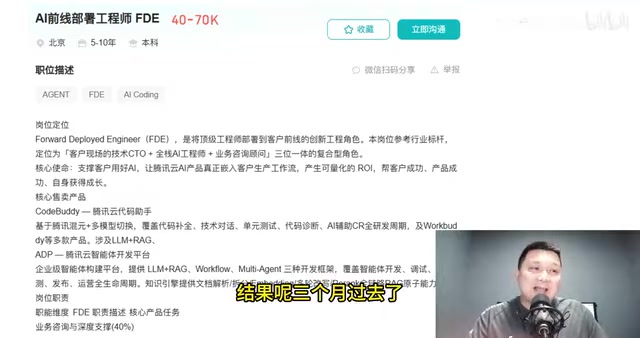
FDE (Forward Deployed Engineer), pioneered by Palantir, is the most sought-after role in the AI deployment era—combining a technical CTO, full-stack AI engineer, and business consultant. This article breaks down FDE's two tracks (ECHO and deployment engineer), core competencies, and how ordinary people can transition into one.
A New Recruiting Buzzword on the Rise: FDE
Workplace competition keeps intensifying, yet a new species has quietly emerged in the job market—commanding absurdly high salaries and in fierce demand. Those three letters are FDE.
FDE stands for Forward Deployed Engineer. This concept was first systematically formulated and put into practice by the Silicon Valley data analytics company Palantir. Palantir Technologies was founded in 2003 by Peter Thiel, Alex Karp, and others. Its origins are closely tied to the deep dilemmas facing the U.S. intelligence community after the September 11, 2001 attacks—at the time, the core challenge intelligence agencies faced was not a lack of data, but the inability to effectively integrate and analyze massive amounts of intelligence. There was a key structural reason behind this: agencies like the CIA, NSA, and FBI each maintained separate databases using incompatible data standards, creating severe "silo effects" that prevented valuable intelligence leads from flowing across agencies.
Building on the fraud detection algorithms PayPal developed in its early days, Palantir creatively migrated them to the intelligence analysis domain and built Gotham, an early core product capable of integrating multi-source heterogeneous data, initially taking on intelligence analysis projects for the CIA. Notably, Gotham was designed specifically for intelligence analysis, supporting cross-agency graph correlation and time-series analysis. Its subsequent product, Foundry, introduced the concept of "Ontology," mapping raw enterprise data into semantic objects that business users could directly understand—fundamentally solving the dilemma of "data that is visible but unusable"—and was purpose-built to handle the massive heterogeneous data integration needs of large enterprises.
It was precisely this highly customized, security-sensitive customer base that gave rise to the prototype of the FDE model—engineers had to hold security clearances and travel to military bases or government intranet environments to work, in order to truly understand the decision-making logic behind the data. It's worth noting that these customers' data often resided in physically isolated intranets (air-gapped networks)—meaning internal network environments completely physically disconnected from the internet and other external networks, commonly found in high-security settings such as military command systems and nuclear power plant control networks.
The security model of such networks is built on the foundation of "zero trust in external connections," typically achieving controlled one-way data ingestion through data diodes, dedicated hardware transfer devices, and similar mechanisms. The Stuxnet worm that destroyed Iran's nuclear centrifuges in 2010 was only able to penetrate such isolated systems by infecting USB drives—revealing that supply chain attacks and human factors remain the primary threat surface for such systems. This also means engineers working within them must pass rigorous security clearance reviews; the highest-level TS/SCI clearance vetting process can take as long as 18 months, making certified holders extremely scarce in the job market. Because there is no network connection channel whatsoever, all modern software delivery methods—remote access, cloud deployment, API calls—completely fail. Every system update, debugging session, and troubleshooting effort must also be completed physically on-site. This dictates, at the technical architecture level, that "people follow the system" is the only viable delivery method.
Palantir thus pioneered a profound delivery philosophy: engineers are not merely people who write code, but ambassadors on the ground who understand the language of business and seamlessly integrate complex analytical systems into clients' decision-making processes—a philosophy that also became Palantir's most core competitive advantage. When deploying complex data systems for the U.S. government, military, and large enterprises, Palantir discovered that a purely remote delivery model simply could not work—clients' real needs were buried in the details of daily operations and could only be uncovered by going deep to the front lines. Palantir therefore dispatched its top engineers directly to client sites to work shoulder-to-shoulder with business teams for weeks or even months.
This model was later widely borrowed and evolved by a new generation of AI companies such as Anduril and Scale AI. Anduril Industries, founded by Palmer Luckey, focuses on defense technology; its FDE engineers are typically stationed at U.S. military bases, responsible for real-time integration of hardware systems like autonomous drones and border sensors with AI decision-making software. Scale AI, which started in data labeling, has an FDE team (internally called "Solutions Engineers") that dives deep into client data pipelines, transforming raw business data into high-quality datasets ready for model training—extending the FDE model from "consulting + deployment" to "data closed loop + continuous iteration." As the wave of large-model deployment spread to the Chinese market, this model has also been widely adopted by domestic AI companies.
But don't be misled by the word "engineer"—this isn't a role of sitting at a desk quietly writing code. By industry definition, an FDE is "an innovative engineering decision-maker deploying top engineers to the client's front lines," essentially a three-in-one hybrid role: a technical CTO at the client site + a full-stack AI engineer + a business consultant.
Why has this role suddenly become so scarce? The answer lies in the widespread predicament of AI deployment today.
AI Isn't Incapable of Working—It Just Doesn't Know What Work to Do
Here's a real case. An online education company spent nearly a million yuan integrating multiple large-model APIs to launch features like intelligent question generation and automated grading. Three months later, the business department reported: teachers were still exhausted, students still couldn't focus on learning, and conversion rates hadn't budged an inch.
A large-model API (Application Programming Interface) refers to vendors such as OpenAI, Anthropic, Baidu ERNIE, and Alibaba Tongyi opening up the capabilities of their trained large language models externally in the form of interfaces. Enterprises can obtain capabilities like text generation, comprehension, and reasoning simply by calling the interface, without needing to train models themselves. This dramatically lowered the barrier to using AI, but it also spawned a large number of projects that "pile up features" rather than "create value."
The root of the problem lies in the structural limitations of large models: current mainstream large language models are based on the Transformer architecture proposed by Google Brain's team in the 2017 paper "Attention Is All You Need." The architecture's core innovation, the "self-attention mechanism," allows the model, when processing a word at any position in a sequence, to simultaneously reference information from all other words in the sequence and dynamically allocate "attention weights," thereby capturing complex long-range semantic dependencies—a mechanism that solved the vanishing gradient problem that plagued the earlier RNN architecture when handling long sequences, while naturally supporting large-scale parallel computation and laying the foundation for the large-scale training of models like GPT and LLaMA.
It's worth noting that although the self-attention mechanism is powerful, its computational complexity grows quadratically with sequence length (O(n²)), which is the fundamental reason for the limited context windows of early models. Subsequent research, through optimizations like Flash Attention and sparse attention, expanded context windows from the early 2K tokens to 128K or even millions. Yet the structural problems of "knowledge cutoff" and "private data blind spots" were not thereby resolved—instead, they became more prominent as demand for enterprise-grade deployment grew. This also dictates several unavoidable limitations: once training is complete, model parameters are frozen, and knowledge is cut off at the timestamp of the training data; the model lacks the ability to actively perceive its external environment and cannot autonomously obtain real-time enterprise data; and pre-training corpora consist mainly of public text, with enterprises' internal private processes, proprietary terminology, and organizational culture almost entirely absent. These limitations are not engineering bugs but structural characteristics of the current architecture, requiring supplementary technologies to compensate.
Technologies like RAG (Retrieval-Augmented Generation) and Fine-tuning can address this deficiency to a certain extent, but the two have fundamentally different applicable scenarios. RAG works as follows: when a user asks a question, the system first retrieves the most relevant content fragments from the enterprise's private document repository via a vector database (such as Pinecone, Milvus, or Chroma), then injects these fragments as context into the model's prompt, letting the model "reference" the latest enterprise knowledge when answering. The core of a vector database is converting text into high-dimensional dense vectors via an embedding model, then achieving millisecond-level semantic retrieval through approximate nearest neighbor algorithms (ANN, such as HNSW); the trade-off between retrieval recall and precision, as well as the design of chunking strategies and re-ranking modules, all directly affect the final generation quality. RAG is suited for scenarios where knowledge is frequently updated and specific sources need to be cited, such as FAQ knowledge bases, contract review, and internal policy queries.
Fine-tuning, on the other hand, performs a second round of gradient descent updates on the pre-trained model's parameters using thousands to tens of thousands of domain-specific data points, causing the model to "internalize" a specific style, format, or specialized knowledge. The core idea of the parameter-efficient fine-tuning technique LoRA (Low-Rank Adaptation) is: assuming the model weight update matrix is low-rank, it approximates the full weight update using the product of two small matrices, reducing the number of trainable parameters to 0.1%-1% of the original. This significantly compresses GPU memory requirements and training time, giving small and medium-sized enterprises a degree of model customization capability. Fine-tuning is better suited for vertical scenarios with fixed-format outputs and high specialization, but offers lower flexibility for knowledge updates. In actual projects, an FDE often needs to make comprehensive judgments based on the client's data scale, update frequency, budget, and latency requirements—and may even use both technologies together—first fine-tuning to lock in output style, then adding RAG to supplement real-time knowledge. Judging which technical path best fits the client's specific business scenario, rather than blindly applying the latest technology, is precisely what distinguishes an FDE from an ordinary engineer. Getting the interface working is only the first step; the real challenge lies in how to deeply bind the model's capabilities to specific business decision-making chains.
Where's the problem? AI can grade assignments, but after grading it only gives a score and doesn't tell the student "why they got it wrong"; AI can act as a teaching assistant, but when a student asks "how should I study," it just throws out a pile of generic advice—effectively giving nothing. The tech side feels wronged: "The interfaces are working fine, all the features are implemented."
This is the most awkward truth right now: AI is no longer a question of whether it can do the work—it's that it doesn't know what work to do or how to do it well.
Imagine you hired an all-powerful super intern—able to analyze data, write code, write copy, and make graphics. But can it help the company boost revenue? It's stumped. Because it doesn't know where revenue is getting stuck: is it insufficient sales leads, low conversion rates, churning existing customers, or a pricing problem?
This critical information isn't in any document or database. It's held by the operations colleague working overtime into the night, buried in every reply from customer service, hidden in the behavior of users who paid but churned within three days. AI can't see these things because it hasn't worked a single day at a desk, hasn't attended a single meeting with the business department, and hasn't sat through the boss's gut-feel decisions.
The person who can translate business problems into technical requirements and make AI hit business pain points precisely—that is the truly scarce species. And that person is the FDE.
The Two Directions of FDE: ECHO and Deployment Engineer
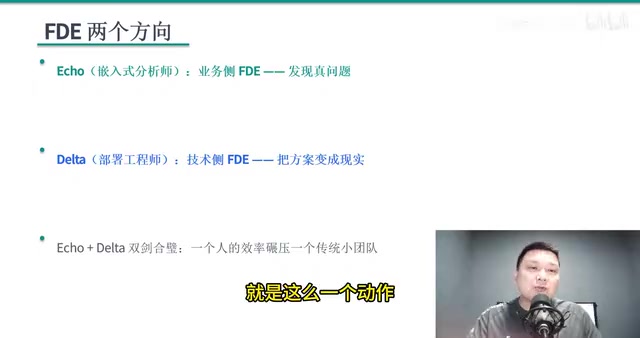
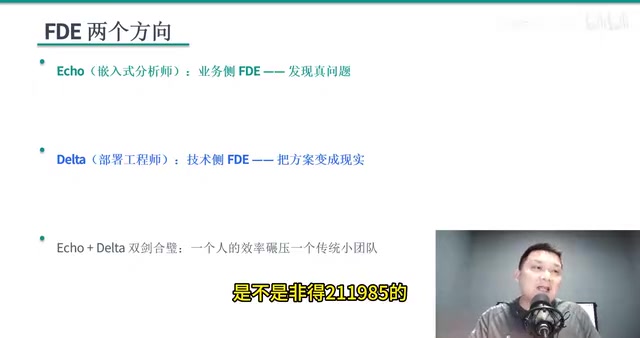
An FDE doesn't do everything single-handedly. The mainstream industry splits it into two directions.
Embedded Analyst (ECHO): Handling the Business Side
ECHO is the person who dives deep into the business. They accompany sales on client visits, sit beside operations to observe daily work, and comb through client chat logs to identify the most frequently asked questions. Their task is singular: to find the entry point where "AI, once deployed, can deliver significant returns."
For example: a community group-buying company where the operations team manually processed order tallies for hundreds of WeChat groups every day, with one person working until the early hours. After bringing in ECHO, they spent three days inside the groups and discovered that 80% of the repetitive questions fell into just three categories—checking order status, changing delivery times, and refunding price differences.
Deployment Engineer: Handling the Technical Side
The deployment engineer is responsible for turning the solution ECHO found into a system that actually runs, scales, and can be maintained. Against the backdrop of the current explosion of AI tools, almost no one builds wheels from scratch anymore—they're more like a "master assembler of AI capabilities," using the Vibe Coding development paradigm to combine large models, rule engines, traditional scripts, and even human fallback steps like building with Lego.
Vibe Coding is a development paradigm formally proposed by Andrej Karpathy (former Tesla AI director and OpenAI co-founder) in early 2025. This paradigm is built on a historical inflection point where the capabilities of code generation models underwent a qualitative leap: reasoning-enhanced large models represented by OpenAI's o1/o3 series and Anthropic's Claude 3.5/3.7 Sonnet have seen a qualitative change in their performance on SWE-bench. SWE-bench, released by a Princeton University research team in 2024, contains 2,294 GitHub issues from 12 real open-source Python projects, each accompanied by test cases as a verification standard—it tests "end-to-end engineering task completion capability" rather than isolated code generation. Models must understand the context of large codebases, locate the root cause of problems, generate patches, and pass tests, closely aligned with the daily work of real engineers. Top models' scores on this benchmark jumped from less than 5% to over 50%, meaning models can now independently complete moderately complex engineering tasks.
IDEs deeply integrated with large models, such as Cursor and Windsurf, support "conversational codebase-level refactoring" through a "codebase indexing + multi-file awareness" architecture. Developers can describe their intent in natural language, and the AI automatically identifies relevant files in the codebase and modifies them in batches, enabling AI to perform cross-file refactoring in real projects spanning hundreds of thousands of lines of code. Its core philosophy is "fully trust AI-generated code; developers only need to describe intent and verify results," enabling even people with basic programming literacy—but who are not professional engineers—to build a functional prototype system within a few days.
In actual deployment, deployment engineers also make extensive use of low-code and no-code platforms, such as domestic options like Chuanyun and Jiandaoyun, and international ones like Retool, Bubble, and n8n—these tools allow rapid construction of business systems by dragging and dropping components and configuring parameters, compressing prototypes that once required weeks of development into a matter of days. Combined with the Vibe Coding paradigm, an FDE can showcase an interactive demo the day after discussing requirements with a client, compressing the traditional software consulting waterfall process of "requirement confirmation → design → development → testing → demonstration"—which spans weeks—into a closed-loop validation of just a few hours, dramatically shortening the business validation cycle. This is precisely the underlying reason why the FDE role has relatively relaxed educational-background requirements, while execution speed and business understanding are far more critical.
Back to the example above: ECHO said they needed to automatically handle the three categories of questions, and the deployment engineer had to solve—how to identify which category a user's message falls into? How to integrate with the order system API? How to verify permissions? Should human intervention be added when AI misidentifies something? Would the system's daily request volume cause timeouts?
The final result: the operations team saved half their manual hours every day, and customer complaint rates dropped by 50%. ECHO probes forward into the business while the deployment engineer backs it up with technology—each is formidable on their own, and together they deliver a dimensional strike.
How Can an Ordinary Person Transition into an FDE?
Many people's first reaction is: don't you have to have a computer science master's or PhD from a top school?
The answer is: no. The most sought-after FDEs in the industry today often don't come from a pure technical background.
Some studied marketing, worked in operations for two years, then self-taught the basics of MySQL and Python, followed by systematically learning AI deployment methodology. They now serve as an FDE at a SaaS company with an annual salary that can reach 600,000 yuan. It's worth understanding the business logic of SaaS in depth here: SaaS (Software as a Service) refers to a business model that delivers software via the cloud on a subscription basis, with representative companies like Salesforce, DingTalk, and Feishu. SaaS companies generally adopt a "Land and Expand" growth strategy: acquiring customers at low cost (Land), then expanding contract scale by continually deepening customer use cases (Expand).
The core health metric of the SaaS business model is NRR (Net Revenue Retention)—it measures the net revenue growth rate that the existing customer base delivers through expanded usage and upsells, after deducting churn. An NRR above 100% means that even if customer acquisition stops, the company's revenue continues to grow; top SaaS companies like Salesforce and Snowflake have long maintained NRR in the 125%-140% range, fundamentally because customers continually expand their depth of usage. Research in the Customer Success field shows that achieving the "First Value Moment" within 90 days of a customer going live is the strongest predictor of the 12-month renewal rate—an FDE's ability to rapidly deploy on-site is essentially about competing for this critical time window. Industry data shows that the cost of acquiring a new customer is typically 5-7 times that of retaining an existing one, making "keeping customers continually perceiving value" a life-or-death proposition for SaaS companies.
The role an FDE plays in this: by continually discovering new AI application scenarios in the client's business and rapidly deploying them, they continually reinforce the client's depth of dependence on the product—once a key business process relies on the AI system to operate, the cost of migration rises sharply—while the deployment of new scenarios naturally drives continued usage expansion, directly propelling "Expansion Revenue" and reducing the risk of customers churning because they "can't perceive value." This also explains why SaaS companies are willing to pay FDEs salaries significantly higher than ordinary engineers.
There's market logic behind FDEs' high salaries: according to data from multiple domestic recruiting platforms, FDEs with 1-3 years of relevant experience generally earn between 400,000 and 800,000 yuan annually, while senior FDEs at leading AI companies can reach the million-yuan level. The salary premium stems from two core factors: the extreme scarcity of talent that possesses both business insight and AI engineering capability, and the fact that an FDE's output value is directly quantifiable (customer renewal rates, project implementation cycles, business metric improvements), making it easy to tie to performance. The reason is simple: they understand users so well that a single glance at operational data tells them where the problem is—AI is just a tool in their hands.
The Three Core Competencies of an FDE
- Questioning ability: Can they probe deeper into "why do we need this feature" and "what is the client's real usage scenario"?
- Decomposition ability: Can they break a vague goal like "increase conversion rate" into three actionable sub-problems: first-order conversion, repurchase conversion, and average order value?
- Execution ability: Can they, within three days, quickly stitch together a demonstrable prototype using AI tools, Python scripts, or low-code platforms, letting the business side intuitively see the results?
Conclusion: The Era of Real Problem Solvers
The rise of the FDE fundamentally reflects the AI industry's deep shift from "capability stacking" to "value delivery." When large-model APIs are readily available, the true moat is no longer the technology itself, but the ability to precisely connect technology to business pain points.
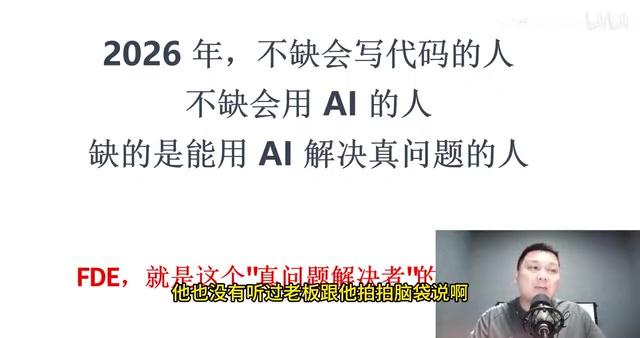
There's no shortage of people who write code, no shortage of people who can use AI—what's lacking are people who can use AI to solve real problems. And the FDE is the clearest professional definition of this "real problem solver."
Key Takeaways
Related articles

GPT-Next Leak, Gemini 4 Argon Imminent: AI News Roundup
GPT-Next leak suggests extreme efficiency; OpenAI's 28-day shipping pledge boosts speed 50%; Gemini 4 Argon nears release; Anthropic subscription value report sparks debate.

GPT-Next Leaked, Gemini 4 Argon Speeds Up, Fable 5.5 May Launch Today
OpenAI's GPT-Next model leaks, expected to be extremely low-cost and possibly part of the 28-day release plan; Gemini 4 Argon internal testing accelerates, NanoBanana 2.1 is live; Semi Analysis tests show Claude Max's equivalent API value is about 5 times that of ChatGPT Pro; Fable 5.5 may launch today.

Gemini 4 Argon Launches Globally: Key Highlights from the AI Daily Brief
Google opens Gemini 4 Argon globally across Pro and Ultra subscriptions and the API, and demonstrates robot control. This article rounds up open-source models, Agent infrastructure, cost transparency, and safety governance updates.