What Is Loop Engineering? A Full Breakdown of AI Agent Automated Workflows

Loop engineering uses a system to drive an agent's goal-action-observation-adjustment loop automatically, while humans set goals and verify results.
The article introduces loop engineering, an emerging concept in AI development viewed as an upgrade to prompt engineering: instead of writing prompts one by one, humans build a system where an agent iterates automatically through a four-stage goal-action-observation-adjustment loop until the task is done. What truly needs engineering are the components around the loop—triggers, context management, a persistent trunk, an MCP-based tool access layer, and an independent sub-agent inspector. The article stresses that minimizing human intervention isn't zero intervention: humans must define verifiable goals with stopping conditions, record intent, and continuously verify output, or comprehension debt and intent debt accumulate, leading to cognitive surrender.
Title
What Is Loop Engineering? A Full Breakdown of AI Agent Automated Workflows
Meta Description
What is loop engineering? This article explains how AI agents build automated workflows through goal setting, action-observation loops, context management, MCP tool calls, and sub-agent verification, and analyzes human-in-the-loop pitfalls like comprehension debt, intent debt, and cognitive surrender.
Article Content
Prompt engineering hasn't cooled off yet, but a new concept is already quietly emerging in AI development circles—Loop Engineering. Many see it as an upgraded version of prompt engineering: rather than agonizing over writing one perfect prompt, you design a system that lets an AI agent run on its own within a closed loop of goals, actions, observations, and adjustments.
This idea comes from a popular science video by a Bilibili creator. The core point is clear: the loop itself has only four stages and isn't complex. What truly deserves engineering effort is the entire set of components built around the loop, and the responsibilities humans cannot relinquish within it. Let's break it down layer by layer.
From Prompt Engineering to Loop Engineering: A Shift in Thinking
The prompt engineering paradigm is "a human writes one perfect prompt → the model returns a result → the human writes the next prompt," with the human always driving the loop. Loop engineering hands the driving power to the system: assign a task to the agent, the system checks its work output, then automatically sends it the next prompt, repeating until completion, with human intervention reduced to an absolute minimum.
Take the example from the video: a settlement service has a bunch of failing unit tests, and the task is to make them all pass. The loop starts here—the agent opens files and modifies code (action), runs tests and observes output (observation), and decides the next step based on results (adjustment). If a test turns green, it moves to the next one; if it's still red, it tries a different fix and goes another round. This four-stage closed loop of "goal—action—observation—adjustment" really is too simple to look like a "discipline."
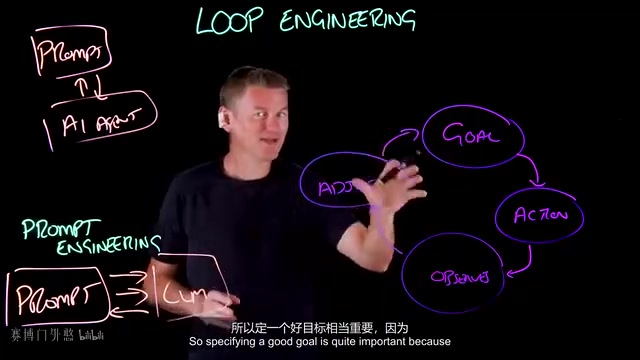
A Good Goal Is the Loop's Anchor
Every time the loop turns, the goal is re-evaluated, and it directly determines whether the agent continues or stops. So the goal must be verifiable and have a stopping condition. "Make settlement faster" is a classic bad goal—there's no measurable criterion, so the agent might loop forever, or it might run one round and declare victory. "Stop when every unit test in the settlement suite passes" is a good goal, because the agent can clearly judge whether it's been achieved.
This seems basic, but it's the precondition for whether the entire loop can converge. A loop with a vague goal drifts further off the faster it runs.
The Engineering Components Around the Loop
What really justifies the word "engineering" is the infrastructure outside the loop.
Triggers: Letting the Loop Start Itself
The loop needs a starter. The most common is scheduled execution, such as running a settlement loop once every night, which many teams can implement with traditional cron jobs. Another is event-driven hooks—automatically triggered when specific events occur, like file changes or pull request creation. The video mentions that developers mainly use hooks in security and quality scenarios, such as enforcing policies.

Context Management: Fighting Information Accumulation
Each turn around the loop generates new context—test output, file contents, logs—piling up more and more, diluting the agent's attention. What context engineering must solve is "which content actually gets fed to the loop." Techniques include compression and progressive disclosure (similar to the agent skills approach: writing instructions for how to do a recurring task and expanding them on demand).
Progressive disclosure is borrowed from interaction design and documentation writing: rather than handing all information to the user at once, you give a summary first and expand details layer by layer as needed. In the agent context, its typical form is "Agent Skills": the complete operating instructions for a certain type of recurring task are written as a standalone document, with only a brief index kept in the main prompt, and the full text is read when the loop actually encounters that task. The benefit is that each round's context window carries only the information necessary for the current decision, preventing long-tail content like test logs and history from crowding out attention. The accompanying compression technique summarizes or trims existing context; one "fetches on demand," the other "slims down afterward," and together they fight the problem of information expanding linearly with each loop iteration.
The Trunk: Persistent Memory
The video calls one kind of persistent state within the loop the "trunk"—possibly a few markdown files where the agent records what it did and whether it succeeded. These records provide reference for subsequent iterations: what worked, what might not. Without it, the agent gropes around in an amnesiac state every round.
Here the "trunk" corresponds to what the agent field often calls external persistent memory (external memory / scratchpad), distinct from the implicit knowledge in model weights and the context window of a single conversation. Storing state in plain text forms like markdown files has several practical advantages: humans can read and edit it directly, facilitating auditing; it doesn't depend on any specific vendor's storage interface and can be version-controlled; and when problems arise, you can trace back the decision basis for each round. It's complementary to context management—the trunk is responsible for "what to remember," while context management is responsible for "what to feed this round"; the former is a full archive, the latter is on-demand retrieval. Without persistent memory, an agent in multi-round loops easily repeats the same mistake, or loses early conclusions in the later stages of long tasks.
Tool Access: Connecting to the Outside World
The action stage often needs to call external resources, achieved through tool access—using standards like MCP (Model Context Protocol), or going directly through APIs for tool calls. Executing code, accessing the file system, running commands in the terminal, and querying databases all belong to this layer.
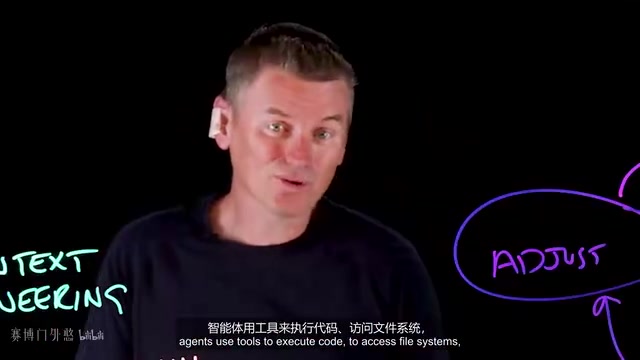
MCP (Model Context Protocol) is an open standard introduced by Anthropic at the end of 2024, aiming to unify how large language models connect to external tools and data sources. Before MCP, each tool integration (database, file system, third-party API) often required a custom integration codebase, creating N×M repetitive adaptation work among model vendors, tool providers, and developers. MCP standardizes this adaptation layer with a client-server architecture: tool providers implement an MCP server to expose capabilities, and the agent side acts as a client calling according to a unified protocol, achieving integrate once and reuse everywhere. It doesn't conflict with traditional function calling—the latter leans toward structured output within a single request, while MCP focuses on a long-term, discoverable, composable tool ecosystem. For loop engineering, the significance of standards like MCP is that capability expansion in the action stage doesn't require rewriting glue code every time.
Sub-Agents: Independent Inspectors
Having the same agent that writes code check its own code has limited effect. Loop engineering's approach is to introduce a second agent as an inspector and colleague, which can have its own instructions, its own limits, and possibly a different underlying model from the main agent, sending results back after verification. This "separation of writing and review" structure is a key link in the loop's credibility.
The Human's Place in the Loop: Four Pitfalls
Even if the loop is built as completely as possible—with triggers, inspectors, and a trunk—it still needs human participation. The video's author emphasizes that humans in the loop are the means to avoid the most dangerous pitfalls of automated code generation, and lists four of them.
Unverified code. The inspector sub-agent is, after all, just an agent, and responsibility for shipping code ultimately rests with human developers. A real person must read and verify the code.
Comprehension debt. The gap between the total amount of code in the system and the degree to which humans truly understand it is comprehension debt. The more the agent writes and the less humans review, the faster this debt grows. It comes due all at once when you need to handle an urgent production incident or plan an architectural migration.

Intent debt. The agent knows what the system does, but struggles to understand why it does it—unless this is written down, such as in architecture documents. Without intent records, the agent may make changes that are technically impeccable but violate project goals. The video's example is typical: the agent fixes a test by loosening the discount code validation rules—a perfect fix from the test's perspective, but terrible from a business standpoint.
Cognitive surrender. The most insidious and dangerous one: humans blindly accept whatever the loop produces—"if AI made it, it must be right." Once this happens, comprehension debt climbs further, because no one even tries to understand the AI-generated content anymore.
So "minimizing human intervention" doesn't equal "zero intervention." The video's conclusion is: humans need to write goals with stopping conditions, write down intent and place it where the agent can find it, and continuously read the agent's output. Do these three things, and loop engineering can deliver its best results.
Summary
Loop engineering is less a new technology than a re-division of labor in how we work: hand mechanical prompt iteration to the system, and leave goal definition, intent recording, and result verification to humans. Anyone can build the four-stage loop, but the quality of the combination of triggers, context, trunk, tools, and sub-agents—and whether humans hold the bottom line of verification—determines whether this loop is boosting efficiency or manufacturing debt.
Will you design agent loops in your own workflow?
One-line Summary
Loop engineering uses a system to automatically drive an agent's goal—action—observation—adjustment loop, while humans set goals and verify results.
Paragraph Summary
The article introduces a concept emerging in AI development circles—loop engineering—viewing it as an upgrade to prompt engineering: instead of writing prompts one by one, humans build a system that lets an agent iterate automatically in a four-stage loop of "goal—action—observation—adjustment" until the task is complete. The four stages themselves aren't complex; what truly needs engineering is the components around the loop: triggers that start it, context management that fights information accumulation, a persistent trunk that records experience, a tool access layer based on standards like MCP, and an independent sub-agent inspector responsible for separating writing from review. The article also emphasizes that minimizing human intervention doesn't mean zero intervention: humans must define verifiable goals with stopping conditions, record intent, and continuously verify output—otherwise comprehension debt and intent debt accumulate, ultimately leading to cognitive surrender.
Related articles

Don't Rush AI to Write Code: 4 Skills That Turn Design into Executable Tasks
A 20-year veteran engineer explains why AI coding means humans should focus on design and planning, not code. Use architecture.md to anchor architecture with four skills—design, architecture review, HTML docs, and planning—to turn technical plans into executable tasks and improve software quality.

The Early History of the AI Revolution: Google, Musk, and the Race That Changed Everything
From Google's DeepMind acquisition to ChatGPT's surprise breakout, The Vergecast and Kevin Roose's new book reveal the early decisions that changed AI forever.

Gmod TTT in Horror Mode: Vampires and Werewolves New Roles Tested
Yogscast Halloween Gmod TTT special: Vampire conversion, Werewolf silver-bullet weakness, Frenchman wall-penetrating baguette kills, and role draft strategy shifts—plus balance feedback from the match.