What Is Meta-Harness? Unpacking the Battle of AI Evaluation Frameworks

Meta-Harness emerges as a framework-of-frameworks to unify and standardize fragmented AI model evaluation.
As AI evaluation benchmarks and frameworks proliferate, the industry faces severe fragmentation, reproducibility crises, and scaling challenges. Meta-Harness represents a higher-level abstraction layer that manages, coordinates, and ensures comparability across multiple evaluation frameworks. This evolution mirrors CI/CD tooling maturation in software engineering and signals AI evaluation's transition from artisanal to industrial-scale infrastructure.
Introduction: When Evaluation Tools Themselves Need Evaluation
In the AI field, model benchmarking has always been a critical component for measuring technological progress. From MMLU to HumanEval, from GPQA to ARC, various evaluation benchmarks continue to emerge. However, a noteworthy trend is surfacing—we're entering the "Meta-Harness Summer," where frameworks for managing evaluation frameworks are becoming the new focal point.
The benchmarks mentioned above each have distinct focuses: MMLU (Massive Multitask Language Understanding) covers knowledge comprehension across 57 subjects; HumanEval focuses on functional correctness of code generation; GPQA (Graduate-Level Google-Proof Q&A) tests graduate-level reasoning ability with questions designed to be unsolvable through simple search; and ARC (AI2 Reasoning Challenge) targets scientific commonsense reasoning. These benchmarks characterize model capabilities from different dimensions, but their execution methods, scoring criteria, and implementation details all differ—which is precisely why evaluation frameworks exist.
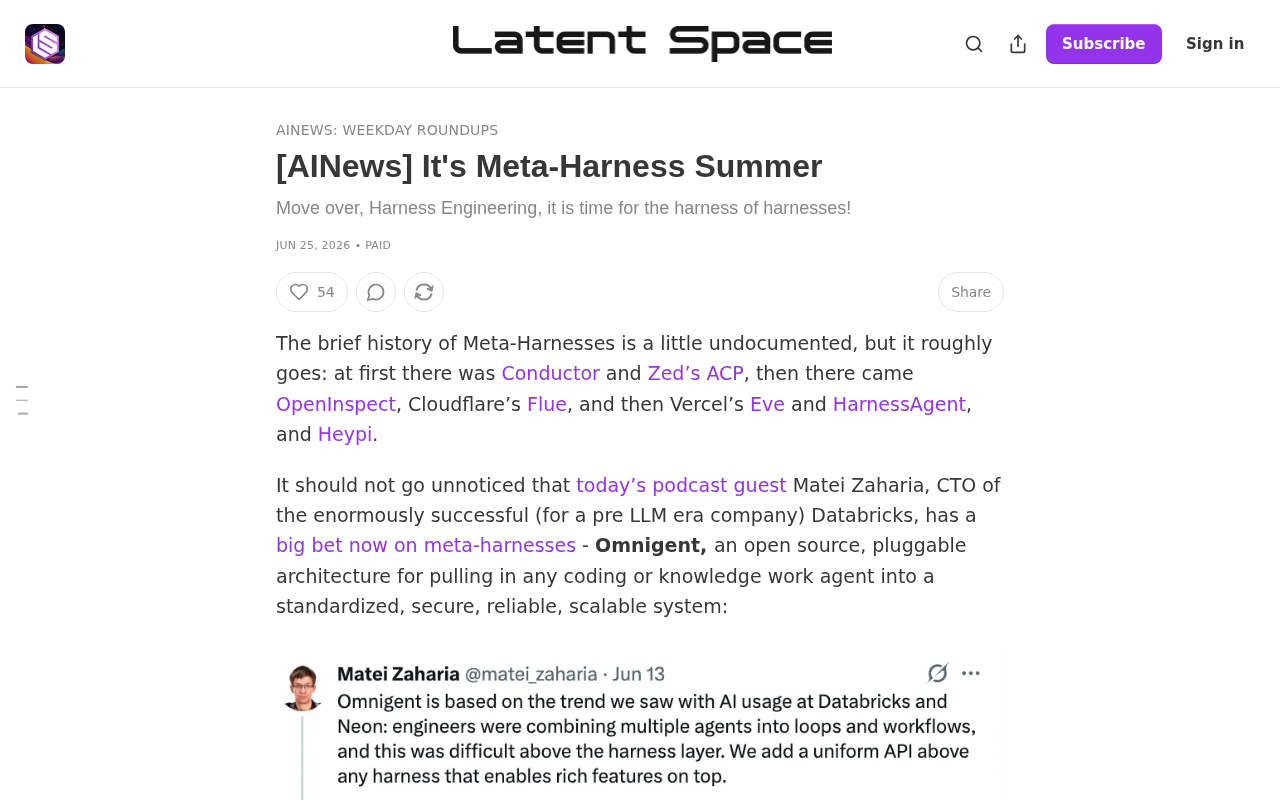
What Is Meta-Harness?
The Evolution from Harness to Meta-Harness
"Harness" in the AI evaluation context refers to engineering frameworks used to run and manage model evaluations. The most well-known example is EleutherAI's Language Model Evaluation Harness (lm-eval-harness), which provides researchers with a unified interface to evaluate language models across various benchmarks.
The core design philosophy of lm-eval-harness is to decouple the evaluation process into several independent modules: task definition, model API adapter, prompt template, and metric computation. By defining evaluation tasks through YAML configuration files, researchers can quickly combine different benchmarks and output results in a unified format. To date, the framework supports over 400 evaluation tasks, spanning from basic language understanding to complex reasoning. It also serves as the core evaluation engine behind the Hugging Face Open LLM Leaderboard.
"Meta-Harness" represents a higher level of abstraction—it's a system for managing, coordinating, and comparing multiple evaluation frameworks. When the number of evaluation benchmarks explodes and implementation differences between frameworks lead to irreproducible results, a unified upper-layer management tool becomes indispensable. Meta-Harness needs to address not just "how to run evaluations," but the fundamental question of "how to ensure that evaluation results across different frameworks, different points in time, and different hardware environments are comparable."
Why Do We Need Meta-Harness Now?
The current AI evaluation ecosystem faces several core problems:
-
Severe Fragmentation: Different organizations use different evaluation frameworks, and even for the same benchmark, differences in implementation details can lead to inconsistent scores. For example, for the same MMLU question, different frameworks might use different prompt templates ("Answer:" vs. "The answer is:"), different orderings of few-shot examples, different tokenization approaches (whether to add a space before options), or even different probability calculation methods (comparing probabilities of complete option text vs. only the first token). These seemingly minor differences can cause 3-5 percentage point score fluctuations for the same model on the same benchmark.
-
Reproducibility Crisis: Scores reported in papers are often difficult for third parties to reproduce, as details like prompt format and few-shot example selection have enormous impact on results. Multiple studies in 2023 showed that merely changing the few-shot example selection strategy could cause model performance to fluctuate by more than 10% on certain tasks. Even more problematic, many papers don't fully disclose all evaluation configuration parameters—sampling temperature, top-p values, maximum generation length, batch size, and other hyperparameters can all affect final results but are often dismissed as "unimportant engineering details."
-
Scaling Challenges: As the number of models and evaluation benchmarks grow simultaneously, manually managing evaluation workflows becomes unsustainable. Leading labs today may release multiple model variants per month, while the benchmarks to cover may number in the dozens, each with multiple configurations (zero-shot, few-shot, chain-of-thought, etc.). This combinatorial explosion makes evaluation itself an infrastructure task requiring dedicated engineering teams.
Industry Impact and Trend Analysis
The Urgent Need for Standardized Evaluation
The rise of Meta-Harness reflects the AI industry's urgent need for standardized evaluation. When companies like OpenAI, Google, Meta, and Anthropic each release models, without unified evaluation standards and execution environments, cross-model comparisons lack credibility.
There have already been important standardization attempts in the industry. Stanford's HELM (Holistic Evaluation of Language Models) project aims to establish a comprehensive evaluation methodology that goes beyond accuracy to systematically assess model calibration, robustness, fairness, and efficiency. Hugging Face's Open LLM Leaderboard provides the community with a relatively trustworthy horizontal comparison platform through fixed evaluation configurations and transparent execution environments. However, these attempts remain independent "evaluation islands," and Meta-Harness envisions building bridges above these islands.
This parallels the evolution of CI/CD tools in software engineering—from single build tools (like Make, Maven), to platforms managing multiple build pipelines (like Jenkins, GitLab CI), to cross-platform DevOps orchestration systems (like Kubernetes, Terraform). Each layer of abstraction emerged because the diversity and complexity of lower-level tools exceeded the limits of manual management. AI evaluation is undergoing a similar maturation process, and Meta-Harness is the next link in this evolutionary chain.
Practical Implications for Researchers and Developers
For AI researchers and developers, Meta-Harness delivers value in three areas:
- Lower Evaluation Barriers: No need to configure environments separately for each benchmark—one framework covers multiple evaluation needs. This means a small research team no longer needs to spend weeks setting up and debugging evaluation pipelines, freeing them to focus on model development itself.
- Higher Result Credibility: A unified execution environment reduces noise from implementation differences, making score comparisons more meaningful. When all models are evaluated under the same prompt templates, sampling strategies, and hardware environments, score differences can truly reflect capability differences rather than engineering implementation differences.
- Better Traceability: Complete records of evaluation configurations and runtime environments facilitate reproduction and auditing. This holds significant importance for peer review of academic papers, enterprise model selection decisions, and regulatory compliance reviews of AI systems.
Outlook: The Future of AI Evaluation Infrastructure
As AI model capabilities continue to advance, evaluation itself is becoming increasingly complex. From simple multiple-choice questions to multi-turn dialogue assessment, from code generation to Agent task completion, the dimensions of evaluation are constantly expanding.
Agent evaluation is one of the most challenging frontier directions today. Unlike traditional single-turn Q&A, Agent evaluation requires models to execute multi-step tasks in complex environments—browsing web pages, manipulating file systems, calling APIs, and even collaborating with other Agents. This type of evaluation needs to judge not only the correctness of final results but also the reasonableness of intermediate steps, efficiency of resource usage, and robustness in the face of anomalies. SWE-bench (evaluating a model's ability to solve real GitHub issues) and WebArena (evaluating a model's ability to complete tasks on real websites) are representative benchmarks in this direction.
The emergence of Meta-Harness signals that AI evaluation is transitioning from a "cottage industry" model to an "industrialized" model. This represents not just an improvement in engineering efficiency, but an important signal that the entire AI research ecosystem is maturing.
In the future, innovation around evaluation infrastructure will likely concentrate in several directions: automated evaluation discovery and configuration, dynamic benchmark generation, and automatic model optimization based on evaluation results. Dynamic benchmark generation is particularly noteworthy—it attempts to address the increasingly serious problem of benchmark contamination. When training data scales reach trillions of tokens, the probability of evaluation questions being included in the training set rises sharply, causing inflated evaluation scores that fail to truly reflect a model's generalization ability. Dynamic benchmarks ensure models cannot have "seen" test questions during training by programmatically generating new questions or extracting test samples from the latest data sources, thereby maintaining evaluation validity.
"Meta-Harness Summer" may be just the beginning of this evaluation revolution. As AI systems are increasingly deployed in critical domains (healthcare, law, finance), reliable, trustworthy, and auditable evaluation infrastructure will no longer be a "nice-to-have" for academia, but a "must-have" for the entire AI industry.
Key Takeaways
Related articles
Codex Security: A Configuration Guide to Automatically Blocking Vulnerabilities at the PR Stage
OpenAI engineers demonstrate Codex Security PR Reviews: automatically scan for vulnerabilities at the GitHub PR stage, have AI generate fix commits and re-verify, with repository-level automatic review and alert threshold configuration.

Daybreak Blue Application and Enablement: Complete Process Guide
Based on the official demo video, this guide details the Daybreak Blue application and enablement process, covering enterprise verification, intended use statements, role permission configuration, user access verification, and API key creation to help cybersecurity teams quickly onboard frontier AI models.
United Airlines Bans AI Agents from Booking Flights, Escalating the Battle Between Airlines and Intelligent Agents
United Airlines bans AI agents from booking flights for travelers, sparking Hacker News debate. This analysis examines channel control, risk logic, the trust gap in the agent economy, and practical impacts on travel AI developers.