What Is Spring AI Alibaba? A Beginner's Guide to the Bridge Framework Connecting Java and LLMs

Spring AI Alibaba is the JDBC-like bridge framework connecting Java microservices to large language models.
This article explains to Java developers why Spring AI Alibaba is worth learning. As LLMs move into enterprise applications, Java microservices and large models — once separate worlds — need to be connected, much like how JDBC bridges Java and databases. Spring AI Alibaba, Spring AI, and LangChain4j all serve this "bridge" role as enterprise-grade Java AI frameworks. Spring AI Alibaba, built by Alibaba on top of Spring AI, is deeply integrated with Alibaba Cloud's Qwen models and the Cloud Alibaba ecosystem, making it ideal for teams already invested in Alibaba Cloud infrastructure.
Why Java Developers Need to Learn Spring AI Alibaba
As large language model (LLM) technology becomes mainstream, Java developers are facing a very practical question: how do you integrate traditional Java microservices with LLM capabilities?
In the past, Java engineers had a relatively focused scope — mastering distributed microservice architecture was enough. That meant knowing the full stack: Redis, MySQL, Spring Cloud, Cloud Alibaba, and so on. On the other side, LLM engineers focused on model training, fine-tuning, deployment, and parameter tuning. The two worlds were separate and self-contained.
But as LLMs move into real-world applications, these two parallel technical tracks need to converge. Enterprises want to empower their traditional Java microservices with LLM capabilities — and that creates a core demand: who builds the bridge between Java and large models?
Understanding Spring AI Alibaba Through the JDBC Analogy
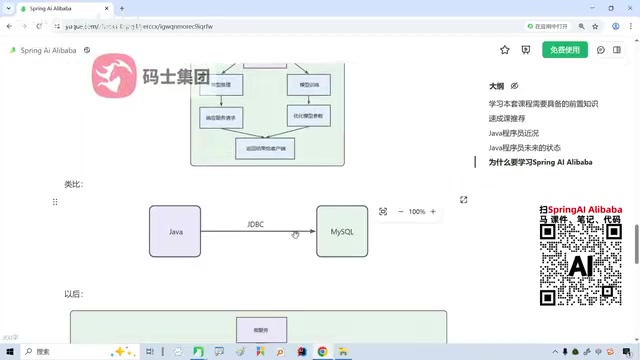
To understand what Spring AI Alibaba does, a fitting analogy is the relationship between Java and databases.
Java and MySQL are two distinct, independent technologies with clearly defined roles. If you want to manipulate MySQL data from Java code, you need a bridge in the middle — the most native option is JDBC, or you can use a framework like MyBatis. Either way, the essence is the same: you need an intermediate technology to connect these two major tech ecosystems.

Apply the same logic to the LLM world: Java microservices and large models are two entirely different systems that run independently. To make them work together, you need a new layer of connecting technology — one that plays exactly the role JDBC plays in the database world.
The analogy goes even further: just as JDBC defines a standard interface for Java programs to access databases, while MySQL Connector and PostgreSQL JDBC Driver are the concrete driver implementations, Spring AI serves as the "standard interface" layer, and Spring AI Alibaba acts as the "driver implementation" targeting Alibaba Cloud's models. Just as ORM frameworks like MyBatis and JPA build higher-level abstractions on top of JDBC to reduce boilerplate code, Spring AI Alibaba similarly wraps higher-order capabilities — such as prompt management, conversation memory, RAG (Retrieval-Augmented Generation), and Function Calling — on top of raw HTTP calls, letting developers focus on business logic rather than the low-level details of interacting with model APIs.
What Exactly Is Spring AI Alibaba?
When it comes to connecting Java with large models, there are currently a few mainstream options in the industry — all serving roughly the same high-level purpose:
- LangChain4j (the Java version of LangChain)
- Spring AI
- Spring AI Alibaba

All three share the same core mission: they act as bridges between Java and large models, connecting the two ecosystems. If JDBC connects Java to MySQL, these frameworks connect Java to LLMs.
You can think of Spring AI Alibaba as a mediator, middleware, bridge, or connector — fundamentally, it's an intermediary that links Java applications to large models and handles the communication and integration between them.

It's worth understanding the clear hierarchy among these three options. LangChain4j is a Java port of the widely popular Python-ecosystem LangChain framework. It operates independently of the Spring ecosystem and is well-suited for Java projects that don't rely on Spring Boot. Spring AI is Spring's official AI integration framework, providing a unified API abstraction layer that connects to multiple model providers — including OpenAI, Azure OpenAI, and Anthropic — so developers can switch models without rewriting business logic. Spring AI Alibaba is Alibaba's extension built on top of Spring AI, deeply integrated with Alibaba Cloud's Qwen (通义千问Ad) model series and related AI services, with extra adaptations for Chinese developers and Alibaba's microservice ecosystem (including Nacos and Sentinel). For teams already running on Alibaba Cloud infrastructure or the Cloud Alibaba tech stack, Spring AI Alibaba delivers the best out-of-the-box integration experience.
The Essence in One Sentence
To sum it up: whether it's Spring AI Alibaba, Spring AI, or LangChain4j, they are all enterprise-grade Java AI application development frameworks.
They exist to solve a specific, well-defined problem: when you want to empower traditional Java microservices with LLM capabilities, you need a technical layer in the middle to integrate the two systems — and these frameworks are the tools built for exactly that job.
For developers already familiar with the Java microservice ecosystem, the learning curve for Spring AI Alibaba isn't steep. Just hold onto the core concept of "bridge," and you'll immediately understand where it fits and why it matters in the AI application development chain. Mastering it means you can smoothly bring LLM capabilities into enterprise-grade applications — right on top of the tech stack you already know.
Related articles

Apple HomeView Hands-On Review: Is the $300 Smart Home Hub Worth It?
Apple HomeView hands-on: a $300 smart home hub with facial recognition for quick account switching, but no App Store or voice recognition. Is the wall-mounted version worth it? Should you buy the first generation?

Meta Muse Wonder Launch: What It Means for Meta's Return to the Frontier AI Race
Meta releases Muse Wonder and WonderFull, benchmarks reach the frontier, community feedback is polarized. An in-depth look at Meta's return to the frontier AI race, its personal agent strategy, and Zuckerberg's different path.

Apple Home Smart Home Lineup Leaked: LG and Schneider Team Up, UWB Door Lock on Board
Apple Home ecosystem gains new LG and Schneider devices: UWB smart lock with proximity unlock, 2.5K dual-camera doorbell, privacy indoor camera, and AirPods-like seamless pairing.