What to Do When Your EMNLP Paper Gets Rejected? Navigating NLP Top Conference Submission Challenges and Strategies for Recovery

A guide to navigating NLP top conference rejections with practical strategies and community support.
Inspired by a Reddit community for EMNLP-rejected researchers, this article examines the intense competition at NLP top conferences, controversies in peer review mechanisms, and the psychological toll on researchers. It offers practical strategies for handling rejection, including analyzing review comments, choosing resubmission targets, leveraging preprints, and building collaborative networks for stronger future submissions.
A Community for the "Rejected"
Recently, a heartfelt post appeared on Reddit — "Crying place for EMNLP rejects." The poster, with a lighthearted and humorous tone, invited researchers whose papers were rejected from the EMNLP conference to gather together: "Welcome everyone to join this club! This is a place to vent about rejection experiences, encourage each other, and come back stronger."
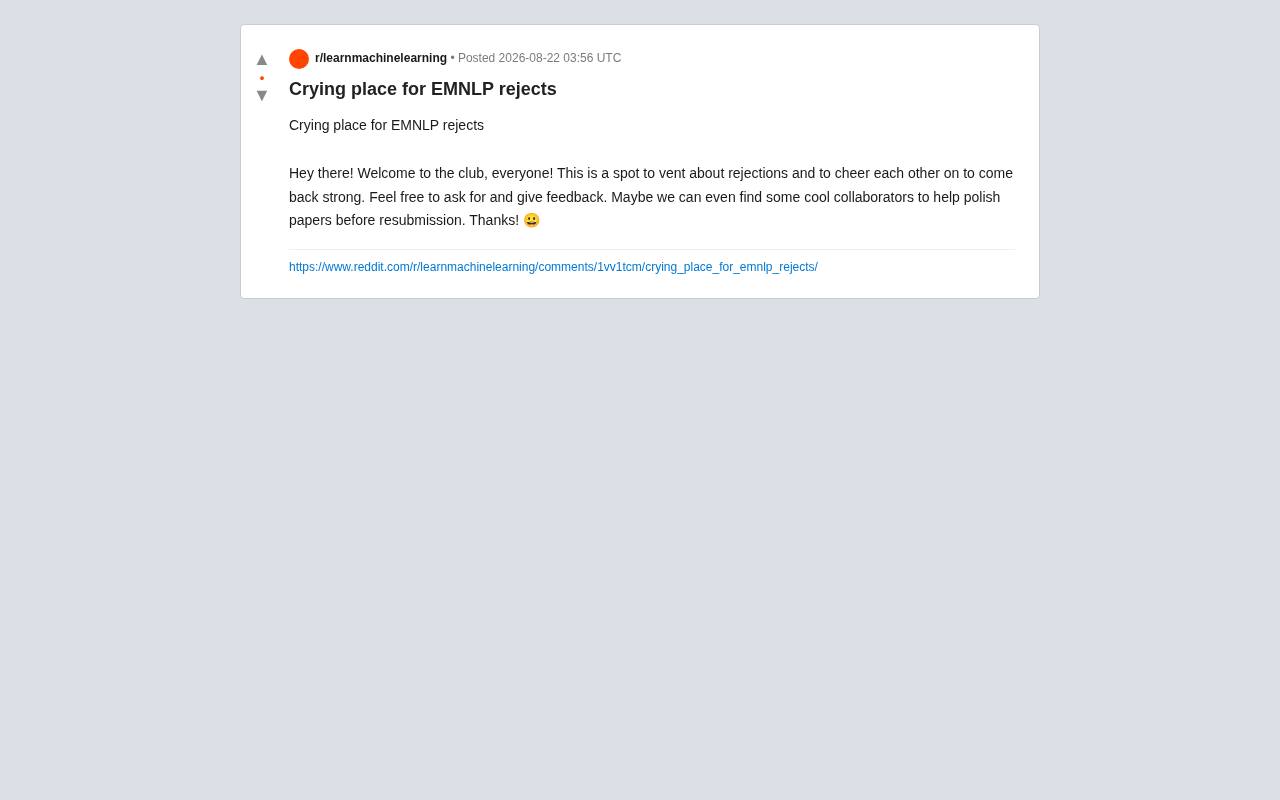
Though brief, the post resonated widely. The poster not only encouraged people to share their experiences but also proposed more constructive ideas: providing mutual feedback, finding potential collaborators, and polishing papers together before resubmission. This atmosphere of collective solidarity reflects a phenomenon in today's AI/NLP academic community that deserves deeper reflection.
How Competitive Is EMNLP Submission?
EMNLP (Empirical Methods in Natural Language Processing) is one of the most influential top-tier conferences in the field of natural language processing, standing alongside ACL and NAACL as the three premier NLP venues. With the explosion of large language models (LLMs), NLP research has experienced unprecedented growth, with submission numbers reaching record highs.
EMNLP is organized by SIGDAT under ACL (Association for Computational Linguistics). Since its inaugural edition in 1996, its academic positioning has consistently emphasized "empirical methods" — validating the effectiveness of language processing technologies through data-driven experiments. Unlike ACL's focus on theory and methodology, or NAACL's emphasis on North American regional research, EMNLP's distinctive character has given it tremendous momentum in the deep learning era. In recent years, with the emergence of Transformer architecture, pre-trained language models, and ChatGPT, EMNLP's submission topics have expanded from traditional syntactic analysis and machine translation to cutting-edge directions such as dialogue systems, code generation, and multimodal understanding. This diversification of tracks also means competition has intensified across the board.
Acceptance Rates Continue to Decline
Recent editions of top conferences like EMNLP routinely receive thousands of submissions, while acceptance rates typically hover around 20% or even lower. This means that even high-quality work may be rejected due to reviewer subjective preferences, overcrowded tracks, or sheer luck. For PhD students and early-career researchers, whether a paper gets accepted often directly impacts graduation, job prospects, and career trajectories.
Controversies Around Peer Review
The academic community has long questioned the peer review mechanism. Limited reviewer time, inconsistent expertise matching, and subjective scoring criteria all mean that "rejection" doesn't necessarily equal "bad work." Many classic papers that went on to be cited thousands of times were rejected upon their first submission. This uncertainty is the deeper reason why this Reddit community struck such a powerful chord.
The peer review system originated in 17th-century scientific journals and serves as a cornerstone of academic quality control. However, in the AI/NLP field, this mechanism faces unprecedented pressure. Take the famous NeurIPS 2021 experiment as an example: the same paper submitted twice received drastically different review outcomes, revealing the high degree of randomness in the review process. Specific issues include: reviewer overload (a single reviewer may be responsible for over ten papers simultaneously), imprecise domain matching (a paper on LLM safety might be assigned to a reviewer specializing in machine translation), and "novelty bias" (reviewers tend to reward novel methods while undervaluing robust incremental improvements). The rise of platforms like OpenReview represents the academic community's attempt to improve review transparency and accountability.
From "Crying" to "Rebuilding": The True Value of a Rejection Community
What's most touching about this post isn't the "crying" itself, but its attempt to transform negative emotions into positive action.
Mental Health Support for Researchers Cannot Be Ignored
Researchers endure enormous psychological pressure. The frustration of paper rejection, if left unaddressed, can accumulate into anxiety or even depression. In recent years, academia has increasingly focused on researcher mental health, and informal communities like this provide a low-barrier emotional outlet — here, everyone understands each other because "we've all experienced the same pain."
This isn't unfounded. A 2018 study published in Nature Biotechnology showed that the proportion of graduate students experiencing moderate to severe anxiety and depression was more than six times that of the general population. In the AI/ML field, this problem is amplified by the "publish or perish" academic culture. The conference-based (rather than journal-based) publication rhythm means researchers face multiple fixed deadlines each year — EMNLP, ACL, NeurIPS, ICML, and other conferences create a high-pressure cycle that runs nearly year-round. Additionally, the paper promotion culture on social media (such as paper threads on Twitter/X) exacerbates comparison anxiety, making rejected researchers feel especially dejected when seeing peers' acceptance announcements. In recent years, top conferences like ICML and NeurIPS have begun establishing mental health-related workshops and support resources, but systematic institutional care remains insufficient.
Shifting from Competition to Collaboration
Even more valuable is the poster's suggestion to "find collaborators and polish papers together." This represents a shift from zero-sum competitive thinking to collaborative win-win thinking. In traditional perception, researchers are competitors; but in today's era of information explosion and overcrowded tracks, open peer feedback and cross-institutional collaboration may actually be effective paths to improving paper quality and breaking through personal limitations.
The Reddit "rejection community" is not an isolated case. In recent years, various new forms of mutual aid and knowledge sharing have emerged in academia: open-source research communities like EleutherAI have gathered large numbers of independent researchers for collaboration; academic servers on Mastodon and Discord provide topic-specific discussion spaces for different research directions; "Paper Reading Groups" have expanded from offline to online, transcending institutional and geographical boundaries. The rise of these informal academic networks reflects researchers' desire for broader intellectual communities beyond the traditional "advisor-student" and "lab" units. Particularly for researchers lacking resources from top universities, these communities may be an important — or even the only — channel for obtaining high-quality academic feedback.
Practical Strategies After Paper Rejection
For researchers facing rejection, beyond gaining emotional support from communities, it's more important to focus on how to respond rationally and improve hit rates for future submissions.
Study Review Comments Thoroughly
Although review comments can sometimes be harsh or one-sided, they often contain valuable clues for improving papers. Distinguishing "constructive criticism" from "subjective bias" and making targeted revisions to experimental design, argumentation logic, and writing quality is key to improving success rates for the next submission.
Choose Appropriate Resubmission Targets
Being rejected from EMNLP doesn't mean the work lacks value. Researchers can consider submitting to other top conferences (such as ACL, NAACL, COLING), or choose journals and workshops that better fit the nature of their work. Reasonably assessing the positioning and contribution points of your work is wiser than blindly targeting the hottest conferences.
It's worth noting that the widespread adoption of the arXiv preprint platform is profoundly changing the academic ecosystem in NLP. Researchers can publicly share their results before a paper is accepted by a conference, which both reduces the risk of "rejected means disappeared" and provides new channels for community feedback. Data from Semantic Scholar and other academic search engines shows that many high-impact NLP works were initially disseminated as preprints, and their academic influence doesn't entirely depend on whether they were published at top conferences. A classic example is "Attention Is All You Need" (the original Transformer paper), whose influence far exceeds what any single conference's recognition could confer. This provides an important psychological anchor for rejected researchers: good work will eventually be recognized by the community, and publication venue is not the only measure of value.
Maintain Long-term Perspective and Academic Resilience
An academic career is a marathon, not a sprint. A single rejection is just a minor setback on a long journey. As the community name suggests — after having a good cry, what matters is to "come back strong." Many renowned scholars have experienced multiple rejections; what matters is learning and growing from each round of feedback.
Conclusion: The Academic Community Needs More Warmth
This seemingly tongue-in-cheek Reddit post actually reveals the human side behind the rapid development of the AI academic community. As technical competition intensifies and paper volumes surge, mutual support and collaboration among researchers become especially precious. Academic progress depends not only on individual talent but also on a healthy, inclusive, and supportive community. Perhaps it is precisely such a "crying place" that can ultimately incubate better research and stronger collaborations.
Related articles

M&M's Spent Millions Replacing Artificial Blue Dye — Why Is It So Hard?
Mars spent millions trying to replace artificial blue dye in M&M's with spirulina, but thick material clogs pipes and residue risks mold, forcing a full production-line rebuild. Here's the engineering behind the reformulation.
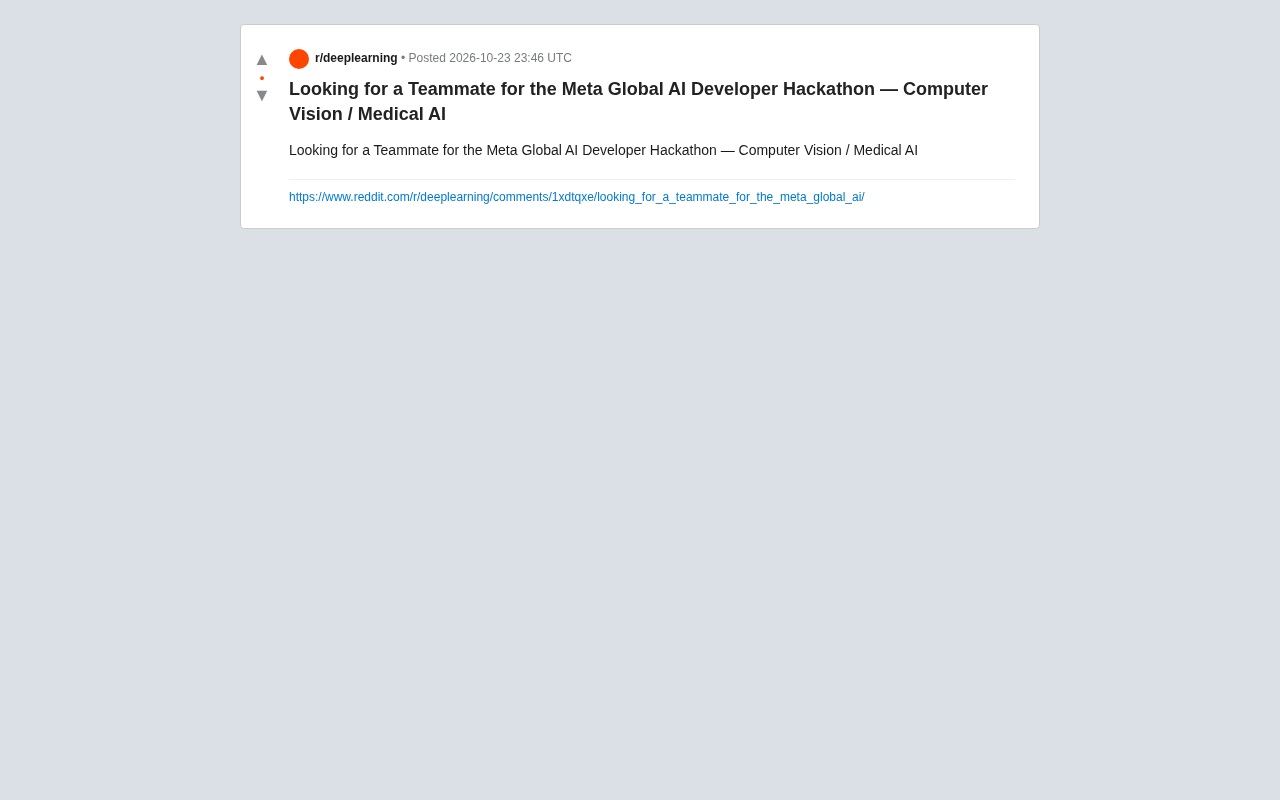
Teammate Wanted for Meta Global AI Developer Hackathon: Computer Vision & Medical AI
A Reddit developer seeks teammates for the Meta Global AI Developer Hackathon, focusing on computer vision and medical AI. This article analyzes the track logic, skills-complementarity needs, and topic selection strategy behind this teaming signal.
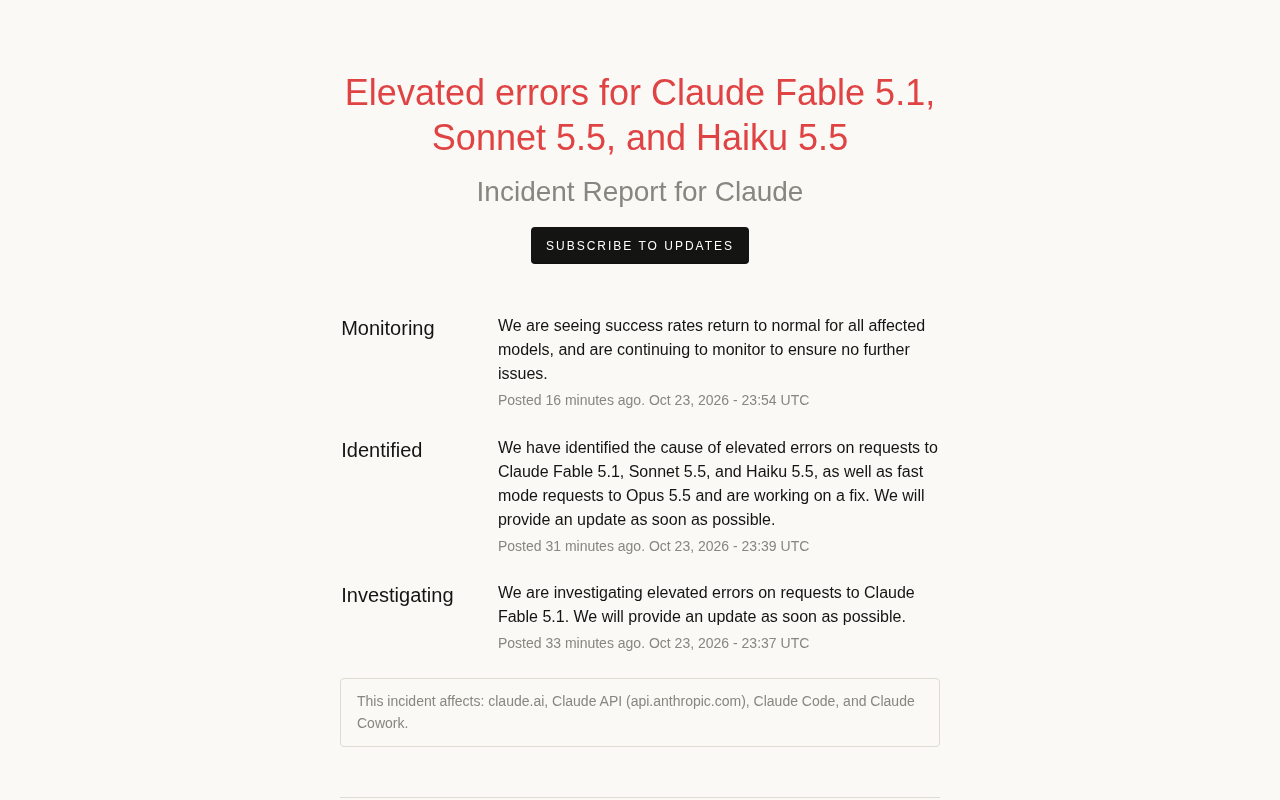
Multiple Claude Models Hit by Errors: A Postmortem of Fable 5.1, Sonnet 5.5, and Haiku 5.5
Claude Fable 5.1, Sonnet 5.5, Haiku 5.5, and Opus 5.5 fast mode saw elevated errors; Anthropic identified and resolved the issue in 17 minutes. This postmortem covers the timeline, the technical reasons for the multi-model cascading failure, and practical lessons for retry and degradation strategies.