What We Forgot: The Concept Short Film That Imagines Looking Back at Life Before AI
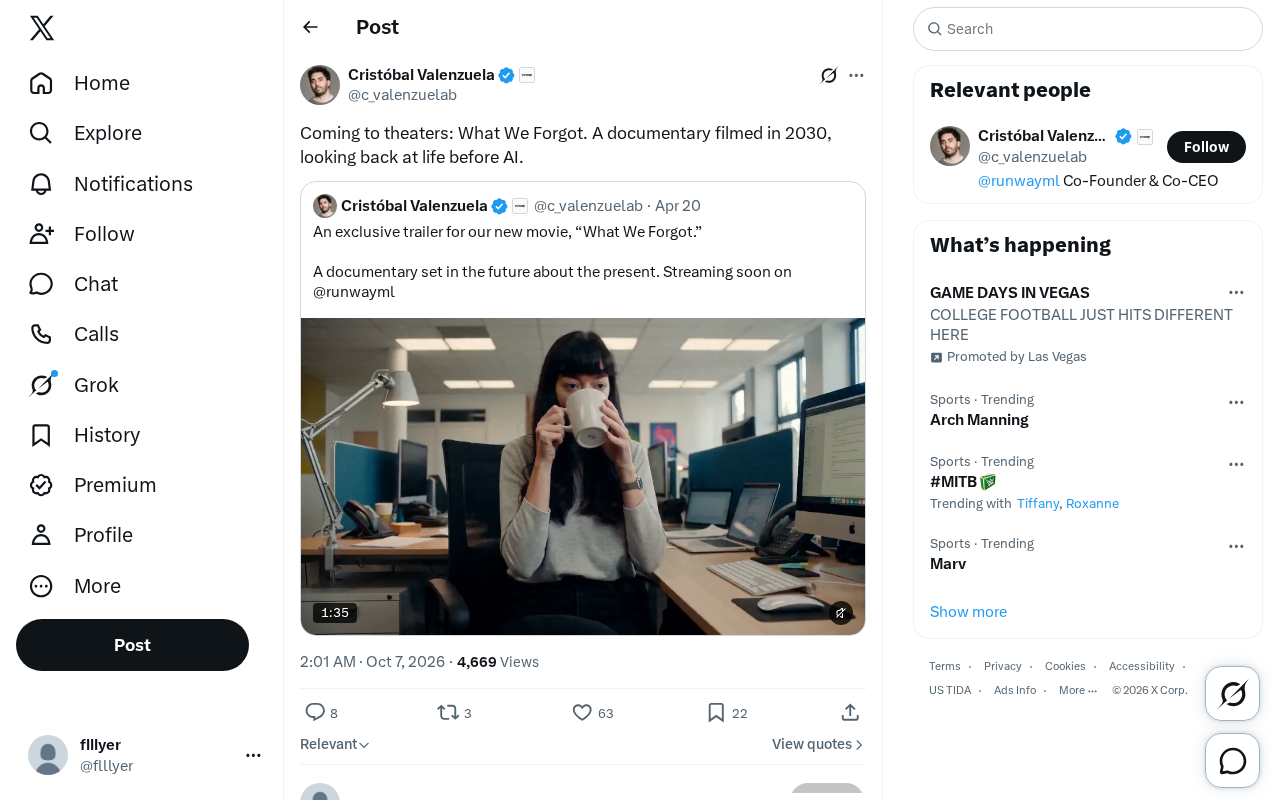
A fictional 2030 documentary trailer uses the word "forgot" to spark reflection on AI-era human capability loss.
A concept piece called *What We Forgot* appeared on social media, framed as a documentary filmed in 2030 looking back at life before AI. It's not a real film — rather, a clever thought experiment that borrows the documentary format to place today's technological shifts into the past tense, generating a disorienting sense of temporal displacement. Its emotional core is technostalgia: an anxiety that cognitive capabilities may be quietly outsourced to AI, and a gentle inquiry into the hidden costs of efficiency. From a communication design standpoint, it deploys borrowed format, temporal displacement, and open-ended framing to spark maximum discussion with minimal content. Real or not, it already works as a mirror held up to the present.
A Single Tweet That Sparked Collective Imagination
A remarkably thought-provoking piece of content surfaced on social media recently — written in the voice of a movie trailer, it announced the upcoming release of What We Forgot, a "documentary" set in 2030 that looks back on human life before AI became ubiquitous.
Based on available information, this appears to be more of a conceptual art piece or creative statement than an actual theatrical film. Yet in a single sentence, it poses a question compelling enough to make you stop and think: once AI has fully permeated everyday life, what exactly will we have forgotten?
Why This Concept Resonates
The brilliance of this kind of expression lies in how it borrows the documentary format — a genre associated with "recounting real history" — and repositions the technological shifts happening right now into the past tense.
When we look back at today from a 2030 vantage point, many things we currently take for granted might become artifacts of a bygone era, worthy of documentary preservation: writing an email by hand, planning a travel itinerary yourself, completing a report independently without an AI assistant. The creative tension comes precisely from this sense of displacement — the feeling that the future has already become the present.
Rather than passing judgment on whether AI is good or bad, the piece uses the word "forgot" — carrying a faint undercurrent of wistfulness — and invites the audience to fill in the answer themselves. That deliberate openness is exactly what gives it its viral power.
The Tug-of-War Between Tech Optimism and Technostalgia
At its core, this content taps into one of the defining emotional undercurrents in today's AI discourse: technostalgia.
On one hand, AI tools are taking over cognitive work — writing, coding, design, decision-making — at an unprecedented pace, and the efficiency gains are real and tangible. On the other hand, a growing number of people are beginning to worry: as machines take on more and more of our thinking, will the very human process of actively engaging our minds, working with our hands, making mistakes, and learning from them quietly get "outsourced" away?
The subtext of the title What We Forgot is precisely this anxiety about capability atrophy. It reminds us that the cost of technological convenience doesn't always show up immediately — it often only becomes visible years later, when we realize that certain skills we once took for granted have quietly grown rusty.
Technostalgia is a concept widely discussed in media studies and the sociology of technology. It refers to the sense of longing people feel for older practices displaced by new technology. Every major technological shift in history has triggered similar emotions: the spread of the printing press prompted laments over the death of hand-copied manuscripts; the telephone made people mourn the decline of letter-writing; the rise of digital photography gave analog film an unexpected aesthetic glow as a symbol of the "slow life." This pattern reveals a recurring truth: technological convenience and skill atrophy are often two sides of the same coin, and society's awareness of what it has "lost" tends to lag behind the technology itself — we only truly appreciate a capability once it has become rare. In the context of AI, this nostalgia points not just to specific skills, but to the cognitive process itself: independent thinking, trial and error, and the kind of work that is inefficient yet deeply meaningful.
The Design Intelligence Behind Its Spread
Setting aside the emotional dimension, this tweet is also a compelling case study in content creation worth breaking down:
- Borrowed format: By adopting the structure of a movie trailer, it gives an abstract technological debate a concrete, tangible "product" shell.
- Temporal displacement: Setting "2030" as the filming date creates a sense of the future that feels both familiar and alien.
- Open-ended premise: It offers no conclusions — only questions — maximizing the potential for discussion and secondary creation in the comments.
This kind of minimal expression, rich with imaginative space, tends to travel far more effectively on social networks than lengthy technical analysis ever could.
In communication theory, this technique is often called narrative displacement — pulling the audience out of their current context and placing them in an imagined observational position, which lowers psychological defenses and increases empathic efficiency. The movie trailer, as a highly refined narrative format, comes pre-loaded with structural advantages: suspense front-loaded, emotion neatly packaged. Audiences have an ingrained familiarity with this format — even when the content is fictional, they automatically slip into the mindset of "this is a real work." This mirrors a common technique in marketing known as the "concept launch": rather than showing a product, you cultivate a sense of absence and let the audience imagine and fill in the gap themselves. On social media, the logic of "the blank space is the message" is especially effective — every comment, speculation, and reply in the thread is essentially free secondary distribution for the original post.
A Mirror Held Up to the Present
Whether or not What We Forgot ever becomes a real film, it has already succeeded as a thought experiment. It isn't predicting what AI will destroy — it's asking: as we embrace technology, which human capabilities and experiences are worth consciously choosing to preserve?
The answer will differ for everyone. But the act of asking the question itself is a gentle recalibration against technological fervor. In an age where our tools grow smarter by the day, staying attuned to the question of what we might be losing may be the most clear-eyed stance of all.
Related articles

AI Digital Twin in Action: Using DOT to Automatically Track Bugs and User Feedback
DOTS engineers demonstrate how AI digital twin DOT collects cross-platform user feedback, categorizes issue themes, opens threads to investigate bug root causes, and submits PRs—showcasing a complete AI agent workflow for defect triage with auditable design.

Why Transistors Are No Longer Flat: The Evolution from Planar to Gate-All-Around
Transistor evolution from planar to FinFET to gate-all-around: why gates went from three-sided to four-sided wrapping to suppress short-channel effects and leakage current, extending Moore's Law.

Swarm Intelligence = a Single RL Agent? A Proof of Multi-Armed Bandit Equivalence
A paper proves that collective decision-making through local imitation in swarms is mathematically equivalent to single-agent reinforcement learning: N blind imitators act as N parallel environment samples, with an effective learning rate of 1/N. This article explains the derivation and implications of the Maynard-Cross Learning algorithm.