What Would Happen to the AI Industry If Jensen Huang Left Nvidia?
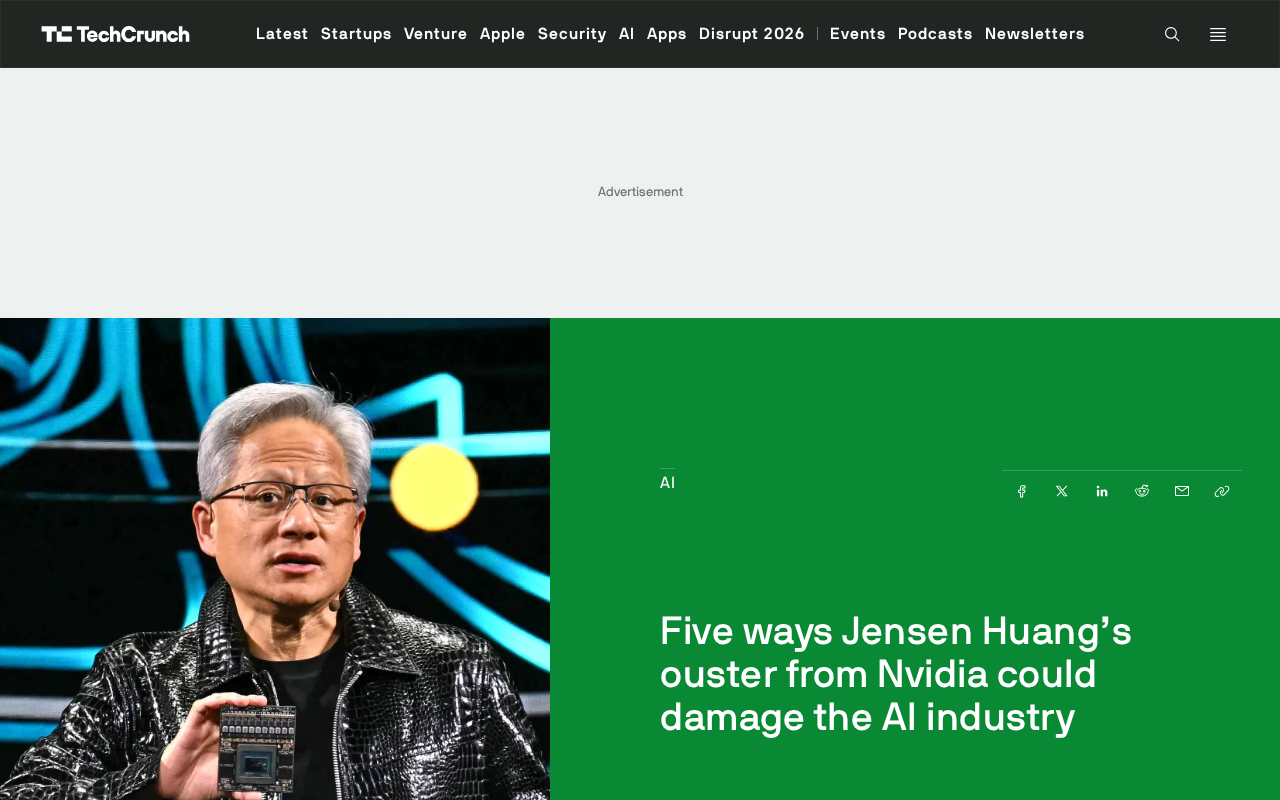
If Jensen Huang left Nvidia, it would hit the AI industry across strategy, ecosystem, confidence, competition, and regulation.
Based on public information and industry analysis, this article explores the five dimensions of impact that Nvidia CEO Jensen Huang's departure could have on the AI industry: a break in strategic continuity that leaves the AI computing roadmap uncertain; a CUDA ecosystem trust crisis that could trigger developer migration; fluctuations in industry confidence and investment decisions affecting upstream and downstream companies; an unexpected loosening of the competitive landscape that gives rivals a window of opportunity; and variables in AI regulation and industry collaboration that slow consensus building. The article stresses that Huang's influence has spilled beyond the company's boundaries to become part of the AI industry ecosystem, and that any change in his position should be examined within the framework of industry impact.
Nvidia CEO Jensen Huang's rumored departure, if it comes true, would amount to far more than a piece of business gossip. The founder long ago outgrew the role of an ordinary CEO to become a key driver of the AI industry's direction. Based on public information and industry analysis, this article lays out the five dimensions of impact that Huang's departure could have on the AI industry.
1. A Break in Strategic Continuity: The AI Computing Roadmap Faces Uncertainty
Huang's grip on Nvidia is extraordinarily strong, and his personal judgment has profoundly shaped the company's AI computing roadmap. From GPU architecture to the long-term investment in the CUDA ecosystem, everything bears the clear stamp of "founder will." Once he departs, a successor might shift priorities—for example, focusing more on short-term financial performance than on long-cycle technology bets. According to the original analysis, Huang is using his influence to "push the AI industry in a particular way," and once that directional push is interrupted, Nvidia's AI chip iteration cadence and ecosystem building could drift off their original track.
CUDA (Compute Unified Device Architecture) is the parallel computing platform and programming model introduced by Nvidia, allowing developers to use GPUs for general-purpose computing. Since its release in 2006, CUDA has become the de facto standard for AI training and inference, and its moat lies not only in technical performance but also in its vast developer ecosystem and long-accumulated libraries (such as cuDNN and TensorRT). As a staunch champion of the CUDA strategy, Huang has repeatedly emphasized his long-term commitment to it, and this continuity is crucial to developer confidence.
2. A Trust Crisis for the CUDA Ecosystem
CUDA is Nvidia's moat in AI training, and its success rests not only on technology but also on developers' trust in Nvidia's long-term commitment. As a firm defender of the CUDA strategy, Huang's departure could trigger concerns in the developer community about the ecosystem's continuity. Although the original article does not elaborate, ecosystem lock-in is a core element of "pushing the AI industry in a particular way." If developers begin to question long-term support for CUDA, some teams may accelerate their migration to open-source alternatives, thereby weakening Nvidia's software barrier.
Open-source alternatives such as OpenCL, ROCm (introduced by AMD), and SYCL aim to provide cross-platform GPU computing capabilities. In recent years, as AI frameworks (such as PyTorch) have strengthened support for multiple backends, some developers have begun exploring these alternatives to reduce their dependence on Nvidia. However, these ecosystems still lag behind CUDA in maturity, toolchains, and community support, and migration costs remain high. Huang's departure could accelerate some teams' evaluation of migration.
3. Fluctuations in Industry Confidence and Investment Decisions
Huang is an iconic figure in the AI computing narrative, and his public statements are often seen as a bellwether for the industry. His departure could be interpreted by the market as a signal of strategic uncertainty at Nvidia, in turn affecting purchasing and investment decisions at upstream and downstream companies. The original article stresses that this is no ordinary scandal but involves "using influence to push the AI industry," meaning Huang's personal credibility is deeply bound up with confidence in the AI industry. Once that bond breaks, computing buyers may postpone orders and turn to multiple suppliers, triggering short-term market turbulence.
The AI computing narrative refers to the set of industry consensus and investment logic built around the central role of hardware such as GPUs in AI development. Thanks to its GPU dominance in deep learning, Nvidia has become one of the biggest beneficiaries of this AI wave. As the iconic figure of this narrative, Huang's public remarks (such as "the more you buy, the more you save") are often read by the market as a bellwether for the industry. His departure could shake market confidence in Nvidia's continued leadership in computing innovation.
4. An Unexpected Loosening of the Competitive Landscape
Nvidia's competitors—including AMD, Intel, and cloud providers building their own chips—have long tried to pry loose its market position. Huang's departure could give rivals a window of opportunity: on one hand, internal adjustments at Nvidia could divert focus; on the other, customers seeking to reduce risk may be more willing to try alternatives. The original article notes that Huang "pushes the AI industry in a particular way," and as that driving force weakens, the competitive landscape could shift from Nvidia's dominance to a more dispersed state.
Cloud providers building their own chips include Google (TPU), Amazon (Trainium/Inferentia), Microsoft (Maia), and Meta (MTIA), among others. To reduce dependence on Nvidia GPUs, optimize costs, and achieve software-hardware co-design, these companies have all invested in developing their own AI chips. Although these chips currently serve mainly internal workloads, their progress could change the competitive landscape of the AI computing market. Huang's departure could open up more market opportunities for these in-house chips.
5. Variables in AI Regulation and Industry Collaboration
Huang plays an active role in AI regulation discussions and industry collaboration, and his personal influence helps coordinate issues such as chip supply and standards setting. After his departure, Nvidia's say on these issues could weaken, and the efficiency of industry collaboration could decline. Especially as global AI governance frameworks gradually take shape, the absence of a rallying industry leader could slow the formation of consensus.
Conclusion
Huang's deep entanglement with Nvidia makes his departure a risk factor the AI industry cannot afford to ignore. From strategic continuity, ecosystem trust, and market confidence to the competitive landscape and industry collaboration, the five dimensions of impact are intertwined. The core reminder of the original article is this: this CEO's influence long ago spilled beyond the company's boundaries to become part of the AI industry ecosystem. Any discussion of a change in his position should be examined within the framework of industry impact.
(This article is compiled from a single-source opinion piece; the relevant facts have not been cross-verified across multiple sources, and readers are advised to exercise discernment.)
Related articles
The Other Side of Anthropic's IPO: The Trillion-Dollar Loss Illusion and the 2008 Specter Hiding in AI Debt
Anthropic's IPO sparks fierce debate: headlines show a $104B loss over nine months, yet adjusted operating profit hit $4.1B. This article unpacks the accounting magic in the S-1, the $900B compute commitment, four future scenarios, and why AI data center debt is being compared to the 2008 subprime crisis.

Anthropic's $1.4 Trillion IPO Bid: Explosive Revenue Growth and a Massive Compute Bet
Anthropic races toward an IPO at up to a $1.4 trillion valuation, with revenue surging from $41M to $17B a quarter—but $895B in compute commitments and unproven margins pose huge risks. This analysis breaks down its business, finances, and IPO pricing logic.

Anthropic's $1.4 Trillion IPO: The $400 Billion Compute Bill Hiding a Two-Way Trap
Anthropic races toward a $1.4 trillion IPO, but its prospectus reveals over $400 billion in fixed compute commitments against usage-based revenue that customers can cut at any time.