WhatsApp AI Agent in Action: A Complete Service Pipeline for Online Courses

How to use WhatsApp AI Agents to build a complete, automated service pipeline for online courses.
This guide explores how online course businesses can transform WhatsApp from a simple broadcast channel into a structured service pipeline. Using AI Agents for lead screening, API automation for service delivery, Campaigns for re-engagement, and human consultants for trust-building and closing, businesses can run a stable, scalable conversion workflow with clear role boundaries between systems and people.
From Bulk Messaging to Service Pipelines: A Mindset Shift for Online Courses
When most businesses think of WhatsApp, their first instinct is "bulk outreach" — treating it as a cheap marketing channel. But in the online education space, what actually happens most frequently isn't marketing at all — it's course service delivery.
YCloud shared a compelling set of real-world data: for one English-language course provider, service messages on WhatsApp totaled 6,580 with a 99% delivery rate, while marketing messages numbered just 346 with a 92% delivery rate. In other words, service messages outnumbered marketing messages by nearly 20 to 1.
This ratio reflects an important platform mechanic: WhatsApp Business API divides business messages into two categories — "service messages" and "marketing messages." Service messages are replies sent within the 24-hour window after a user initiates a conversation; Meta charges very little or nothing for these. Marketing messages are proactively sent Template Messages that require Meta approval, are billed per message, and are subject to strict monitoring of delivery rates and block rates. This pricing and classification logic explains why service messages far outnumber marketing messages — the former involves high-frequency two-way interaction, while the latter is constrained by platform policy.
The key insight hidden in this ratio: for online courses, WhatsApp isn't about pushing ads to as many people as possible. It's about connecting every touchpoint — consultations, trial lessons, enrollment, material delivery, replay notifications, renewal follow-ups — into a reliable, end-to-end service pipeline. Whoever builds this pipeline most effectively will hold the advantage in long-cycle conversions.
AI Agent Handles Initial Screening and Smart Routing
So how does this pipeline actually work? Let's start from the user's very first interaction.
When a user clicks an ad on Facebook, Instagram, or TikTok, they're taken directly into a WhatsApp conversation. This relies on Meta's Click-to-WhatsApp (CTWA) mechanism — instead of landing on a webpage, users are instantly connected to a WhatsApp chat with the business. This eliminates friction between ad exposure and live conversation, while automatically triggering the 24-hour service window so subsequent replies don't require marketing template approval. This moment represents peak user intent — and it's also the most fragile moment. One slow response, and the lead is gone.

Through YCloud, an AI Agent automatically sends a welcome message the instant a user enters the conversation, and can escalate to a human agent or consultant when needed. This AI Agent isn't a simple keyword-triggered bot — it has multi-turn conversation management capabilities. It can identify user intent, extract structured information from conversations (such as age and course preferences), and dynamically adjust its questioning logic based on context. Most importantly, the AI Agent can handle initial screening by automatically asking:
- What type of course are you interested in?
- Do you have any prior learning background?
- What age group is the child in?
- Do you have access to the necessary devices for class?
- Would you like to schedule a trial lesson?
None of this requires human resources upfront. Based on user responses, the AI automatically assigns tags and routes users, then passes complete context to the consultant.
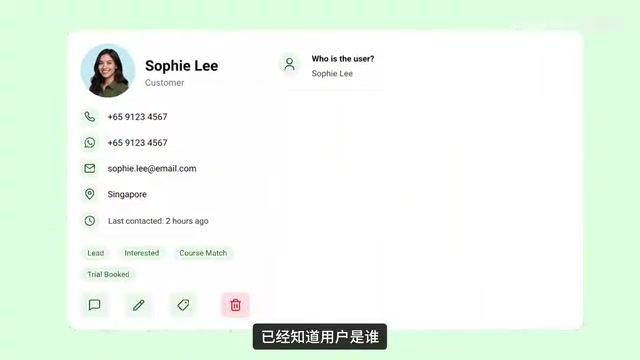
By the time a consultant takes over, they already know who the user is, what they want to learn, and what course to recommend — allowing them to jump straight into course matching, trial scheduling, pricing, and enrollment. Human agents are no longer consumed by repetitive basic questions; instead, their time is focused on building trust and closing sales.
API-Driven Automated Service Delivery
For online courses, trial lessons are often the critical conversion point. Whether the user attends on time, whether they receive the class link in advance, and whether they get feedback and replay access afterward — all of this directly influences the decision to enroll.
Through YCloud, businesses can automatically send reminders and class links before a lesson, and automatically deliver learning feedback, replay recordings, and enrollment prompts afterward. Once a user officially enrolls, the number of service touchpoints increases further.
YCloud's API platform is essentially a middleware layer built on top of the WhatsApp Business API. Its core value lies in connecting message-triggering logic to internal business systems — such as course management platforms, CRMs, and payment systems. When a user completes enrollment, payment, or scheduling, the business system sends an event to the YCloud API via Webhook, and the platform automatically triggers the corresponding WhatsApp notification based on preset templates. This event-driven architecture ties service message delivery tightly to business status, eliminating missed steps and delays caused by manual operations. The following service messages can all be triggered automatically:
- Enrollment confirmed: Send course schedule details
- Before class: Send reminders and class entry links
- After class: Send replay videos and practice materials
Copying links, sending account credentials, sending reminders — these highly standardized, repetitive tasks are far more reliably handled by automated systems than by humans. When consultants are freed from administrative busywork, they can truly focus on high-value interactions.
Campaigns to Re-engage Silent Leads
Online course conversion cycles are long, and there will always be users who go quiet midway — no response after initial inquiry, no enrollment after a trial lesson, no follow-up after downloading materials. Without proactive management, these leads simply disappear.
Through YCloud Campaigns, businesses can run targeted re-engagement based on user status and tags. This capability depends on a comprehensive lifecycle tagging system — users typically move through stages such as potential lead, initial inquiry, trial lesson participation, formal enrollment, and active student. Users at the "completed trial but not enrolled" stage are best reached with post-lesson learning reports and limited-time offers; users at the "downloaded materials but gone silent" stage respond better to content-driven re-engagement rather than direct promotional pushes. Campaigns might include:
- Trial class reminders
- Material download follow-ups
- Course replay delivery
- Limited-time offer notifications
- Renewal win-back messages
Precise targeting based on segmented tags brings silent leads back into the conversion pipeline, rather than blasting all users with the same message. It's worth noting that Meta's platform algorithm dynamically adjusts business account sending permissions based on user report rates and block rates — which means smart segmentation is itself a necessary measure to protect long-term account health.
System and Human Collaboration: Clear Role Boundaries
The core logic of this entire approach lies in clearly defined responsibilities:
- AI Agent: Handles initial screening and smart routing, reducing repetitive inquiries
- API Automation: Standardized service delivery — automatically sends reminders, materials, and replays
- Campaigns: Re-engagement and reactivation of silent leads
- Human Consultants: Focus on trust-building and closing
Put simply: let systems handle the repetitive work, and save critical conversations for humans — this is the core value of using WhatsApp AI Agents for efficient online course operations.
Building a Healthy, Sustainable Outreach Rhythm
Online course follow-up cycles tend to be long, with frequent reminders, confirmations, follow-ups, and re-engagement. So more important than "getting the message delivered" is establishing a healthy outreach cadence.
Operators need to continually ask:
- Which users are appropriate for continued follow-up?
- Which users should be contacted less frequently?
- Are message templates and user response signals healthy?
- Is there a clear opt-out mechanism in place?
These questions should be built into day-to-day operations. Over-messaging doesn't just hurt delivery rates — it can trigger platform risk controls. Meta actively reduces message delivery permissions for accounts based on quality signals like user report rates and block rates, and in serious cases may suspend accounts entirely. A healthy outreach rhythm is both a sign of respect for user experience and a necessary investment in protecting the business's long-term service capacity.
Conclusion
Online courses are never short of ways to reach users. The real challenge is — how to serve users consistently, reliably, and without being intrusive throughout a long conversion cycle.
YCloud's approach is to transform scattered, one-off WhatsApp conversations into a manageable, reusable course service pipeline: consultants focus on trust-building and closing, while the system handles screening, reminders, material delivery, replay distribution, and lead re-engagement. When each party plays its defined role, course service becomes more stable and conversion becomes more sustainable.
Key Takeaways
Related articles

GPT-Next Leak, Gemini 4 Argon Imminent: AI News Roundup
GPT-Next leak suggests extreme efficiency; OpenAI's 28-day shipping pledge boosts speed 50%; Gemini 4 Argon nears release; Anthropic subscription value report sparks debate.

GPT-Next Leaked, Gemini 4 Argon Speeds Up, Fable 5.5 May Launch Today
OpenAI's GPT-Next model leaks, expected to be extremely low-cost and possibly part of the 28-day release plan; Gemini 4 Argon internal testing accelerates, NanoBanana 2.1 is live; Semi Analysis tests show Claude Max's equivalent API value is about 5 times that of ChatGPT Pro; Fable 5.5 may launch today.

Gemini 4 Argon Launches Globally: Key Highlights from the AI Daily Brief
Google opens Gemini 4 Argon globally across Pro and Ultra subscriptions and the API, and demonstrates robot control. This article rounds up open-source models, Agent infrastructure, cost transparency, and safety governance updates.