WhatsApp Coexistence Mode Sync Challenges: How to Monitor the Boundary Between Human Agents and the API

In WhatsApp coexistence mode, the API needs message.echo webhooks to detect manual messages and avoid state drift.
The article focuses on state synchronization when the WhatsApp Business app and API coexist on the same number. Because the API side cannot naturally detect messages sent by human agents through the Business app, automated processes may send duplicates, miss conversations, or misjudge intent, creating "drift." A developer shares a lightweight monitoring example based on Python/Flask and Telnyx: receiving message.echo webhooks, verifying signatures with Ed25519, checking coexistence status, caching lifecycle state for 60 seconds, skipping processing when inactive, and writing PII-minimized JSONL audit logs. The article further discusses the trade-offs among mirroring, independent audit streams, and periodic reconciliation as drift-handling strategies, and suggests that enterprises clarify perception latency, compliance requirements, and consistency tolerance before choosing an approach.
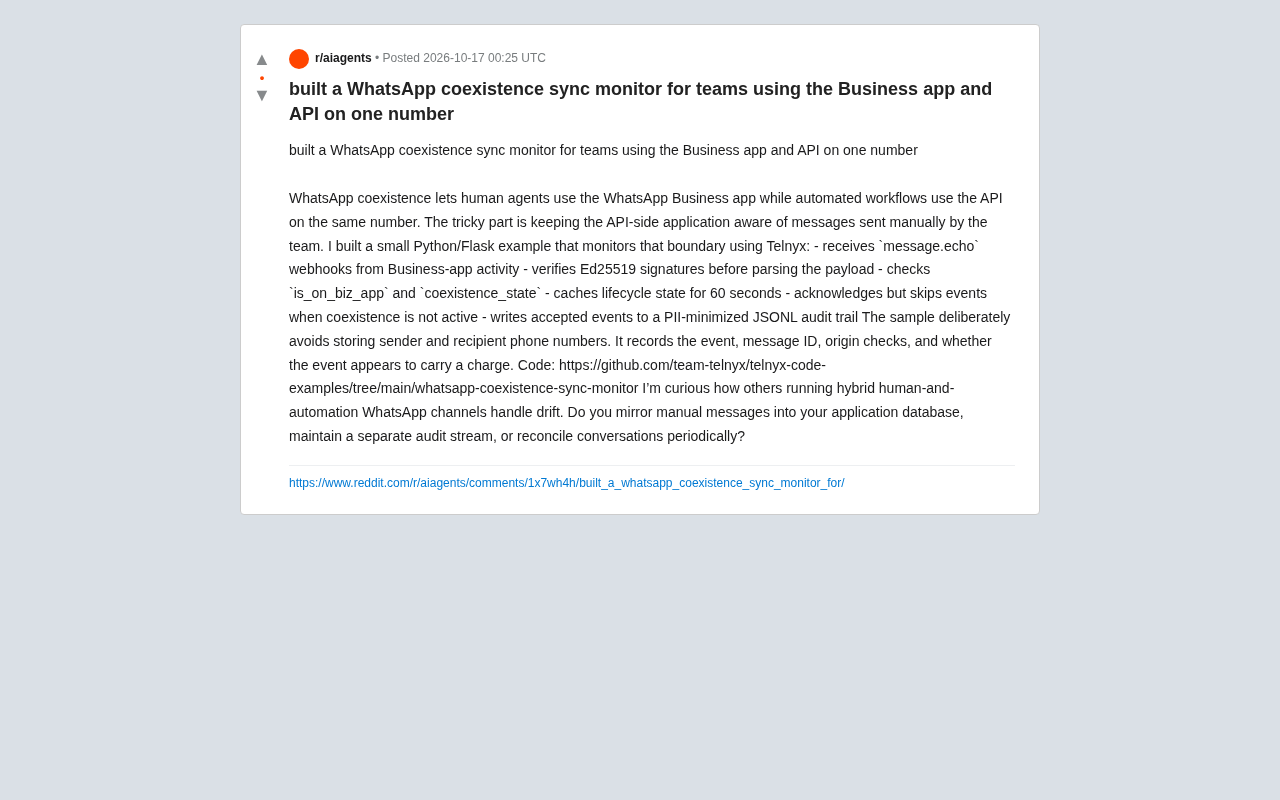
WhatsApp Business app and API coexistence on the same number allows businesses to keep the flexible manual operations of human agents while connecting automated workflows. But state synchronization between the two—especially how the API side becomes aware of messages sent manually by the team—has always been a pain point in practice. Recently, a developer shared a Python/Flask-based sync monitor example on Reddit, sparking discussion about how hybrid operating models should handle "drift."
The Core Challenge of WhatsApp Coexistence Mode
WhatsApp coexistence allows businesses to use both the WhatsApp Business app and the API on the same number. Human agents reply directly to customers through the Business app, while automated processes handle tasks such as batch notifications and menu interactions through the API. This hybrid model sounds ideal, but the technical challenges it introduces are not to be underestimated.
According to the Reddit post, the trickiest part is: the application on the API side needs to know which messages the team has sent manually. Otherwise, the automation system may make wrong decisions based on incomplete data—for example, sending duplicate messages, missing unread conversations, or misjudging customer intent. Developers usually call this state inconsistency "drift."
The essential difference between the WhatsApp Business app and the WhatsApp Business API: The Business app is a manual mobile tool for small and medium-sized businesses, where agents send and receive messages directly on their phones; the Business API is a programming interface for medium and large enterprises, where a backend system processes messages automatically. The two were originally mutually exclusive—a number was either registered on the app or on the API. The so-called "coexistence mode" is a capability Meta introduced in recent years that allows the same number to be bound to both the app and the API, but the message streams of the two channels do not naturally share the same state store. The API side can only see messages sent and received through itself; operations performed manually on the Business app are "invisible events" to the API and must rely on additional event pushes (such as message.echo) to complete the view. Without understanding this architectural premise, it is hard to appreciate why state synchronization becomes a core pain point in practice.
A Lightweight Boundary Monitoring Solution
The developer built a small Python/Flask example with Telnyx specifically to monitor the boundary between manual operations and the API. The solution includes several key designs:
- Receive the
message.echoWebhook: When there is activity on the Business app, Telnyx pushes amessage.echoevent, and the monitor uses it to capture messages sent manually. - Ed25519 signature verification: Before parsing the payload, verify the Webhook signature to ensure the event source is trustworthy.
- Check coexistence status: Use the
is_on_biz_appandcoexistence_statefields to determine whether the current number is in coexistence mode and whether the message comes from the Business app. - Cache lifecycle state for 60 seconds: Reduce repeated queries and balance real-time performance with resource consumption.
- Skip processing in inactive states: If coexistence is not active, the monitor acknowledges receipt of the event but skips subsequent processing to avoid invalid logic.
- PII-minimized auditing: Write accepted events to a JSONL audit log, but deliberately do not store the sender's and receiver's phone numbers; only record the event type, message ID, source check result, and whether charges may be incurred.
The code is open-sourced in the team-telnyx/telnyx-code-examples repository on GitHub, under the path whatsapp-coexistence-sync-monitor. This example is positioned as a "minimal runnable prototype" rather than a production-grade solution, but it clearly demonstrates the basic skeleton of boundary monitoring.
Ed25519 signature verification is a digital signature algorithm based on elliptic curves, widely used in Webhook scenarios to verify the authenticity of event sources. When the service provider (here, Telnyx) pushes a Webhook, it uses a private key to generate a signature over the request payload and places it in the request header; the receiver holds the corresponding public key and can independently verify whether the signature matches. Compared with HMAC shared-key schemes, the advantage of Ed25519 is that the receiver does not need to safeguard a secret that could be used to forge signatures, so the risk of leakage is lower, and signing and verification are fast with short signature lengths. Completing verification before parsing any business fields is a basic prerequisite for defending against forged events and replay attacks—this is also why the example places verification before payload parsing.
The Trade-off Between Privacy and Compliance
It is worth noting that this example actively removes personally identifiable information (PII) such as phone numbers from the audit log. For businesses subject to regulations such as GDPR and CCPA, this design reduces the risk of data leakage and also makes audit logs easier to retain long-term.
However, PII minimization also has a side effect: when a specific conversation needs to be traced back, the log itself cannot be directly linked to the customer's identity. Developers may need to keep a mapping relationship in another system or rely on message IDs for cross-system correlation. The trade-off depends on the company's compliance requirements and operational habits.
PII (personally identifiable information) minimization is the concrete implementation of the "data minimization" principle in Article 5 of the GDPR: collect and process only the minimum data necessary to achieve a specific purpose. In communication scenarios, phone numbers are identifiers that can directly identify a natural person; once combined with message content and timestamps, they may constitute traceable personal communication records. If an audit log retains complete numbers for a long time, it will significantly expand the blast radius of a data breach and may also exceed the scope necessary for the purpose of "auditing." Therefore, the example retains only the event type, message ID, and source check result. The cost is that the log loses the ability to directly associate identities, requiring cross-database mapping in controlled systems via message IDs. In effect, this isolates sensitive data within a smaller storage boundary with stricter permissions.
Community Focus: Mirroring, Audit Streams, or Periodic Reconciliation?
At the end of the post, the author posed an open question to the community: When running a mixed manual and automated WhatsApp channel, how does everyone handle drift? He offered three common approaches:
- Mirror manual messages to the application database: High real-time performance, but requires handling message ordering, duplication, and state write-back.
- Maintain an independent audit stream: Like this example, record only events without polluting the main business data. Suitable for compliance and debugging, but the query experience is poor.
- Periodically reconcile conversations: Correct state by pulling conversation history on a schedule. Simple to implement, but there is a latency window.
Judging from the direction of community discussion, no single solution works for all scenarios. Customer service teams with high-frequency interactions may prefer the mirroring approach, while enterprises with high data isolation requirements may choose audit streams. Periodic reconciliation is often used as a fallback and combined with other approaches.
Takeaways for Developers
Although this Reddit share does not involve much code, it touches on a typical problem in hybrid communication architectures: when humans and automation share the same channel, state synchronization cannot rely on assumptions—it must be explicitly monitored. Through Webhook signature verification, state caching, and PII minimization, the author provides a reusable starting point.
For enterprises evaluating WhatsApp coexistence mode, it is advisable to first clarify three things: how quickly manual operations need to be perceived by the automation system, the retention and compliance requirements for audit logs, and whether eventual consistency is acceptable. Once these are clear, choosing a mirroring, audit stream, or reconciliation strategy will be more reliable than directly applying some example.
Project code: https://github.com/team-telnyx/telnyx-code-examples/tree/main/whatsapp-coexistence-sync-monitor
Related articles
2026 AI Coding Tools Comparison: Claude, ChatGPT, Gemini — Which Is the Best?
A 2026 comparison of five mainstream AI coding tools — Claude Code, ChatGPT Codex, Gemini, DeepSeek, and GitHub Copilot — on real projects, pricing, and code quality, to help you decide where that $20/month should go.

ChatGPT Codex Can Clone Any Software? Testing the Risks and the Truth
YouTube shorts claim ChatGPT Codex or Claude Code can clone Adobe, Excel, and Figma for lifelong free use. We break down the feasibility, legal risks, and DM-funnel tactics—and explain what AI coding tools are truly good for.

Kilo Code Is Free to Install but Charges for API: Cost Estimation and Configuration Guide
Kilo Code is free to install, but connected AI models are billed per token. This guide covers VS Code extension and CLI setup and shows how to estimate API costs.