When AI Follows the Crowd: How Social Signals Shape AI Attention in Scientific Research
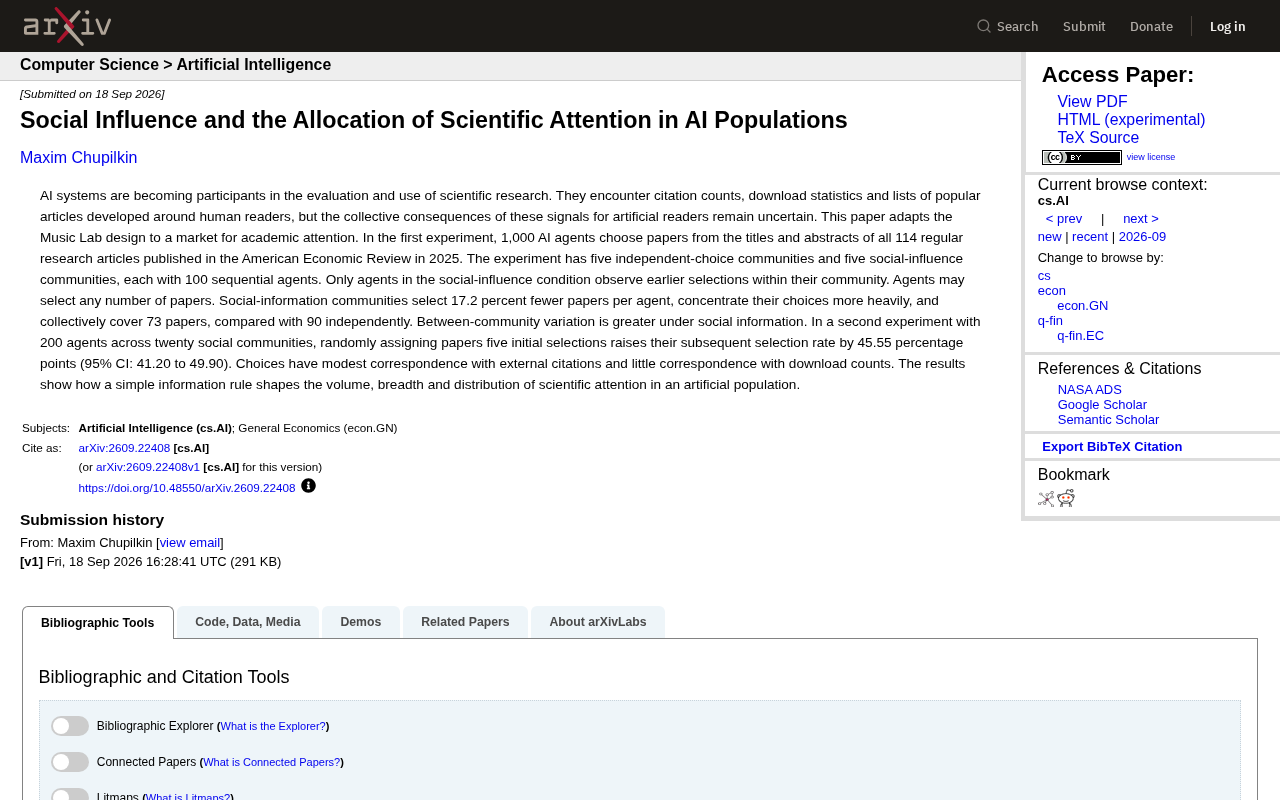
Experiment proves AI populations show strong conformity effects, with social signals systematically distorting scientific attention allocation.
A new study adapting the classic "Music Lab" paradigm divided 1,000 AI agents into independent and socially-informed communities to choose from 114 economics papers. Socially-informed agents selected 17.2% fewer papers, collective coverage dropped from 90 to 73 papers, and attention concentrated heavily on a few popular articles — mirroring the unpredictability of human cultural markets. A second experiment confirmed that randomly assigning just 5 initial selections to a paper boosted its subsequent selection rate by 45.55 percentage points, establishing the Matthew Effect's causal mechanism in AI populations. Critically, AI preferences showed only modest correlation with citation counts and near-zero correlation with downloads, meaning AI attention allocation doesn't reliably reflect genuine academic value — posing a structural risk for AI-driven research tools.
AI systems are increasingly becoming evaluators and consumers of scientific research. They encounter citation counts, download figures, and trending article lists — signals originally designed for human readers. But when the audience becomes AI, what are the collective consequences of these social signals? A new study published on arXiv offers an experimental answer that is both surprising and thought-provoking: AI populations also "follow the crowd," and this conformity effect is substantial.
Transplanting a Classic Social Experiment into the AI World
This study cleverly adapts the famous "Music Lab" design from social science. The original Music Lab experiment revealed that when people can see others' download choices, the music market becomes more concentrated and less predictable — the popular get more popular, the obscure get more obscure. The researchers transplanted this paradigm into the "academic attention market."
In the first experiment, 1,000 AI agents chose from the titles and abstracts of all 114 regular research articles published that year in the American Economic Review. The experiment was divided into two types of communities: five "independent choice" communities and five "social influence" communities, each containing 100 agents making decisions sequentially. The key distinction: only agents in the "social influence" condition could observe the choices made by prior agents in their community, while independent agents relied solely on the papers themselves. Agents could select any number of papers.
The "Music Lab" experiment was published in Science in 2006 by Columbia University sociologist Matthew Salganik and colleagues, and stands as one of the foundational studies in computational social science. The experiment recruited roughly 14,000 participants and had them listen to and download songs by unknown bands on a simulated music download website. Some users were randomly assigned to a condition where they could see real-time download rankings; others made independent judgments. The results showed that social information made the ultimate fate of songs highly unpredictable: the same song could become a massive hit or fade into obscurity across parallel experimental worlds, depending on early random accumulation. This revealed a self-reinforcing "success breeds success" mechanism in cultural markets that had little to do with the intrinsic quality of the music itself. By transplanting this design into the academic paper domain, the researchers were essentially testing whether the scientific attention market exhibits the same social influence dynamics — with AI agents now playing the role of "audience."
Three Dimensions of the Conformity Effect
The experimental data clearly shows how social signals alter the behavior of AI populations. Compared to communities making independent choices, communities that could observe others' selections displayed three characteristics:
Fewer selections: In social information communities, each agent selected an average of 17.2% fewer papers. Seeing others' choices made AI agents more "conservative," inclined to follow rather than explore broadly.
Greater concentration of attention: These communities focused their choices on a smaller number of papers, forming a pronounced head-concentration effect.
Narrower coverage: Social influence communities collectively covered only 73 papers, compared to 90 in independent communities. This means a significant portion of papers were entirely overlooked under the influence of social signals.
Even more notable is the increased "between-community variance" under social information conditions. Different communities ended up favoring very different papers — precisely the "unpredictability" seen in the Music Lab experiment. Which papers became popular depended largely on early random choices, not on intrinsic paper quality.
The Snowball Effect of Early Advantages
The second experiment directly tested the causal power of "initial signals." Across 20 social communities and 200 agents, the researchers randomly assigned 5 initial selections to certain papers (effectively creating an artificial "head start"). The results showed that these randomly boosted papers saw their subsequent probability of being selected increase by 45.55 percentage points (95% CI: 41.20 to 49.90).
This is striking causal evidence: simply because a paper "appeared more popular" at the outset, it attracted overwhelming subsequent attention — even when that initial popularity was entirely randomly assigned. This reveals a classic "Matthew Effect" mechanism operating equally within AI populations: those that gain attention first find it easiest to keep gaining attention.
The "Matthew Effect" was coined by sociologist Robert K. Merton in 1968, drawing from the biblical passage in Matthew: "For unto every one that hath shall be given." Merton used it to describe how already-prestigious scientists tend to receive more resources, citations, and recognition, while the work of lesser-known researchers is more likely to be overlooked — even when quality is comparable. In information systems and recommendation algorithms, this effect is understood as "cumulative advantage" or the "rich get richer" mechanism: content that gains early attention ranks higher and is displayed more frequently, attracting still more attention and creating a positive feedback loop. Experiment 2 in this study advances the Matthew Effect from correlational observation to causal testing — by randomizing initial advantages to eliminate content quality as a confound, it directly demonstrates that "starting position" itself has independent causal power in AI populations.
AI Choices Decoupled from Real-World Value
The study also uncovered a concerning phenomenon: AI agents' choices showed only "modest" correspondence with external citation counts, and virtually no correspondence with download figures. In other words, the attention AI populations allocate does not reliably reflect the true impact or value of papers within the human academic community.
As AI systems become increasingly involved in literature filtering, research recommendation, and knowledge synthesis, this finding carries real-world implications. If AI systems can be misled by social signals when evaluating research, and their preferences show limited correlation with genuine academic value, then AI-driven discovery and recommendation systems could amplify existing attention inequalities — or even manufacture "artificial hits" disconnected from quality.
This finding sits against the backdrop of longstanding debate in academia about the validity of citation counts and download figures as proxies for paper quality. Citation counts are influenced by field size, paper age, self-citation rates, and many other factors; download figures more often reflect exposure and headline appeal than depth of content. Despite this, both metrics remain the most widely used quantifiable signals of academic impact, and are heavily employed for ranking and recommendation by platforms such as Google Scholar and Semantic Scholar. When AI systems' selection preferences show limited correlation with both signals, it suggests that AI attention allocation neither adequately captures traditional academic impact nor reflects independent judgment — instead becoming a hybrid bias that is neither quality-driven nor truly independent. This represents a structural risk for research workflows that rely on AI for literature review, hypothesis generation, or prioritization.
The Far-Reaching Impact of One Simple Rule
The central insight of this research is that an extremely simple information rule — "whether or not one can see others' choices" — is sufficient to systematically alter how an artificial population allocates scientific attention, affecting its quantity, breadth, and distributional structure.
For developers building AI research assistants, literature recommendation systems, and automated review tools, this raises a design question that cannot be ignored: How much social signal should AI be exposed to? Should citation counts and popularity rankings be deliberately withheld to preserve the independence and diversity of AI evaluation? While pursuing efficiency, how do we prevent AI populations from falling into the same conformity trap as human societies?
This study does not offer complete answers, but it uses rigorous experimental methods to illuminate a risk dimension that had previously been overlooked. As AI becomes the "reader" and "gatekeeper" of scientific knowledge, the collective behavioral patterns of these systems deserve far more careful attention.
Related articles

The Other Side of the Agricultural Revolution: How Disease Helped Farmers Defeat Hunter-Gatherers
Historian Kyle Harper explains how agricultural societies defeated hunter-gatherers: not only through population growth from superior energy extraction per unit of land, but also through pathogens bred by settled life that caused extra mortality during expansion—a dual replacement mechanism.

Why Is AI-Generated Language So Hard to Understand?
Why is AI-generated language fluent yet hard to understand? Based on a Hacker News discussion, this article analyzes the cognitive load of AI text from three angles—imbalanced semantic density, lack of common ground, and side effects of alignment training—and offers practical advice for getting along with AI language.

Progressive Disclosure Makes Agents 2.3x Faster: A New Approach to Context Engineering
A Hacker News discussion proposes using progressive disclosure to optimize AI agent context, achieving a 2.3x speedup. This article analyzes the three performance costs of context bloat and introduces practical approaches such as layered tool catalogs, on-demand retrieval, and history compression, along with implementation considerations.