When AI Wearables Become a Psychological Burden: Reflections on the Amazon Bee Frontier

A therapist suggests throwing an AI wearable out the window, reflecting the psychological burden and privacy/trust costs of the quantified self.
Using The Verge reviewer Victoria Song's experience as a starting point—her therapist suggested she throw the Amazon Bee Frontier out the window—the article reveals the core contradiction of AI wearables: tools meant to reduce cognitive load and help users understand themselves may instead trap them in constant self-monitoring and metric anxiety. It also highlights the hidden costs of privacy and trust: users often cannot control how continuously collected physiological and behavioral data is stored and used, and once trust is shaken, no amount of features can compensate. The author argues that AI hardware design must balance functionality with users' psychological experience—less is more, and technology should serve people, not the other way around.
Introduction: When Your Therapist Suggests Throwing the Device Out the Window
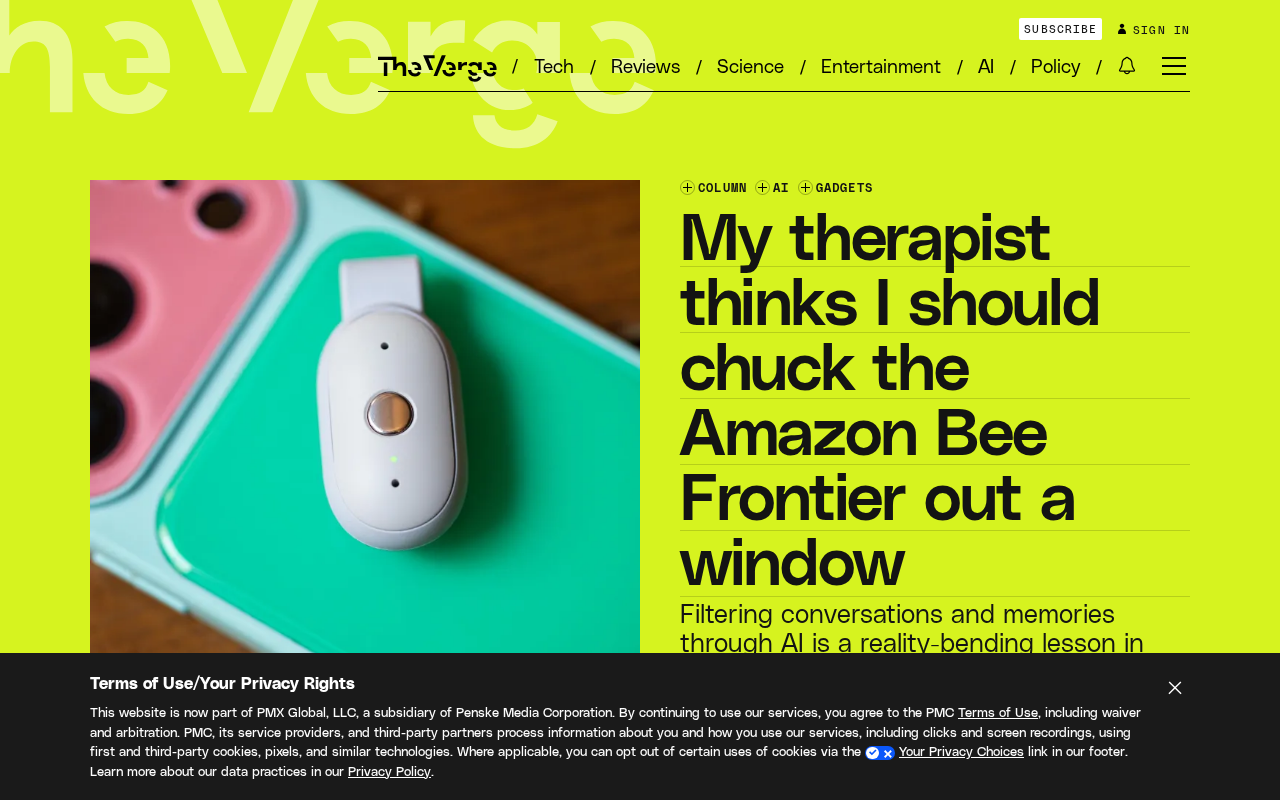
"How does that make you feel?" In therapy, I get asked this question all the time. Life is full of big and small things, and this time, my therapist's question was aimed at the Amazon Bee Frontier on my wrist. According to The Verge senior reviewer Victoria Song, writing in the Optimizer column, her therapist even thought she should just throw the device out the window. It sounds like a joke, but it reflects a serious issue: when AI wearables try to quantify our lives and emotions, are they actually helping us—or creating new anxiety?
From the Promise to "Change Your Life" to a Psychological Burden
The wearable market has never been short on promises to "change your life." From smartwatches to fitness trackers to today's various AI-integrated gadgets, they all sell the idea of "helping you understand yourself better." The Amazon Bee Frontier is no exception—it's positioned as a smart device that accompanies users and records their daily lives. But Victoria Song's experience reveals a contradiction: a tool that was supposed to reduce cognitive load instead became a psychological burden that needed to be "dealt with."
This contradiction is not an isolated case. When a device constantly reminds you to pay attention to your data, your performance, and those "health metrics" defined by algorithms, users can easily fall into a cycle of self-monitoring. The therapist's suggestion may be extreme, but it points to a key question: where is the boundary for technology's involvement in mental health?
Quantified Self is the key background for understanding this phenomenon. The concept was proposed by Wired editors Gary Wolf and Kevin Kelly in 2007, referring to people continuously tracking their physiological, behavioral, and emotional metrics through sensors, wearables, and data-logging tools in order to "know themselves and optimize themselves." It originally had a strong geek self-help flavor, but with the spread of smartwatches and health apps, it gradually evolved into mass consumer behavior. Psychological research suggests that excessive quantification can have side effects of "digital self-monitoring": users replace vague bodily sensations with scores given by algorithms, and feel frustrated whenever metrics fall short; at the same time, constantly paying attention to data consumes cognitive resources and actually worsens anxiety. This closely matches the description of the "self-monitoring cycle" in the article, and also explains why the therapist saw the device as a stimulus that needed to be removed.
Privacy and Trust: The Hidden Cost of Wearables
Beyond the psychological impact, AI wearables also face challenges of privacy and trust. These devices typically need to continuously collect users' physiological and behavioral data, and how that data is stored, how it is used, and whether it will be accessed by third parties are often things users cannot fully control. Victoria Song did not elaborate on technical details in the article, but her experience hints at another kind of cost: once the device becomes part of daily life, if users' trust in it is shaken, no amount of features can make up for it.
For readers interested in AI applications, this is a reminder: when evaluating an AI product, you cannot just look at the feature list—you also need to consider the emotional and privacy burdens it brings. This is especially true for devices related to mental health, whose design ethics require more careful scrutiny.
The physiological and behavioral data collected by wearables is usually classified in regulatory contexts as sensitive personal information. The General Data Protection Regulation (GDPR) classifies health data as a special category of data, requiring a stricter legal basis; China's Personal Information Protection Law likewise lists medical health, movement trajectories, and similar data as sensitive personal information, whose processing requires separate consent and specific purposes. However, data from such devices often flows across multiple devices, multiple apps, and cloud services, making it difficult for users to trace where it goes. The "privacy paradox" often discussed in academia also appears here: users say they value privacy, but in practice they trade data away for convenience. For mental health devices, the risk of leaking emotional and physiological data is even higher, because once such information is misused in advertising or insurance scenarios, the harm may far exceed that of ordinary consumer data.
The Future of Wearable AI Devices: Less Is More?
Victoria Song's experience may represent the feelings of some users. In an era of constantly accumulating AI features, what device manufacturers need to think about is: what do users really need? More data points, or fewer distractions? Smarter reminders, or quieter companionship?
From a product experience perspective, the case of the Amazon Bee Frontier shows that successful AI hardware must not only be technically strong but also establish a healthy relationship with users on a psychological level. Otherwise, even the most advanced device may become something users want to "throw out the window."
Conclusion: Technology Should Serve People, Not the Other Way Around
The therapist's suggestion may be teasing, but it prompts us to reexamine the relationship between people and technology. The original purpose of AI wearables is to improve quality of life, but if they make users feel monitored, judged, or even become a topic in therapy, then the direction of product design needs to be adjusted. For tech creators and product managers, this case is a reminder worth pondering: while pursuing innovation, don't forget to ask—"How does that make you feel?"
One-line Summary
A therapist suggests throwing an AI wearable out the window, reflecting the psychological burden and privacy/trust costs brought by the quantified self.
Paragraph Summary
Using the experience of The Verge reviewer Victoria Song as a starting point—her therapist suggested she throw the Amazon Bee Frontier out the window—the article reveals the core contradiction of AI wearables: tools meant to reduce cognitive load and help users understand themselves may instead trap users in a cycle of constant self-monitoring and metric anxiety. It further points out that such devices also bring hidden costs of privacy and trust: users often cannot control how the continuously collected physiological and behavioral data is stored and used, and once trust is shaken, no amount of features can make up for it. The author therefore argues that AI hardware design needs to balance functionality with users' psychological experience—less is more, and technology should serve people, not the other way around.
Related articles

9 AI Subscription Plans Compared: The Real Cost Per 100M Tokens Revealed
Bilibili creator tests 9 AI subscription plans from Volcano, Alibaba, Tencent, Baidu, Zhipu, Xiaomi, MiniMax and more, converting them all to real cost per 100M tokens, breaking down fixed-quota vs. three-tier coefficient billing and how caching, time-of-day discounts, and window limits affect actual quota.

Vibe Coding for Beginners: Expressing Intent Instead of Handwriting Code
What is Vibe Coding? A 137-episode Bilibili course defines it: the core is expressing intent, not writing code. This article analyzes Vibe Coding's productivity logic, target audience, and entry expectations to help beginners decide if it's worth learning.

LangChain Beginner's Guide: An Agent Development Roadmap from LangGraph to Deep Agents
Clarify the encapsulation relationship among LangChain, LangGraph, and Deep Agents, and master the learning path and selection logic for agent development frameworks—suitable for beginners in large model development.