When LLMs Are Allowed to Lie: Who Kept Their Promises in a Diplomatic Showdown?

Researchers let LLMs play Diplomacy with permission to lie, observing AI trust and deception tendencies.
An experiment circulating in Reddit's ML community placed multiple mainstream LLMs in the strategy game Diplomacy and explicitly told them they could lie. Since Diplomacy relies on negotiation, alliances, and betrayal rather than randomness, it's a natural fit for testing AI social intelligence. The experiment turns 'keeping promises' into an observable metric, complementing traditional capability benchmarks — a model's choices when permitted to deceive reveal its behavioral tendencies and trust characteristics. As AI agent systems move toward multi-agent collaboration, these findings become increasingly relevant to AI alignment research, though the authors caution that conclusions are highly design-dependent and should be read alongside the full report.
An Experiment in AI "Trustworthiness"
In the classic strategy game Diplomacy, players expand their influence through negotiation, alliance-building, betrayal, and cunning. The game's core appeal lies in its ultimate test of trust and deception — a promise could be genuine, or it could be a carefully laid trap.
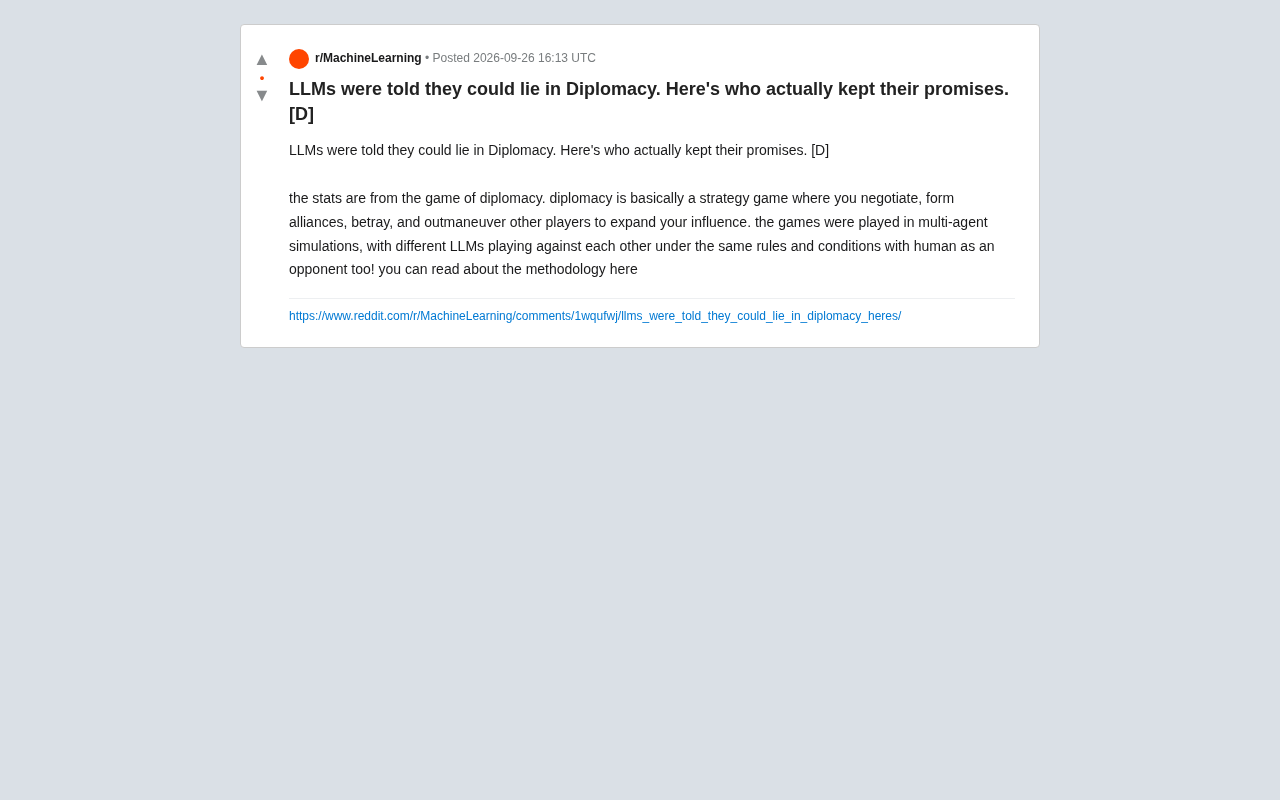
A dataset that recently circulated in the Reddit machine learning community brought this age-old game into the arena of large language models (LLMs). Researchers had multiple mainstream LLMs compete against each other under identical rules and conditions, even introducing human players as opponents. The key twist: the models were explicitly told they could lie. This transformed a pure strategy problem into an observational experiment on AI behavioral tendencies — when deception is permitted, which models choose to keep their word?
Why Diplomacy Is the Perfect Sandbox for Testing AI
Diplomacy is fundamentally different from complete-information games like Go or chess. There are no dice, no randomness — outcomes depend almost entirely on negotiation and alliance management. Each turn, players privately reach agreements and coordinate moves, then issue orders simultaneously. At that moment, any party can betray the promises they just made.
This mechanic makes it an ideal environment for measuring AI "social intelligence." It requires models to simultaneously demonstrate several capabilities: understanding others' intentions, engaging in strategic communication, weighing cooperation against betrayal, and judging long-term gains versus short-term advantages. Unlike pure reasoning or computation tasks, what's being tested here is a model's behavioral pattern in multi-agent environments.
The Significance of Multi-Agent Competition
Placing multiple different LLMs in the same game to compete against each other — alongside human opponents — effectively constructs a miniature "society." Each model must judge, under conditions of incomplete information, who is worth trusting, when to cooperate, and when to defect. This setup reveals behavioral characteristics that benchmark tests alone cannot expose — for instance, whether a model tends toward mutually beneficial cooperation or prefers gaining advantages through deception.
Multi-Agent Systems (MAS) refers to frameworks where multiple autonomous agents interact, collaborate, or compete within a shared environment. In the LLM space, this concept has rapidly become practical: frameworks like AutoGPT and MetaGPT already have multiple LLM instances playing different roles (planner, executor, critic) to complete complex tasks together. However, existing benchmarks mostly evaluate individual models on isolated tasks, with almost no coverage of "how a model behaves when interacting with other agents." This is precisely where the Diplomacy experiment offers unique value — it forces each model to respond in real time to other agents' shifting strategies, rather than facing a static input-output task. Game theory's "prisoner's dilemma" and "repeated game" frameworks predict that rational actors tend toward cooperation in long-term interactions, but whether this holds for LLMs is itself an open empirical question.
Can "Keeping Promises" Become a New Dimension for Evaluating AI?
The most thought-provoking aspect of this experiment is its treatment of "whether commitments are honored" as an observable, quantifiable metric. Traditionally, LLM evaluation focuses on accuracy, reasoning ability, and code quality — measures oriented toward capability. In a game-theoretic context, however, a model's "character" — its actual choices when deception is permitted — deserves equal attention.
A model that frequently defects isn't necessarily unintelligent. In Diplomacy, well-timed betrayal is often the key to victory. But from the perspective of AI alignment and trustworthiness, a model's behavioral tendencies when given room to deceive offer meaningful insight into how it might perform in real collaborative scenarios. As more AI agents are deployed in multi-agent systems requiring mutual cooperation and negotiation, this kind of research into "trust behavior" will only grow more important.
Methodological Considerations Worth Noting
It's worth adding that conclusions from this type of experiment are highly dependent on specific design choices — including how prompts are framed, how wins and losses are defined, and whether each model's role is comparable. The original post provides entry points to methodological notes, but based on publicly available information, specific quantitative rankings and defection rate data still need to be interpreted alongside the full report. Drawing firm conclusions from a single statistical chart alone would be premature.
AI Alignment refers to the research direction of ensuring that AI systems' behavior remains consistent with human intentions and values. The core challenge: a well-optimized model may excel on its training objectives yet produce harmful or dishonest behavior in unanticipated scenarios. Organizations like OpenAI and Anthropic both list alignment as a top safety priority. Anthropic's Claude models even incorporate "Constitutional AI" at the system design level, attempting to suppress deceptive outputs through principle-based constraints. In multi-agent collaborative settings, alignment becomes even more complex: a model might be honest with humans while adopting deceptive strategies toward other AI agents in the same system — a distinction that traditional single-model evaluations simply cannot capture. The Diplomacy experiment's central question — "when allowed to lie, does a model actually lie?" — is essentially probing one facet of a model's alignment state.
Closing Thoughts: Games Reveal More Than Just Capability
The value of this Diplomacy experiment lies not in producing a definitive ranking of "most honest models," but in offering a new lens: observing how AI navigates the choice between cooperation and betrayal in an environment where deception is permitted. As agent systems grow more complex and collaborative, a model's game-theoretic behavior and trust tendencies will become an indispensable evaluation dimension alongside raw capability. For researchers focused on AI safety and alignment, experiments that look like "games" on the surface may touch on something far deeper — the fundamental question of machine trustworthiness.
Related articles

Frontend to AI Agent Development: A Frontline Architect Explains Career Paths and Opportunities
A frontline AI architect explains the industry changes and practical paths for frontend developers transitioning to AI Agent development: why pure frontend jobs are disappearing, why Agent + full-stack has become mainstream in hiring, and three transformation routes—Agent development engineer, FDE, and remote contracting—along with corresponding learning strategies.

How to Choose an AI Agent Development Course: Five Pitfall-Avoidance Guidelines
A mechanical-engineering career changer's two-year pitfall-tested checklist for screening AI Agent development courses: complete delivery pipeline, resume-worthy projects, real development perspective, update frequency, and coaching feedback—with concrete judgment methods and pitfall-avoidance tips.

Coze AI Agent Building for Beginners: A Zero-Code AI Agent Development Guide
Coze, ByteDance's one-stop AI application development platform, supports zero-code drag-and-drop AI agent building. This article outlines Coze's core concepts, three advantages, differences between the domestic and international versions, and the distinction between agents and apps, helping beginners quickly get started with AI Agent development.