When Should a Voice Assistant Speak? A Study on End-of-Turn Detection in Turkish

Turkish study compares fine-tuned, zero-shot, and multilingual models; fine-tuned TurnGPT with timing features detects end-of-turn more accurately.
The article presents a study on end-of-turn detection in Turkish, addressing how fixed silence thresholds fail to distinguish thinking pauses from true endings. Using a two-person video conversation corpus, it compares a fine-tuned Turkish TurnGPT, a zero-shot language model, and an existing multilingual detector, incorporating voice activity timing and facial features. Results show the fine-tuned model outperforms text baselines and is best calibrated; combining timing features with fine-tuned text scores performs best under logistic regression; adding text scores to silence timeout shortens latency at the same interruption rate; and the advantage holds under automatic Whisper transcription. The article recommends treating turn detection as an independent module fusing text and voice timing.
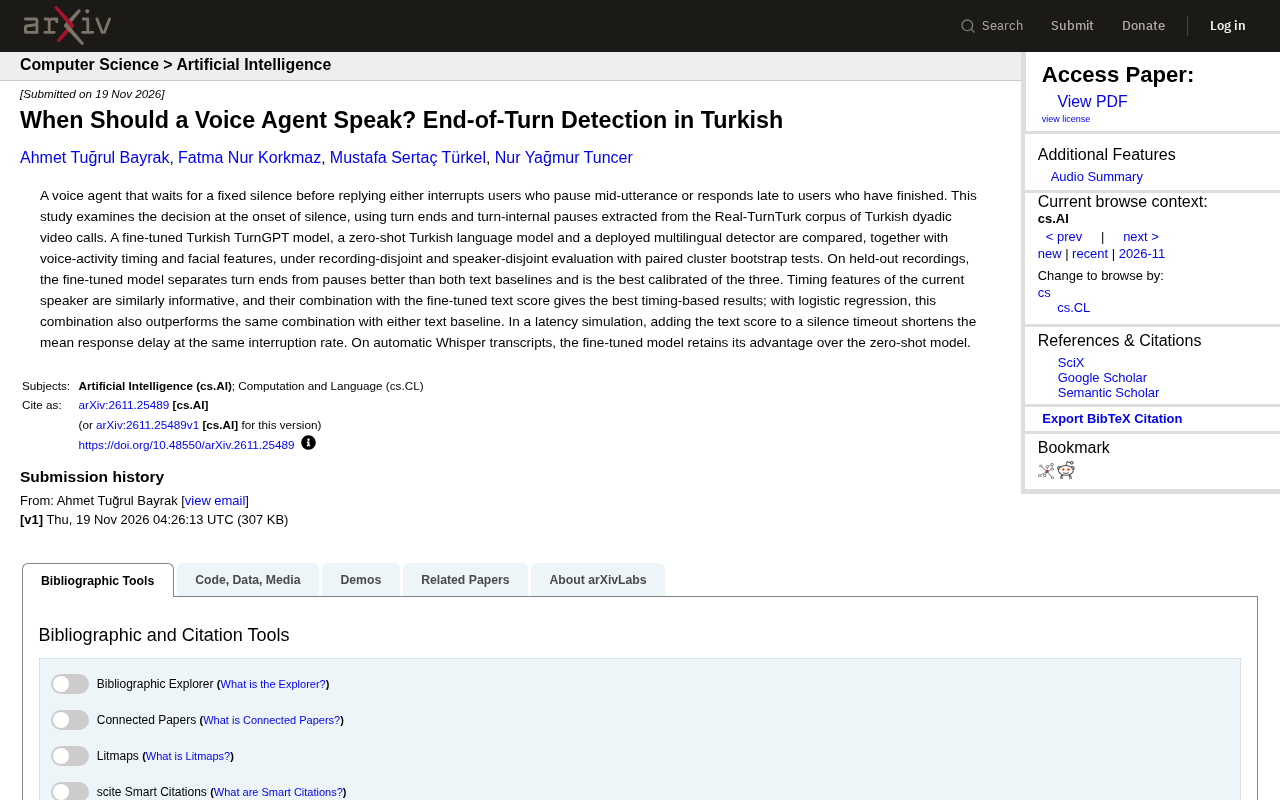
If a voice assistant relies solely on a fixed silence duration to judge whether the user has finished speaking, the results are often unsatisfactory: it either barges in when the user pauses to think, or responds sluggishly after the user has already finished. Detecting the "end of turn" more accurately is key to making voice interaction more natural. A study on Turkish offers valuable insights by comparing a fine-tuned model, a zero-shot model, and an existing multilingual detector.
Research Background: Why Silence Thresholds Fall Short
In two-person video calls, the rhythm of conversation is full of variation. A user may pause mid-sentence to think, or remain briefly silent after truly finishing. A fixed silence timeout cannot distinguish between these two cases, causing the voice assistant to either interrupt the user or respond sluggishly.
This study focuses on "the moment silence begins"—that is, when the system detects silence, it must judge whether this is an intra-turn pause or the true end of a turn. The research uses end-of-turn points and intra-turn pause points extracted from Real-TurnTurk, a corpus of Turkish two-person video conversations, as its data foundation.
Model Comparison: Fine-tuned, Zero-shot, and Multilingual Detectors
The study compared three approaches: a fine-tuned Turkish TurnGPT model, a zero-shot Turkish language model, and a deployed multilingual detector. It also incorporated voice activity timing features and facial features, and used a paired cluster bootstrap for statistical testing under two evaluation settings: recording-disjoint and speaker-disjoint.
On held-out recordings, the fine-tuned model outperformed both text baselines in distinguishing turn endings from pauses, and was the best calibrated of the three. This shows that fine-tuning for a specific language can more effectively capture end-of-turn cues.
TurnGPT is a Transformer-based end-of-turn prediction model whose core idea is to take the conversation history (usually a text transcript) as input and predict whether the current moment is an end-of-turn point. It was originally designed for English, learning the distributional differences between pauses and endings by fine-tuning a language model on conversation data. A zero-shot model refers to a pretrained language model used directly for inference without fine-tuning on the target language or task; its advantage is that it requires no labeled data, but its calibration and discriminative power are usually weaker. Calibration refers to the consistency between a model's output probability scores and actual occurrence frequencies; a well-calibrated model that gives a 0.7 end probability means that roughly 70% of such cases do indeed end, which is crucial for setting thresholds and weighing interruption rates. The paired cluster bootstrap is a statistical resampling method that, when speakers or recordings have a clustered structure, estimates confidence intervals for metric differences through paired resampling, avoiding significance overestimation caused by non-independent data.
Combining Timing Features with Text Scores
Beyond text models, the current speaker's timing features are also informative. The study found that combining timing features with the fine-tuned model's text scores yields the best timing-based results. When using logistic regression, this combination also outperforms the same combination using either text baseline.
In latency simulations, adding text scores to the silence timeout decision can shorten the average response latency at the same interruption rate. This means the system can respond in a shorter time without increasing the probability of interrupting the user.
Voice activity timing features refer to statistics extracted from the voice activity detection (VAD) sequence, such as the duration of the current silence so far, the length of the previous speech segment, or the speech rate or energy changes in the speech before the silence. These features do not depend on text content, are computationally cheap, and can reflect the speaker's rhythmic habits. Logistic regression serves here as a lightweight fusioner, mapping text scores and timing features to an end-of-turn probability; its coefficients are interpretable and not prone to overfitting, making it suitable for small-scale data. Interruption rate refers to the proportion of cases where the system incorrectly triggers a response before the user has finished speaking; response latency refers to the time from when the user truly finishes to when the system responds. The two form a trade-off curve, and adding text scores is equivalent to shifting the curve to the lower left at the same interruption rate, thereby shortening latency.
Robustness under Automatic Transcription
The study also examined performance on automatic Whisper transcripts. The fine-tuned model's advantage over the zero-shot model still held. This is important for real-world deployment, because in real scenarios only automatic transcripts are often available, not human-written transcripts.
Whisper is a multilingual automatic speech recognition model released by OpenAI; its transcripts may contain misrecognized words, missing words, missing punctuation, and segmentation differences. In turn detection tasks, the noise in automatic transcripts weakens the text model's judgment of syntactic completeness, making model robustness a deployment key. The study shows that the fine-tuned model still outperforms the zero-shot model on Whisper text, indicating that the cues it learns do not depend on perfect transcripts but come more from statistical patterns in the conversation context. This also suggests that real systems should evaluate and calibrate models using automatic transcription data consistent with deployment conditions.
Implications for Voice Interaction Design
This study conveys several clear signals. First, fine-tuning a turn detection model for the target language is more effective than directly using a zero-shot or multilingual general-purpose model. Second, combining text information with timing information brings additional gains; relying solely on silence thresholds or a single modality is insufficient. Finally, the preservation of the model's advantage under automatic transcription shows that the method has a certain degree of engineering feasibility.
For teams building voice assistants, this means end-of-turn detection deserves serious treatment as an independent module. Rather than adjusting silence thresholds, it is better to introduce lightweight text scoring and fuse it with voice activity timing features to achieve a better balance between response latency and interruption rate.
(The study is based on a Turkish corpus; applicability to other languages requires further validation.)
One-line Summary
A Turkish study comparing fine-tuned, zero-shot, and multilingual models finds that a fine-tuned TurnGPT combined with timing features detects end-of-turn more accurately.
Paragraph Summary
This article introduces a study on end-of-turn detection in Turkish, aimed at solving the problem that fixed silence thresholds cannot distinguish user thinking pauses from true endings. Based on a corpus of two-person video conversations, the study compared a fine-tuned Turkish TurnGPT, a zero-shot language model, and an existing multilingual detector, and incorporated voice activity timing and facial features. Results show that the fine-tuned model outperforms text baselines in distinguishing endings from pauses and is best calibrated; combining timing features with fine-tuned text scores achieves the best results under logistic regression; adding text scores to the silence timeout decision shortens response latency at the same interruption rate; and the advantage persists under automatic Whisper transcription. The article recommends treating turn detection as an independent module that fuses text and voice timing information.
Related articles

Figma Workplace Scandal: Employee Sues CEO for Forcing Confrontation with Harasser
Figma and its CEO are sued by a current employee alleging sexual harassment and discrimination, and forcing the victim to confront her harasser. This article outlines the background, potential impact, and industry reflection.

Jensen Huang and Nvidia: Elite Privilege Behind the Revolving Door of Business and Politics
An opinion piece uses Jensen Huang's reappointment as Nvidia CEO to examine business-government ties and elite impunity, questioning free-market ideals and AI industry governance.
AI Gateway Launches Extraction Models: Precisely Pull Structured Fields from Invoices and Contracts
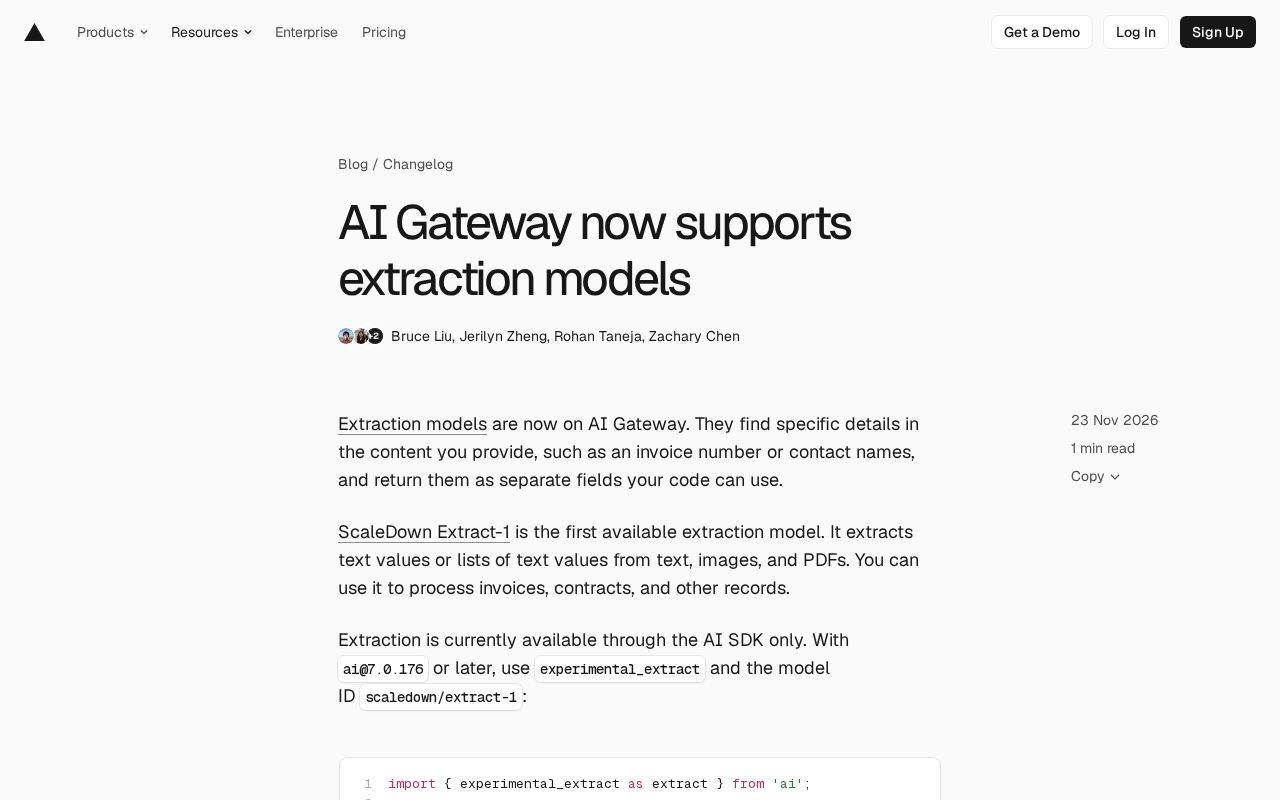
AI Gateway adds extraction models, debuting with ScaleDown Extract-1, which pulls fields like invoice numbers and contacts from text, images, and PDFs, returning confidence scores and character offsets via AI SDK's experimental_extract.