When Tool Calls Time Out: A Failure Drills Lesson for Production RAG

Packt workshop focuses on RAG production failure scenarios: timeouts, retries, tracing, and permissions.
The article introduces a 4-hour hands-on workshop by Packt Publishing this Saturday on the genuinely tricky problems when moving RAG systems from demo to production. The author notes that demo tutorials only show the "happy path" of retrieval hits and smooth model answers, while the core production risks are tool call timeouts, retry loops, overly broad tool permissions, and a lack of records that can reconstruct what the agent did. Using an "AI data analyst" example scenario, the workshop covers timeouts, retries, replanning, and execution budgets, and emphasizes the value of structured tracing for debugging wrong answers, as well as proactively exposing weak points through permissioned tool access and fault injection testing. Led by Bruno Gonçalves, the course uses simulated models, runs on a laptop, and requires no GPU or API key—its focus is the engineering infrastructure layer wrapping the model.
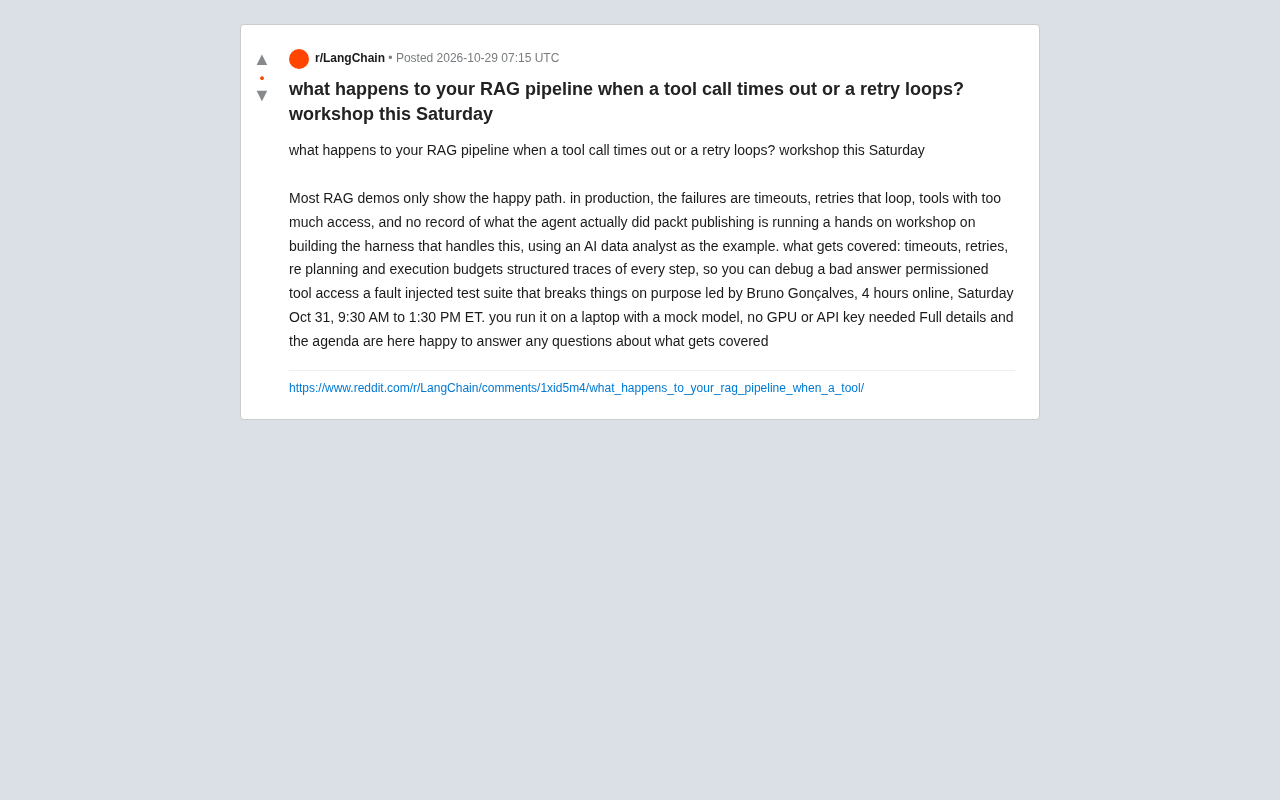
Most RAG (Retrieval-Augmented Generation) demos only show the "happy path": retrieval hits, the model answers, and everything flows smoothly. But when you actually push a system toward production, the problems tend to surface elsewhere—tool call timeouts, retries stuck in infinite loops, overly broad tool permissions, and no records that can reconstruct exactly what the agent did. These are precisely the topics that Packt Publishing's hands-on workshop this Saturday aims to break down.
Why RAG failure scenarios deserve a course of their own
A RAG system is essentially a chain of multiple components: retriever, reranker, generative model, and increasingly a tool-calling layer. Demo environments usually assume every link returns reliably, but in production, timeouts and retries are the norm. When a tool call times out, does the system retry, give up, or replan? If the retry strategy is poorly designed, you can end up with looping retries that burn through the execution budget without producing a useful result. Packt's workshop puts these issues on the table, using an "AI data analyst" as the example scenario to simulate failure handling in a realistic pipeline.
According to the workshop page, the content covers timeouts, retries, replanning, and execution budgets. These points look independent but are actually interconnected: the execution budget sets a resource ceiling for the entire task, while timeout and retry policies determine how that budget gets consumed. Retries without a budget constraint easily turn into infinite loops.
Replanning is the mechanism by which an agent, when a tool call fails or a result doesn't meet expectations, abandons the current execution path and generates a new plan based on existing information. Unlike a simple retry, replanning changes the sequence of subsequent steps—for example, switching to another retrieval source or adjusting the query. The cost is additional model calls and latency, so it must work in tandem with the execution budget: when the budget is exhausted, planning should stop and the system should degrade gracefully. Without replanning capability, an agent tends to retry repeatedly at the same point of failure, forming an ineffective loop.
Structured tracing: the prerequisite for debugging wrong answers
The second key point the workshop emphasizes is "structuring tracing of every step so you can debug wrong answers." This is often underestimated in production RAG. When a user gets a wrong answer, without a complete execution trace it's very hard to tell whether retrieval recalled the wrong thing, the model's reasoning went off track, or some tool call returned a misleading result. Structured tracing records the input/output, state, and latency of each step, turning fault localization from "guessing" into "looking it up." This aligns with general practice in the observability field, except that RAG agents introduce more non-deterministic elements, which amplifies the value of tracing.
Observability in agent scenarios typically consists of three parts: traces, metrics, and logs. A trace records the tree-like call relationships of all steps within a single request, with each node containing input, output, state, and latency. For RAG agents, tracing needs to additionally capture retrieved document IDs, tool call parameters and returns, and key metadata from model sampling. A common industry implementation is based on OpenTelemetry's span model, attaching each tool call and model generation as a child span under the root request, thereby supporting drill-down analysis by latency or error rate.
Permissioned tool access and fault injection testing
Overly broad tool permissions are another easily overlooked risk. The workshop lists "permissioned tool access" as covered content, meaning that when agents call tools they need clear permission boundaries rather than having all capabilities by default. Combined with the "fault injection test suite" item—deliberately introducing faults during testing—it's clear the course's design philosophy is to proactively expose weak points rather than wait for production incidents. Fault injection is already a mature technique in distributed systems testing; ported to the RAG agent scenario, it can reproduce timeouts, abnormal returns, and permission denials in a controlled environment, validating pipeline resilience in advance.
Workshop details
The course is led by Bruno Gonçalves, lasts 4 hours, and is held online on Saturday (October 31) from 9:30 AM to 1:30 PM Eastern Time. Participants only need a laptop to run it; the workshop uses simulated models and requires no GPU or API key. While this lowers the barrier to entry, it also shows that the course's focus is not on the model itself but on the "harness" layer wrapping the model—the engineering infrastructure of timeout handling, retry control, tracing, and permission management.
For teams moving RAG from prototype to production, this kind of content fills in exactly what demo tutorials usually skip. Designing with failure as a first-class citizen is the dividing line between a RAG pipeline that can ship and one that can't.
Related articles

Gemini 4 Carbon Tops Global Rankings as AI Productivity and Open-Source Ecosystems Surge
Google DeepMind's Gemini 4 Carbon tops global benchmarks, built for complex agents and system security. ByteDance launches Doubao Work integrated with Feishu, Anthropic's AI autonomously breaches 5 system-level attack chains, and ModelBest and Fudan open-source on-device multimodal and image generation models.

Overseas Creator Breaks Down N8n AI Agent Business Playbook: From Tooling to Monetization
An overseas creator breaks down the N8n AI agent business playbook: comparing Zapier, Make, and N8n, detailing four monetizable automation categories—lead capture, WhatsApp follow-up, booking, and content pipelines—plus agency pricing and a sales playbook.

Empacer: The Voice-First AI Assistant for Small Business Owners That Topped Product Hunt
Empacer is a voice-first AI assistant for small business owners: three-question setup, voice requests turned into customer replies, social posts, and invoices—all owner-approved. It won #1 Product of the Day on Product Hunt with 231 upvotes and 47 comments.