When Will AI's Trillion-Dollar Bet Pay Off? It All Comes Down to Productivity

Trillion-dollar AI capex is a done deal — but whether it pays off hinges on real productivity gains.
Using Wharton professor Jessica Wachter's analysis as a lens, this article focuses on the core economic question of the current AI boom: a handful of tech giants have committed trillions to data centers and AI infrastructure — an undeniable fact — but whether that spending translates into meaningful productivity gains and commercial returns remains deeply uncertain. The key prerequisite for payoff is AI becoming genuinely embedded in enterprise workflows, not just staying at the concept stage. From a macro view, AI investment is now a significant driver of economic growth, and the outcome looks binary: either a major productivity revolution or a painful correction.
An Unprecedented Capital Gamble
Wharton School finance professor Jessica Wachter faces a long list of business and technological uncertainties when assessing AI's economic impact over the coming years. But she chooses to start from what she calls a "salient fact" — a small number of large tech companies are committing astronomical levels of capital expenditure to build data centers, procure computing chips, and construct AI infrastructure.
The scale of this investment has already reached the trillion-dollar range. The question isn't whether the money is being spent — it is. The real question is whether these massive outlays will ultimately generate returns commensurate with their scale. This is the central challenge that markets, investors, and the broader macroeconomy cannot avoid.
The Certainty of Spending vs. the Uncertainty of Returns
From an accounting and financial perspective, the current AI boom displays a striking asymmetry: the input side — the spending — is certain, quantifiable, and actively happening; the output side — whether these investments will translate into real revenue growth, cost savings, or entirely new business models — remains deeply uncertain.
Wachter's analytical framework has a distinctive quality. Rather than getting drawn into hard-to-predict debates about AI's technical capabilities or the speed of real-world deployment, she anchors the analysis in that one "indisputable fact": capital has already been deployed at massive scale. This provides a solid starting point for economic analysis. When a handful of giants bet the equivalent of a mid-sized nation's GDP in the same direction, the effects on the broader economy cease to be a theoretical question — they become an inevitability.
This asymmetry isn't without historical precedent. During the late 1990s dot-com bubble, telecom companies and internet firms similarly laid fiber-optic infrastructure at scale, pouring hundreds of billions of dollars into buildout while effective demand remained severely insufficient — ultimately contributing to the 2001 tech crash. Yet that infrastructure wasn't truly "wasted" — it laid the physical foundation for two decades of internet prosperity. Economics has a concept called the Overinvestment Cycle, which describes exactly this phenomenon: capital flooding into the early stages of a technology wave, with capacity dramatically outpacing demand. Whether today's AI infrastructure buildout will repeat this historical pattern, or whether rapid application-layer adoption can absorb the capacity, is the key fault line in assessing where this bet is headed.
The Prerequisites for Breaking Even
For this trillion-dollar gamble to ultimately "pay off," several conditions must be met. The core requirement is a substantial improvement in productivity — AI must be genuinely embedded into enterprise workflows, delivering measurable gains in efficiency or revenue growth, rather than remaining confined to concept demos and pilot projects.
From a basic investment-return logic, capital expenditure of this magnitude demands future cash flows of equivalent scale. If AI merely substitutes for some existing workflows without creating incremental value — or if deployment costs remain structurally higher than the labor costs it replaces — the economic math simply doesn't work.
This also explains why markets are so sensitive to revenue growth at AI companies. Capital markets are willing to pay in advance for "future enormous returns," but that patience is not unlimited. The longer the gap between investment and return stretches, the greater the pressure on valuation support.
Whether productivity improvements are actually occurring presents a famous measurement problem in economics: the "Productivity Paradox." Nobel laureate Robert Solow wryly observed in 1987: "You can see the computer age everywhere except in the productivity statistics." This became known as the Solow Paradox. Historical research shows that general purpose technologies (GPTs — such as electricity and the internal combustion engine) typically require decades of organizational transformation and process redesign before significant productivity gains show up in macro-level statistics. Whether AI qualifies as such a technology, and whether firms can accelerate the necessary organizational adaptation, directly determines the timeline for investment returns. This is why some economists remain cautious about seeing significant AI productivity dividends in the near term.
Far-Reaching Implications for the Economy and Markets
Zooming out to the macro level, the stakes of this gamble have already surpassed the financial statements of a few companies. Data center construction is stimulating upstream industries including energy, semiconductors, and construction; AI-related spending has become one of the key drivers of recent economic growth. This means that whether AI delivers on its promised returns matters not just for tech giants' stock prices — it could also shape the pace of overall economic expansion.
If returns materialize as expected, AI will become the engine of a new productivity revolution. If returns are delayed or fall far short of projections, the lofty valuations and heavy investment surrounding AI could face a painful correction. This "either big success or big correction" binary is the source of current market anxiety.
The pull effect of data center construction on the energy sector deserves particular attention. According to International Energy Agency (IEA) estimates, global data center power consumption is expected to roughly double by around 2026, with AI inference and training workloads far exceeding the computational density of traditional cloud computing tasks. This has triggered a chain reaction across grid infrastructure, nuclear energy revival (such as Microsoft's agreement related to the Three Mile Island restart), and renewable energy procurement. From a macroeconomic perspective, AI capital expenditure has become a significant component of U.S. fixed asset investment, providing meaningful support for recent GDP growth figures amid a slowdown in manufacturing investment. This deeply ties the sustainability of AI investment to broader economic cycle dynamics — treating it as purely an internal tech-industry matter is no longer accurate.
Approaching This Bet Rationally
What's worth distilling from this analysis is a posture of measured thinking: in the face of a technology wave filled with uncertainty, first identify what is certain, then reason forward from there. The trillion-dollar investment is an established fact; the returns depend on whether AI can truly translate into productivity gains.
For business decision-makers, this means evaluating AI projects with a more pragmatic eye toward actual value creation, rather than blindly following the herd. For investors, it means staying alert to the risk of temporal mismatch between investment and return. The outcome of this bet will reveal itself gradually over the coming years.
Related articles
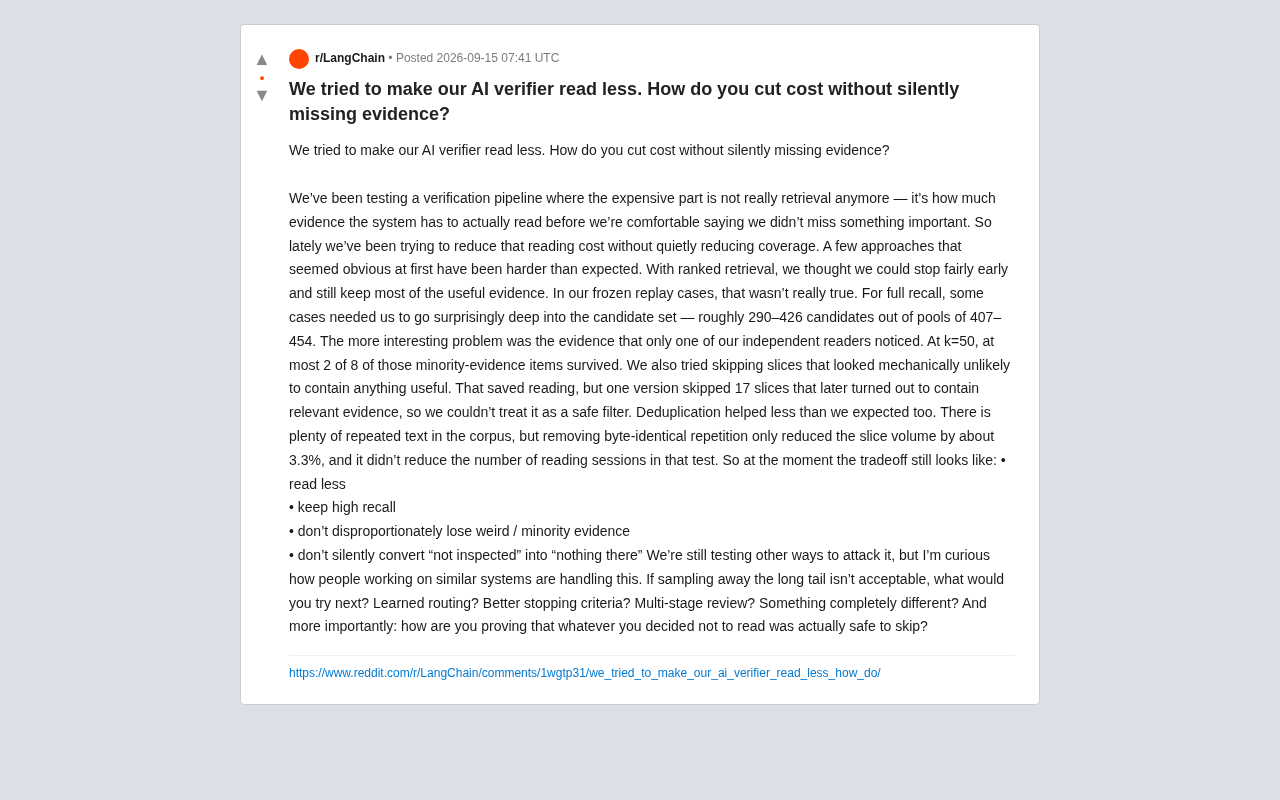
The Cost Reduction Dilemma in AI Verification Systems: How to Read Less Evidence Without Missing What Matters
The real cost in AI verification pipelines isn't retrieval — it's how much evidence must be read. This post examines why early stopping, slice skipping, and deduplication fall short, and the core challenge of preserving minority evidence.

Developer Fine-Tunes AI Model to Remove Video Subtitles and Watermarks
A developer fine-tuned an open-source model to remove subtitles and watermarks from video and images, deploying it on Hugging Face for public use.

Salesforce and Nvidia Launch Koa: How Open-Weight Models Are Disrupting Enterprise AI
Salesforce and Nvidia's Koa reasoning model targets sales, marketing, and customer support using Nvidia's open-weight Nemotron. Here's why this vertical AI strategy should worry general-purpose AI labs.