Where Is Pure Mathematics Headed in the Age of AI?

AI is reshaping pure mathematics through theorem verification and conjecture generation, raising deep questions about understanding and the future of research.
As formal tools like Lean integrate with large language models, AI's role in pure mathematics has expanded from computation to proof verification and conjecture generation. Machine learning has already uncovered previously unnoticed patterns in knot theory and representation theory, hinting at a new paradigm where AI proposes and humans prove. Yet deep concerns remain: do machine-generated proofs humans cannot intuitively grasp hold genuine epistemic value? How will mathematicians redefine their core competencies? And will over-reliance on AI tools erode independent thinking in the next generation? The prevailing view is that AI will serve as a "super-assistant" for verification and pattern recognition, while creative work — posing deep questions and building new concepts — remains distinctly human.
Pure Mathematics Research Under the AI Wave
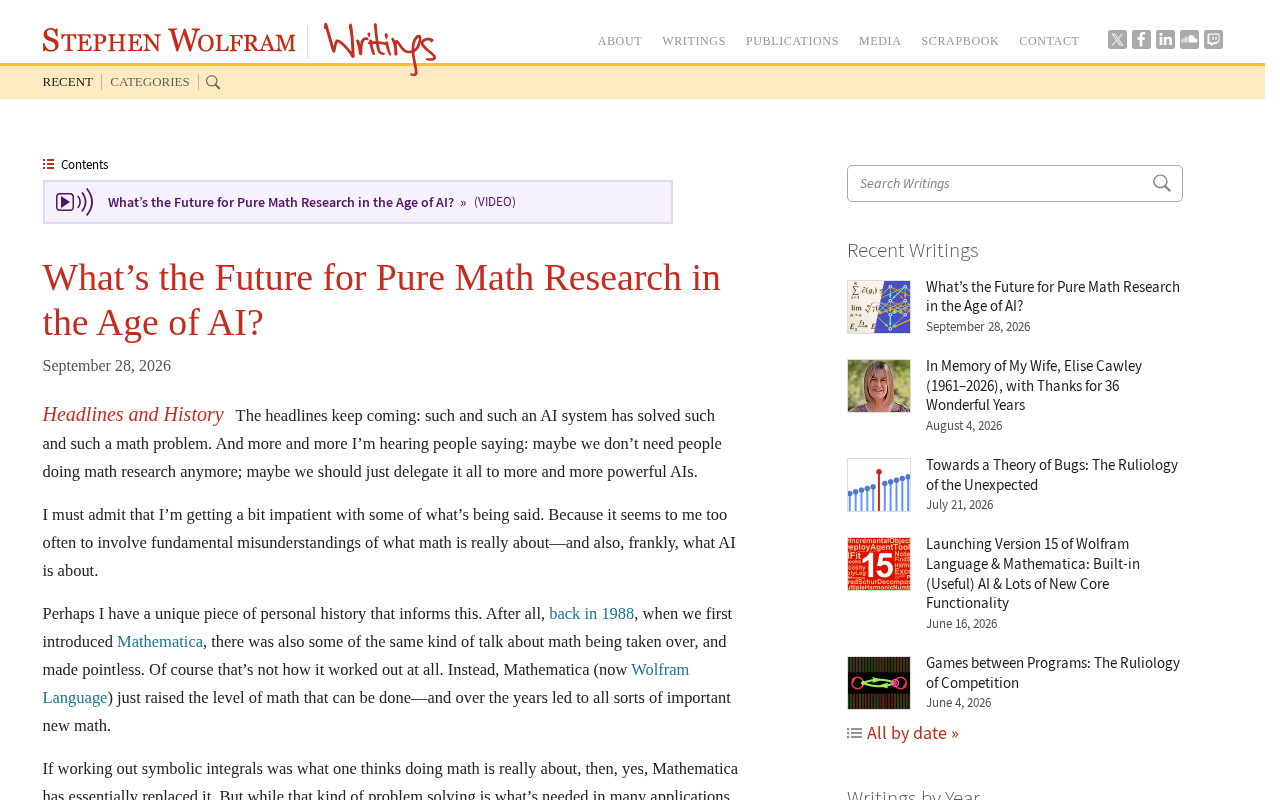
As artificial intelligence continues to make breakthroughs in theorem proving, symbolic computation, and mathematical reasoning, a fundamental question is emerging: where is pure mathematics research headed in an era of increasingly powerful AI? This topic has sparked discussions in technical communities like Hacker News, reflecting the collective thinking of mathematicians and tech enthusiasts about the discipline's future.
Pure mathematics has long been regarded as one of the highest forms of human intellectual activity — independent of direct practical applications, it pursues the beauty of logic and a deep understanding of abstract structure. AI's involvement is now reshaping the ecology of this traditional field, at both the tool level and the cognitive level.
What AI Can Bring to Mathematical Research
Automated Theorem Proving and Verification
The integration of formal proof tools (such as Lean and Coq) with AI has brought machine-assisted proving from concept to practice. AI can help mathematicians verify lengthy, complex proof steps, reducing human error. In recent years, some cutting-edge research has begun using large language models to help generate proof drafts, which are then verified for correctness by formal systems.
This means mathematicians can free themselves from tedious technical verification and focus more on creative idea construction. For proofs involving massive case classifications — like problems in the style of the Four Color Theorem — the value of AI is especially pronounced.
Lean and Coq are classified as Interactive Theorem Provers (ITPs). They require users to translate mathematical proofs into machine-checkable formal languages, where every step of reasoning must conform to strict type-theoretic rules. Lean 4 has gained widespread attention in the mathematics community in recent years, largely due to the Mathlib project — a large, community-built formal mathematics library that already encompasses tens of thousands of theorems. In contrast, Automated Theorem Provers (ATPs) such as Vampire and E-prover require no human intervention and are suited for problems within first-order logic. The introduction of large language models bridges the gap between the two: a model can translate mathematical ideas written in natural language into proof fragments acceptable to Lean, which are then mechanically verified by the formal system. In 2023, DeepMind's AlphaProof system reached silver-medal level on International Mathematical Olympiad problems, marking a milestone validation of this approach's practical viability.
Conjecture Generation and Pattern Discovery
Another potential contribution of AI lies in identifying hidden patterns within large volumes of mathematical data and proposing new conjectures. Research teams have already used machine learning to discover previously unnoticed relationships in areas such as knot theory and representation theory, providing mathematicians with new research leads.
This collaborative model — where "AI proposes conjectures and humans prove them" — may become a normalized paradigm in future mathematical research.
In 2021, DeepMind collaborated with researchers from Oxford, Sydney, and other universities to publish a paper in Nature, demonstrating how machine learning could help discover new relationships between knot invariants and geometric quantities, as well as combinatorial patterns in the characters of symmetric groups in representation theory. The researchers trained neural networks to perform regression on numerical data from known mathematical objects, then used "saliency analysis" to identify which input features the network relied on most heavily — guiding human mathematicians to distill conjectures that could be precisely proved. This pipeline is called "ML-assisted mathematics," and in essence treats neural networks as exploratory analysis tools for high-dimensional data, rather than as direct proof machines. Notably, the "correlations" identified by machines are often statistical and unexplained; translating them into rigorous mathematical propositions still depends entirely on the judgment and creativity of human mathematicians.
Controversy and Concern: Will AI Change the Essence of Mathematics?
Despite the enticing prospects, genuine concerns about AI's involvement in pure mathematics also exist.
The first is the question of understanding. Mathematics is not just about arriving at correct answers — it is about understanding why something is true. If a theorem is proven by AI in a way that humans cannot intuitively grasp, to what extent does such a proof advance human mathematical knowledge? This is a profound philosophical question.
The second is the changing role of researchers. When AI can take on more and more of the reasoning work, where does a mathematician's core competency actually lie? Is it in asking good questions, building valuable theoretical frameworks, or interpreting and giving meaning to results?
The third is the impact on mathematical education and talent development. If young researchers become overly reliant on AI tools, will this erode their capacity for independent reasoning and deep thought? This concerns the long-term health of the discipline.
The "understanding" problem did not arise with AI. In 1976, the computer-assisted proof of the Four Color Theorem first triggered a debate in the mathematics community over whether a machine proof counts as a real proof — the proof required exhaustively checking 1,936 cases, making it impossible for humans to verify one by one. Philosophers and mathematicians subsequently proposed "surveyability" as a criterion for proof legitimacy: a proof should be one that a competent reader can fully examine within a finite amount of time. Proofs generated by current large language models face the same challenge under this standard — arguably an even more severe one — because the internal reasoning processes of neural networks are themselves opaque. This creates a new rift between "formally verified as correct" and "genuinely understood by humans," which the philosophy of mathematics describes as the problem of the "epistemic gap."
Possible Future Scenarios
Based on current trends, the relationship between AI and pure mathematics research is more likely to be one of augmentation rather than replacement. The creative core of mathematics — posing profound questions, establishing wholly new concepts, perceiving connections between abstract structures — remains deeply dependent on human intuition and aesthetic sensibility.
A pragmatic expectation is that AI will become a mathematician's "super-assistant," handling verification, search, computation, and pattern recognition tasks, while humans focus on setting direction and interpreting meaning. The division of labor between the two will gradually become clearer as the technology matures.
At the same time, the mathematics community will need to establish new norms for evaluating AI-assisted research — including standards for the comprehensibility of proofs, questions of authorship credit for AI contributions, and the boundaries of trustworthiness for formal verification.
Conclusion
Pure mathematics research in the age of AI stands at a crossroads filled with uncertainty but also with possibility. It is neither a "sunset discipline" destined to be replaced by machines, nor will it lose its original pursuit of truth and beauty because of AI's involvement. A more realistic picture may be one where humans and machines each play to their strengths, jointly expanding the frontiers of mathematical knowledge.
This discussion itself is still in its early stages, and related practices and consensus are evolving rapidly. What is certain is that how mathematicians and AI collaborate — and how they redefine what "research" means — will be a topic well worth watching in the years to come.
Related articles

M&M's Spent Millions Replacing Artificial Blue Dye — Why Is It So Hard?
Mars spent millions trying to replace artificial blue dye in M&M's with spirulina, but thick material clogs pipes and residue risks mold, forcing a full production-line rebuild. Here's the engineering behind the reformulation.
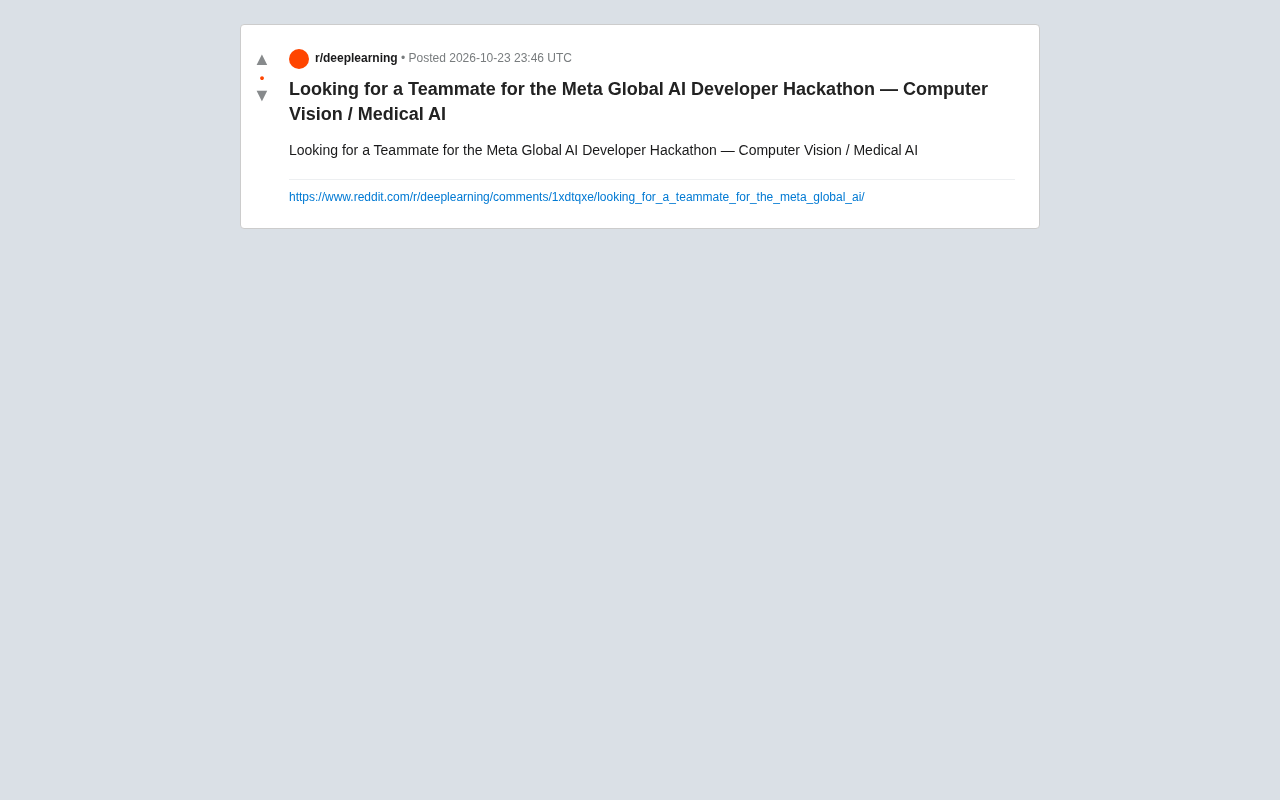
Teammate Wanted for Meta Global AI Developer Hackathon: Computer Vision & Medical AI
A Reddit developer seeks teammates for the Meta Global AI Developer Hackathon, focusing on computer vision and medical AI. This article analyzes the track logic, skills-complementarity needs, and topic selection strategy behind this teaming signal.
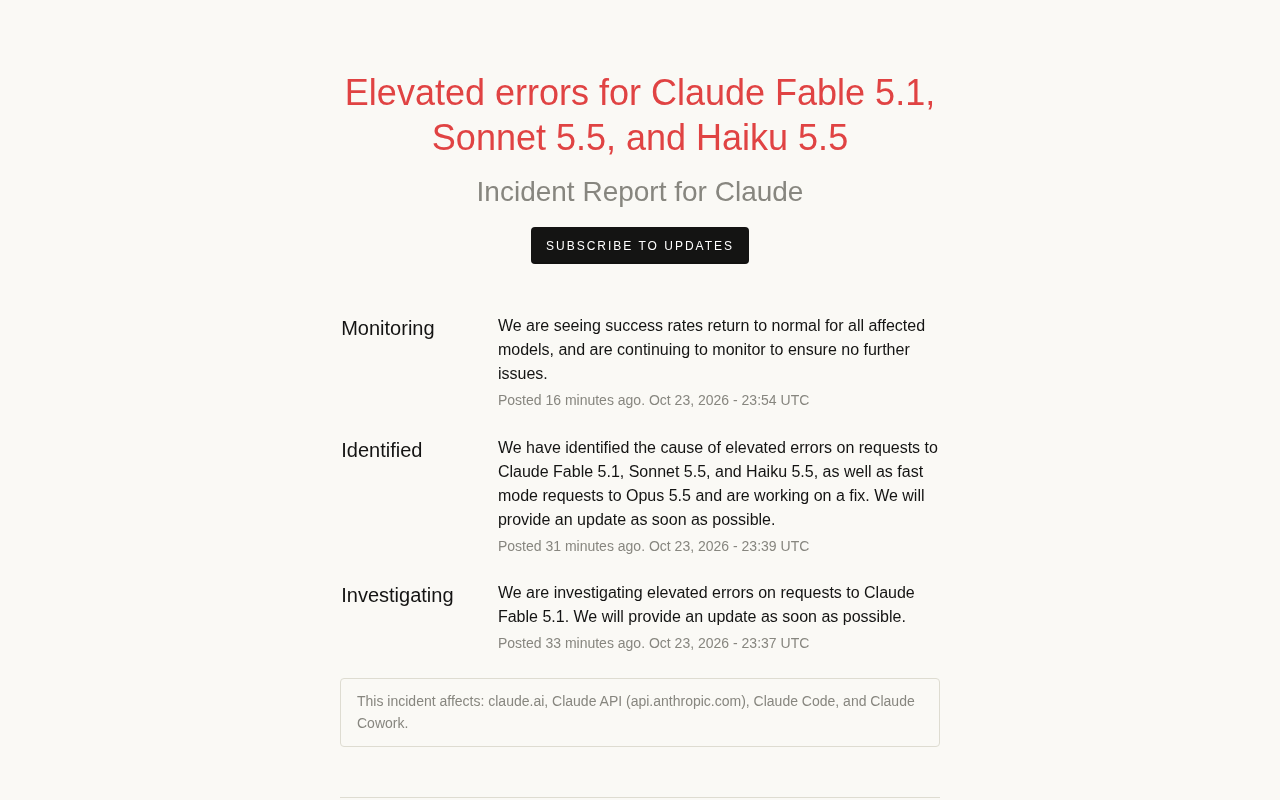
Multiple Claude Models Hit by Errors: A Postmortem of Fable 5.1, Sonnet 5.5, and Haiku 5.5
Claude Fable 5.1, Sonnet 5.5, Haiku 5.5, and Opus 5.5 fast mode saw elevated errors; Anthropic identified and resolved the issue in 17 minutes. This postmortem covers the timeline, the technical reasons for the multi-model cascading failure, and practical lessons for retry and degradation strategies.