Which Framework Should You Choose for a WhatsApp "Digital Coworker"? A Developer's Multi-Tenant State Management Dilemma

Framework selection for a WhatsApp digital coworker for small trade businesses: state ownership matters more than framework choice.
The article explores a developer's framework selection question for building a WhatsApp "digital coworker" for small trade businesses (tree care, plumbers, electricians). The system must handle voice message archiving, material task creation, invoice drafting, and schedule updates. Hard constraints include persisting conversation state per sender, code-level enforcement of human confirmation before writing to external systems, multi-tenancy from day one, office vs. field roles, structured state rather than chat logs as memory, and small-team maintainability. The author analyzes LangGraph's checkpointer and interrupt() fit for human-in-the-loop needs, notes that graph abstraction may become messy under multi-entity concurrent updates, and lists three open questions: context growth, multi-tenant isolation, and real voice evaluation. The inclination is to prototype with LangGraph but extract the business state machine so the framework isn't the sole source of state truth.
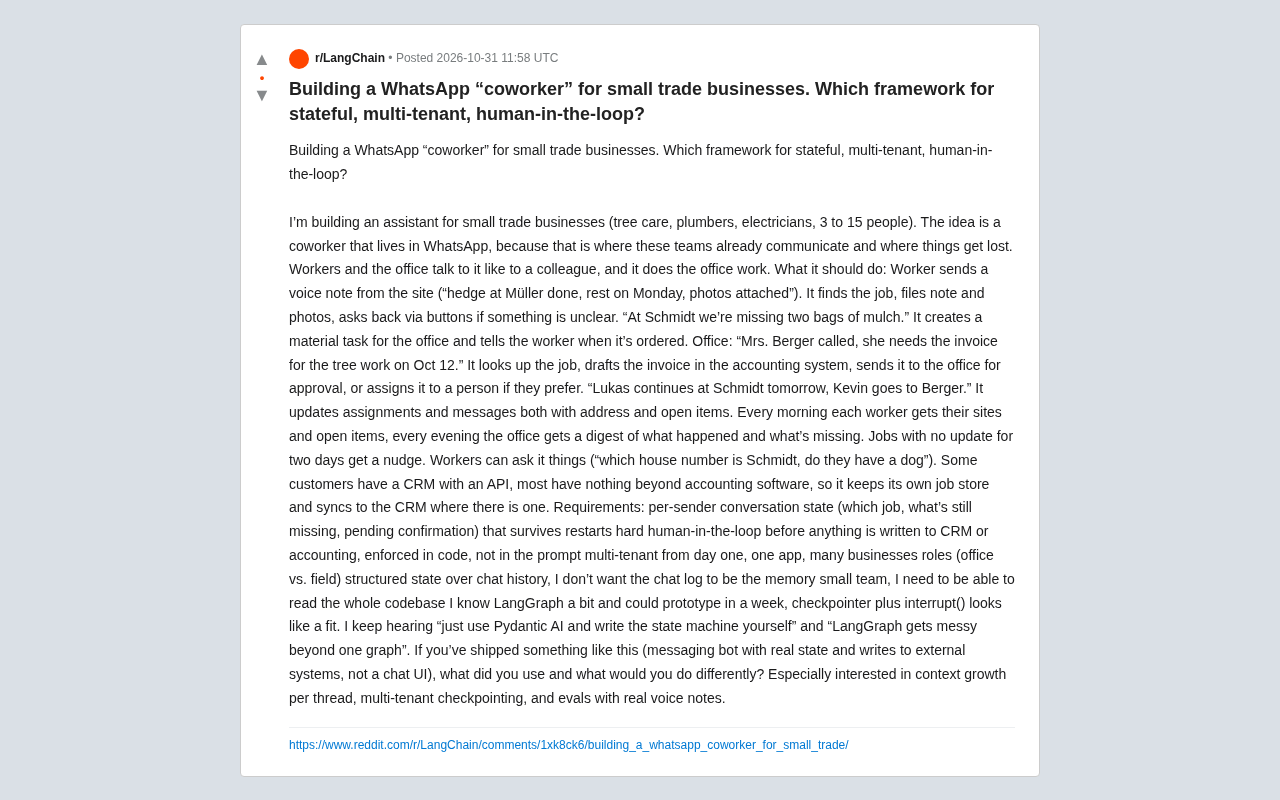
A developer on Reddit raised a fairly specific engineering selection question: he wants to build a "digital coworker" that lives inside WhatsApp for small trade businesses (tree care, plumbers, electricians, teams of 3 to 15 people). Workers and the office talk to it like a colleague, and it handles office work—from archiving field voice messages, creating tasks for out-of-stock materials, to drafting invoices, updating schedules, and daily summaries.
This question is worth examining seriously because it puts a common but underrated architectural challenge on the table: when a conversational bot needs to be truly stateful, multi-tenant, and enforce human confirmation before writing to external systems, how should you approach framework selection?
Breaking Down the Requirements: This Isn't a Chatbot
The feature list the author lays out reads more like the interaction layer of a lightweight ERP than a traditional customer service bot.
A worker sends a voice message: "The hedge at Müller's place is done, we'll continue with the rest on Monday, photos attached." The system needs to find the corresponding work order, archive the note and photos, and ask clarifying questions with buttons when information is unclear. Another message: "Schmidt's place is short two bags of mulch." The system needs to create a material task for the office and notify the worker once it's ordered. The office says: "Mrs. Berger called, she wants the invoice for the tree work on October 12th." The system needs to look up the work order, draft the invoice in the accounting system, and send it to the office for approval.
These scenarios impose several hard constraints on the system:
- Per-sender conversation state (which work order is currently being referenced, what's still missing, pending confirmations) must survive restarts;
- Mandatory human confirmation before writing to CRM or accounting systems, enforced at the code level, not through prompt constraints;
- Multi-tenant from day one, with one application serving multiple businesses;
- Role differentiation (office vs. field);
- Structured state rather than chat history as memory—the author explicitly states he doesn't want the chat log itself to be the memory;
- Maintained by a small team, with a codebase that one person can fully understand.
The last point is actually the constraint most often missing from technical selection discussions. The abstraction power of large frameworks is an asset in multi-person teams, but can become a liability in small ones.
LangGraph's Appeal and Concerns
The author describes himself as having some familiarity with LangGraph, able to build a prototype within a week, and believes that the checkpointer plus interrupt() seems to fit the requirements perfectly.
This assessment makes sense. interrupt() naturally corresponds to the "pause before writing and wait for human confirmation" pattern, while the checkpointer provides a mechanism for persisting state by thread. Together, they can indeed cover the core needs of "stateful + human-in-the-loop." For a product developer who needs to validate quickly, this is the lowest-friction path.
But he's also hearing two opposing voices. One says "just use Pydantic AI and write the state machine yourself." The other says "LangGraph gets messy once you have more than one graph."
Both voices point to the same concern: when the business logic isn't a single graph but a set of interwoven workflows organized by entity (work orders, workers, customers, material tasks), does the graph abstraction still hold?
There's no standard answer to this question. Graph models excel at expressing linear processes with clear branching; but the daily operations of this small business look more like concurrent updates to multiple entity states—the status of a work order, a worker's schedule, the progress of a material task—related to each other but updating at different rhythms. Forcing them into a single graph blurs the boundaries.
How Checkpointer and interrupt() Work
LangGraph's checkpointer is a component that persists graph execution state keyed by thread_id. Each thread corresponds to a conversation or task flow, and a complete state snapshot after each node execution is written to a storage backend (memory, SQLite, Redis, Postgres, etc.). This means that after a process restart, deployment update, or long interruption, the graph can resume from the last checkpoint without replaying the entire history.
interrupt() is a mechanism for actively pausing execution within the graph: when called, the graph saves its current state and suspends, returning an interrupt signal to the caller and waiting for external input (such as a human approval result) before resuming via Command(resume=...). Its key value is that the interruption point is controlled by code rather than prompts—the graph won't execute the next write node until it resumes, so "human confirmation required before writing to CRM" is structurally guaranteed rather than dependent on whether the model complies. For multi-tenant scenarios, checkpointer isolation is typically achieved by encoding the tenant ID into the thread_id or using separate namespaces.
Three Technical Details That Got Followed Up On
At the end of the post, the author names three areas where he most wants to hear real-world experience. These three points happen to be where this system is most likely to go wrong.
Context growth within a thread. A conversation between a worker and a work order could last for weeks, accumulating voice transcriptions, photo descriptions, and button replies. If context grows linearly with the thread, both cost and latency will spiral out of control. The usual solution is to compress the conversation into structured fields (current work order ID, pending items, last updated time) and feed only the necessary summary to the model—which is exactly why the author insists on "structured state first."
Multi-tenant checkpoint isolation. One application serving multiple businesses means state storage must be isolated by tenant and must not cross-contaminate due to thread ID collisions from a particular tenant. The key design of the checkpointer and the choice of storage backend (memory, Redis, Postgres) directly affect operability. The author doesn't mention a specific storage solution, which is itself a decision point that needs to be made in advance.
Evaluating with real voice messages. This is the step most easily skipped. Field workers' voice messages come with accents, background noise, industry jargon, and incomplete sentences—a lab-based text eval set can't cover this at all. If the evaluation set isn't derived from real voice transcriptions, the system's robustness is unknown.
Context Engineering and Structured Memory
The practice of "compressing conversations into structured fields" is often called context engineering in the industry. Its core is separating the easily-bloated raw conversation history from stable business facts. Typical approaches include: maintaining an explicit state object (such as {ticket_id, pending_confirmations, last_summary, missing_fields}) and feeding only the serialized result of that object plus the most recent few messages to the model each turn; generating one-time summaries of older voice transcriptions and photo descriptions while discarding the originals; and writing structured inputs like button replies directly to fields without entering the natural language context. This way, context length grows with the number of business entities rather than the number of conversation turns, making cost and latency controllable while the state itself can be tested and audited.
Selection Tendency Across Multiple Perspectives
Combining the post itself with community feedback the developer mentions in replies, a pragmatic path emerges: use LangGraph to rapidly validate human-in-the-loop and state persistence during the prototype phase, but extract the business state machine separately so the framework doesn't become the sole source of state truth.
This isn't contradictory to the "write the state machine yourself with Pydantic AI" suggestion—the former provides out-of-the-box persistence and interruption mechanisms, while the latter ensures the readability and testability of business logic. What really needs to be avoided is entrusting all state to the framework's graph structure, leaving a small team unable to maintain the entire system in their heads.
The author ends by asking "what did you use, and what would you do differently." This question itself shows he's already realized: framework choice is only surface-level; the real difficulty lies in state ownership—who defines state, who persists state, and who allows state changes at what point in time. Once this is clear, the framework debate becomes much smaller.
For developers building similar systems, the value of this post isn't that it provides an answer, but that it elevates "state management" from an implementation detail to an architectural decision. When your bot needs to remember what a worker said three days ago, needs to pause before writing an invoice and wait for someone to nod, and needs to serve a dozen unrelated businesses simultaneously, the boundaries of the chat framework become the boundaries of product capability.
The Difference Between State Machines and Graph Abstractions
A state machine emphasizes a finite set of states, legal transitions between states, and the events that trigger transitions. Its core is "what state am I currently in, and what is allowed to happen." A graph emphasizes the execution topology of nodes and edges, making it better suited for expressing processing flows with branching and loops. The two can overlap, but their focus differs: state machines are naturally suited for modeling by entity (a work order has states like created, in progress, pending approval, completed), while graphs are better for describing which processing steps a single request goes through. Keeping the business state machine independent of the framework means that legal state transitions are defined and validated by your own code, with the framework only handling scheduling and persistence—thus preventing business semantics from being hijacked by the graph structure.
One-line Summary
Framework selection for a WhatsApp digital coworker for small trade businesses: state ownership matters more than framework choice.
Paragraph Summary
The article revolves around a developer's framework selection question for building a WhatsApp "digital coworker" for small trade businesses (tree care, plumbers, electricians). The system needs to handle voice message archiving, material task creation, invoice drafting, and schedule updates. Hard constraints include persisting conversation state per sender, enforcing human confirmation at the code level before writing to external systems, supporting multi-tenancy from day one, differentiating office and field roles, using structured state rather than chat logs as memory, and maintainability by a small team. The author analyzes how LangGraph's checkpointer and interrupt() fit human-in-the-loop needs, notes that graph abstraction may become messy under multi-entity concurrent update business logic, and lists three open questions: context growth, multi-tenant isolation, and real voice evaluation. The final inclination is to use LangGraph for the prototype but extract the business state machine so the framework doesn't become the sole source of state truth.
Related articles

AI Can Read Neural Network Weights Directly: Do Models Already Exceed Expectations?
A Reddit developer experiment shows language models can directly read neural network weights and infer their function. Astra, Opus 5.5, and Muse Spark 1.3 all passed the test, sparking discussion on model generalization and training sources.

India's Microdrama Market Explodes: EloElo Secures $80M Investment from NBCUniversal
EloElo secures $80M from NBCUniversal to boost StoryTV, its microdrama platform with over 33M monthly active users, as India's microdrama market draws global capital.

Acoustic Detection of Multi-Rotor UAVs: Fusing Handcrafted Features with Pre-Trained Embeddings
Study reveals data leakage from random splits in UAV acoustic detection, proposes source-disjoint protocol with stacked ensemble of handcrafted features and YAMNet embeddings, achieving 95.29% accuracy for low-cost drone detection.