White Hat Expert's 32-Hour Deep Dive: Full Analysis of the AI + SRC Vulnerability Hunting Practical Course

A 32-hour AI + SRC vulnerability hunting course on Bilibili offering beginners a complete path from principles to practice.
This article introduces a 32-hour "AI + SRC Vulnerability Hunting in Practice" course on Bilibili, divided into fundamentals, vulnerability principles, AI tools, and practical hunting. The course targets complete beginners and part-time hunters, emphasizing hand-holding students through their first valid submission. The AI Tools section is highlighted as the biggest differentiator, focusing on AI-assisted asset mapping, report generation, and anomaly identification. The author affirms the course structure aligns with actual SRC workflows while cautioning that promotional language should be viewed rationally.
When AI Meets Vulnerability Hunting: A Practical Path Designed for Beginners
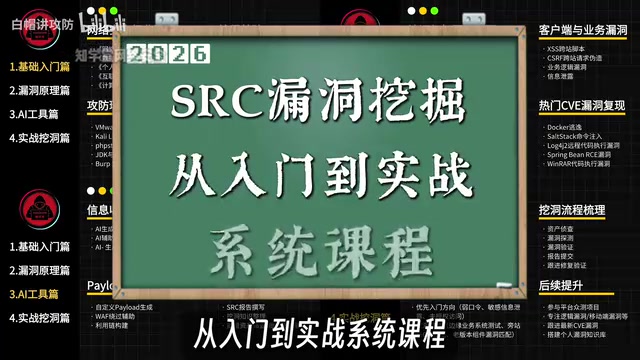
A course titled "AI + SRC Vulnerability Hunting in Practice" on Bilibili has recently attracted considerable attention among cybersecurity enthusiasts. According to the creator, this course was newly recorded in 2026, with a total duration of approximately 32 hours and a very clear positioning: aimed at complete beginners who have just stepped into the cybersecurity field, as well as working professionals who want to hunt vulnerabilities in their spare time to earn some extra cash.
Unlike the many security courses on the market that lean heavily on theory, this tutorial focuses on "hand-holding you through finding your first vulnerability in life." Judging from the course structure, it attempts to solve a long-standing pain point — many people learn a pile of vulnerability principles but never figure out how to make a valid submission on an actual SRC (Security Response Center) platform.
Four-Stage Course Structure: A Complete Loop from Principles to Practice
Fundamentals & Vulnerability Principles
The course is divided into four parts: Fundamentals, Vulnerability Principles, AI Tools, and Practical Hunting. The first two parts serve the function of "laying the foundation." According to the creator, the content covers high-frequency vulnerability principles, asset information gathering, hands-on hunting tool operations, and CVE vulnerability reproduction, among other topics.
This design approach aligns with the actual workflow of SRC hunting. Vulnerability hunting is never about finding bugs right away — it starts with understanding the asset boundaries of the target system, then conducting targeted testing based on known vulnerability patterns. The value of CVE reproduction lies in allowing learners to understand the trigger conditions and exploit chains of vulnerabilities in a controllable environment. This kind of experience is often critical when transferred to real targets.
About CVE: CVE (Common Vulnerabilities and Exposures) is a public vulnerability numbering system operated by MITRE. Every confirmed security vulnerability is assigned a unique identifier in the form of CVE-2024-XXXX. It itself only provides standardized naming and indexing of vulnerabilities, while specific technical details are usually recorded in associated entries such as the NVD (National Vulnerability Database). For vulnerability hunting learners, the value of CVE entries lies in the structured information they provide: PoC (Proof of Concept) code, affected version ranges, CVSS severity scores, and more. By reproducing historical CVEs, learners can build a correspondence between "vulnerability patterns — trigger conditions — exploit chains." This pattern recognition ability can be directly reused when switching to real targets.
AI Tools: The Course's Biggest Differentiator
Among the four parts, the AI Tools section deserves separate discussion. Integrating AI tools into vulnerability hunting education reflects a real change in the security industry over the past two years: AI is extending from assisted coding to assisted security testing.
Specifically, the areas where AI can play a role in SRC hunting include: information aggregation and deduplication in asset mapping, automatic generation of structured descriptions in vulnerability reports, and identifying anomalous patterns in massive return data. For beginners, AI tools can lower the barrier to information organization, allowing them to focus on the vulnerability logic itself rather than being dragged down by tedious manual record-keeping.
However, it should be noted that the original course description does not detail the specific tool selections and technical details of the AI Tools section. Based on available information, this part is more likely to lean toward practical demonstrations of "using AI for efficiency" rather than explanations of AI model principles themselves.
About SRC: SRC stands for Security Response Center, a vulnerability intake and reward platform established by major domestic internet companies or vendors, such as Tencent TSRC, Alibaba ASRC, ByteDance ByteSRC, etc. After white hat hackers submit discovered security vulnerabilities through SRC platforms, they can receive corresponding cash rewards, points, or honors once the vendor confirms and rates them. The barrier to entry for the SRC ecosystem is relatively low: no special penetration testing authorization is needed — as long as you test targets within the scope specified by the platform and submit valid vulnerabilities, you can earn bounties. This is also the realistic basis for the course's positioning of "part-time hunting to earn extra cash." Different SRC platforms have varying rating standards, reward ranges, and testing boundaries for vulnerabilities. Beginners are usually advised to start with the testing scope publicly stated by vendors.
Practical Hunting & CVE Reproduction
The practical section is the culmination of the entire course. The creator promises that after completing the course, "whether you want to switch careers to cybersecurity and become a white hat at a big company, or just lie at home hunting vulnerabilities for bounties, it's all doable." This statement carries obvious course promotion undertones, but it also reflects to some extent the reality of the SRC ecosystem — vulnerability bounties do provide a low-barrier monetization path for people with basic skills.
CVE vulnerability reproduction, as a bridge connecting principles and practice, typically occupies a significant proportion in such courses. The value of reproduction is not in "following along once," but in understanding under what conditions the assumptions about a vulnerability's root cause will be broken.

Learning Materials & Target Audience
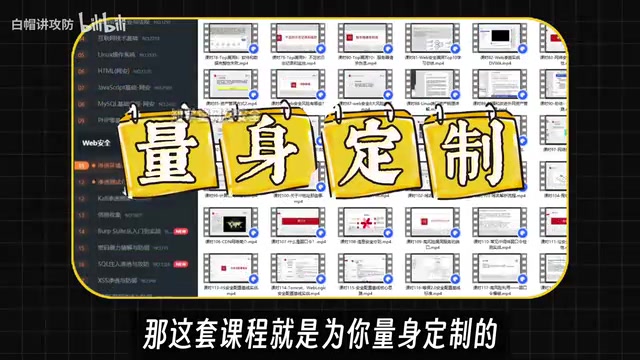
The course comes with a study plan, video tutorials, study notes, and tool installation packages, all bundled together. This "one-stop" delivery approach is relatively friendly to beginners with weak self-study abilities, reducing the time spent on environment configuration and material gathering.
A Rational Perspective: What the Course Can and Cannot Give You
Judging from the course positioning and content framework, this tutorial is suitable for the following groups: beginners with a preliminary interest in cybersecurity but lacking a systematic path, developers who want to understand the SRC hunting workflow, and practitioners who want to explore AI applications in the security field.
But there are several issues that need to be thought through before enrolling or investing time. Whether 32 hours can cover the entire process from zero foundation to independent hunting depends on the course's information density and the authenticity of the practical segments. The core abilities of vulnerability hunting — deep understanding of target systems and sensitivity to anomalous behavior — are hard to acquire by watching videos; they must be developed through extensive practice on real targets.
The course's promotional phrases like "all substance, no fluff" and "hand-holding you to quickly find your first vulnerability" are typical knowledge-paid marketing language. The actual effect depends on whether the course content truly provides transferable methodology, rather than merely demonstrating the hunting process for a few specific targets.
If you are considering learning SRC vulnerability hunting, this course can serve as a structured starting point. But treating it as the finish line is clearly unrealistic.
One-line Summary
A 32-hour AI + SRC vulnerability hunting course on Bilibili offering beginners a complete path from principles to practice.
Paragraph Summary
This article introduces an "AI + SRC Vulnerability Hunting in Practice" course on Bilibili, totaling about 32 hours and divided into four parts: Fundamentals, Vulnerability Principles, AI Tools, and Practical Hunting. The course targets complete beginners and part-time hunters, emphasizing hand-holding students through their first valid vulnerability submission. The article particularly notes that the AI Tools section is the course's biggest differentiator, focusing on using AI to assist with asset mapping, report generation, and anomaly identification, but also mentions that the course does not disclose specific tool selections. The author acknowledges that the course structure aligns with the actual SRC hunting workflow, while reminding readers to view the promotional language rationally — 32 hours can hardly cover the entire process from zero foundation to independent hunting, and core abilities still require extensive practice on real targets.
Related articles

Frontend to AI Agent Development: A Frontline Architect Explains Career Paths and Opportunities
A frontline AI architect explains the industry changes and practical paths for frontend developers transitioning to AI Agent development: why pure frontend jobs are disappearing, why Agent + full-stack has become mainstream in hiring, and three transformation routes—Agent development engineer, FDE, and remote contracting—along with corresponding learning strategies.

How to Choose an AI Agent Development Course: Five Pitfall-Avoidance Guidelines
A mechanical-engineering career changer's two-year pitfall-tested checklist for screening AI Agent development courses: complete delivery pipeline, resume-worthy projects, real development perspective, update frequency, and coaching feedback—with concrete judgment methods and pitfall-avoidance tips.

Coze AI Agent Building for Beginners: A Zero-Code AI Agent Development Guide
Coze, ByteDance's one-stop AI application development platform, supports zero-code drag-and-drop AI agent building. This article outlines Coze's core concepts, three advantages, differences between the domestic and international versions, and the distinction between agents and apps, helping beginners quickly get started with AI Agent development.