Who Is Vfmaddrnd231pd? Tracing an Identity Behind a Hacker News Mystery

A context-free random string on Hacker News sparked community speculation and division, ultimately remaining unresolved.
The article centers on the random string "Vfmaddrnd231pd" that appeared on Hacker News, examining why it drew attention, its possible origins, and the community's reaction. Composed of mixed uppercase and lowercase letters and digits, the string doesn't match common username, hash, or API key formats, and its "meaninglessness" became the focus of discussion. Community guesses centered on three possibilities: a random generator, a base64 or truncated UUID fragment, or a game virtual identity—but none had conclusive evidence. Attitudes in the thread were polarized: some eagerly tried to decode it, while others dismissed it as noise. The article argues that this phenomenon reveals the blurred boundary between signal and noise in open communities, reminding us that not every anomaly is worth tracking, but every anomaly is worth recording.
On Hacker News, a seemingly random string "Vfmaddrnd231pd" has sparked the community's curiosity. The characters carry no obvious meaning and don't match common username or hash formats. It appeared in an RSS feed, pointing to a Hacker News discussion thread. Based on this clue, this article examines the possible origins of the mystery and the community's reaction.
Why a Strange String Draws Attention
"Vfmaddrnd231pd" is composed of mixed uppercase and lowercase letters and digits, roughly 14 characters long. It doesn't resemble a typical GitHub username, API key, or hash value—it has no fixed length and contains no special symbols. This very "meaninglessness" is precisely what makes it meaningful: on a technical community like HN, any anomalous string could be a technical experiment, an anonymous post, or a mislabeling.
Guesses About Possible Origins
Several main theories emerged in the community discussion:
- Random generator: Someone used a password manager or random string tool to generate this ID for testing or anonymous posting.
- Encoding/hash fragment: It could be part of a longer string, such as base64 encoding, a truncated UUID, or an identifier in some proprietary protocol.
- Game or virtual identity: An ID created by a player on a platform like Minecraft or Roblox, inadvertently leaked into a technical community.
One detail worth noting: no consensus answer appeared in the HN comment section, which actually made the discussion more scattered.
Hacker News's RSS subscription mechanism deserves a separate explanation: HN provides stable URLs and RSS endpoints for every discussion thread, user, and comment, and third-party readers (such as Feedly and NetNewsWire) aggregate these feeds by item. Therefore, when a seemingly random string appears in RSS, it's often not HN itself that generated it, but rather some external system that referenced it as a title, author name, or item ID into the subscription stream. In other words, RSS is just a "courier"—the real source could be a scraping script, a custom aggregator, or a subscription address deliberately constructed by some user. This also explains why the original post's context is missing—the item likely lost its metadata as it passed between systems.
Identifying characteristics of Base64 vs. UUID: Base64 encoding typically consists of A–Z, a–z, 0–9, +, / and a trailing =, and its length is usually a multiple of 4; a UUID, on the other hand, is a fixed 36-character hexadecimal format with hyphens. Vfmaddrnd231pd contains no +, /, or =, nor is it a standard UUID, and its length of 14 doesn't match common encoding block sizes either. If it is a truncated fragment of a longer string, then reverse-engineering the original from these 14 characters alone is nearly impossible—it's like receiving a shredded page of a book, missing checksums and context, where any "decoding" attempt is merely guessing at character set distribution.
Community Reaction: Curiosity, Banter, and Cold Reflection
In the corresponding HN thread, users' attitudes were polarized: some eagerly tried to "decode" it, analyzing character frequency with various online tools; others dismissed it as meaningless noise not worth pursuing. This very divergence reflects the technical community's typical response to "unknown signals"—the urge to crack them, tempered by a wariness of over-interpretation.
The "puzzle narrative" phenomenon in technical communities is nothing new. Previously on HN, people have posted a meaningless binary string, a suspected leaked API endpoint, or a screenshot of unknown origin, likewise triggering hundreds of "detective" replies. Such events typically follow a similar lifecycle: the first few comments attempt reasonable explanations, then someone starts half-jokingly constructing conspiracy theories, and finally a calm reply pointing out "this is just someone's test post" or "it's a scraper bug" brings it to an end. Vfmaddrnd231pd currently remains in the first stage, indicating it lacks the key evidence that would drive the narrative toward closure—such as the original poster coming forward or an official clarification from HN.
What This Incident Means
From a broader perspective, the Vfmaddrnd231pd phenomenon reveals the blurred boundary between information noise and signal in open communities. That a context-free string can trigger hundreds of comments shows that, in the absence of an authoritative source, communities will spontaneously construct narratives. For content creators or security researchers, such cases remind us: not every anomaly is worth tracking, but every anomaly is worth recording.
At present, the true identity of this string remains undetermined, and the comments on the original HN post have provided no conclusive evidence. If you have any relevant clues, feel free to add them to the discussion.
One-line Summary
A context-free random string on Hacker News sparked community speculation and division, ultimately remaining unresolved.
Related articles

M&M's Spent Millions Replacing Artificial Blue Dye — Why Is It So Hard?
Mars spent millions trying to replace artificial blue dye in M&M's with spirulina, but thick material clogs pipes and residue risks mold, forcing a full production-line rebuild. Here's the engineering behind the reformulation.

Teammate Wanted for Meta Global AI Developer Hackathon: Computer Vision & Medical AI
A Reddit developer seeks teammates for the Meta Global AI Developer Hackathon, focusing on computer vision and medical AI. This article analyzes the track logic, skills-complementarity needs, and topic selection strategy behind this teaming signal.
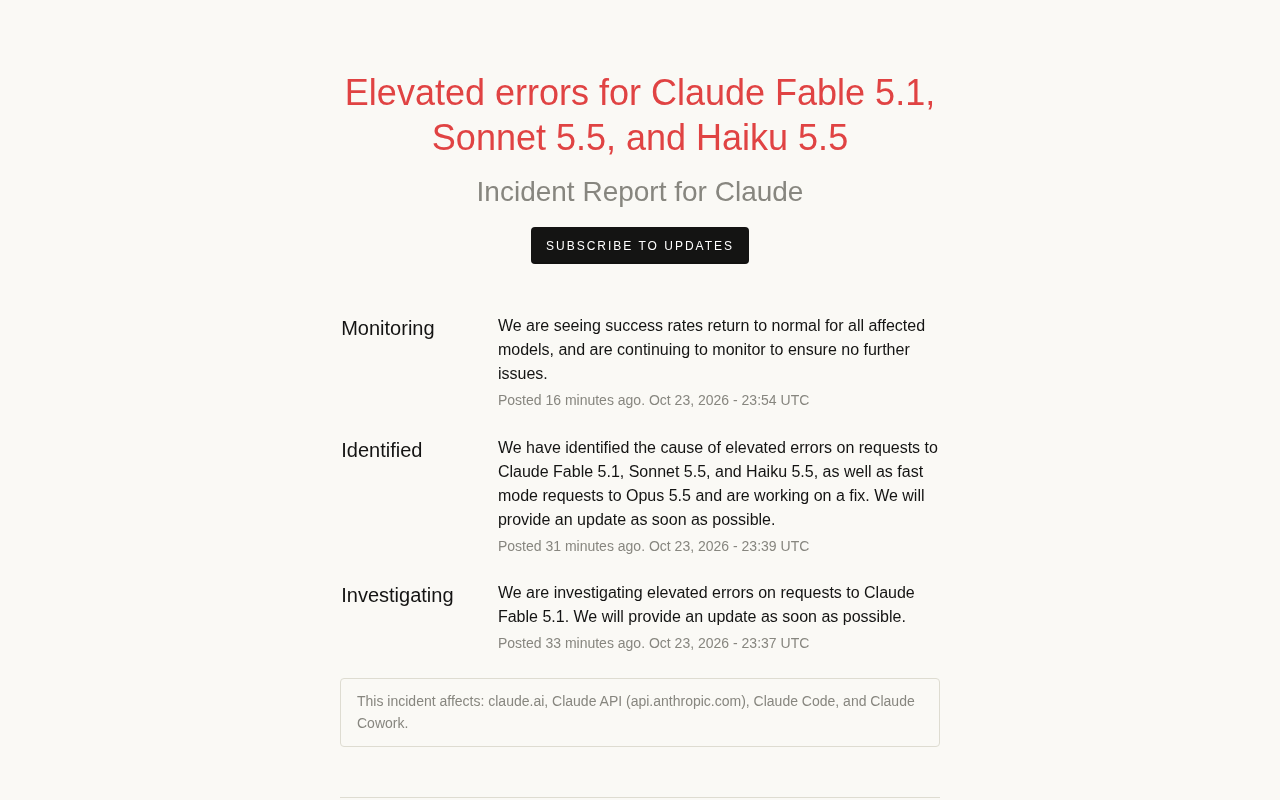
Multiple Claude Models Hit by Errors: A Postmortem of Fable 5.1, Sonnet 5.5, and Haiku 5.5
Claude Fable 5.1, Sonnet 5.5, Haiku 5.5, and Opus 5.5 fast mode saw elevated errors; Anthropic identified and resolved the issue in 17 minutes. This postmortem covers the timeline, the technical reasons for the multi-model cascading failure, and practical lessons for retry and degradation strategies.