Why 86% of Multi-Agent Systems Fail: Unpacking Planner-to-Worker Spec Drift
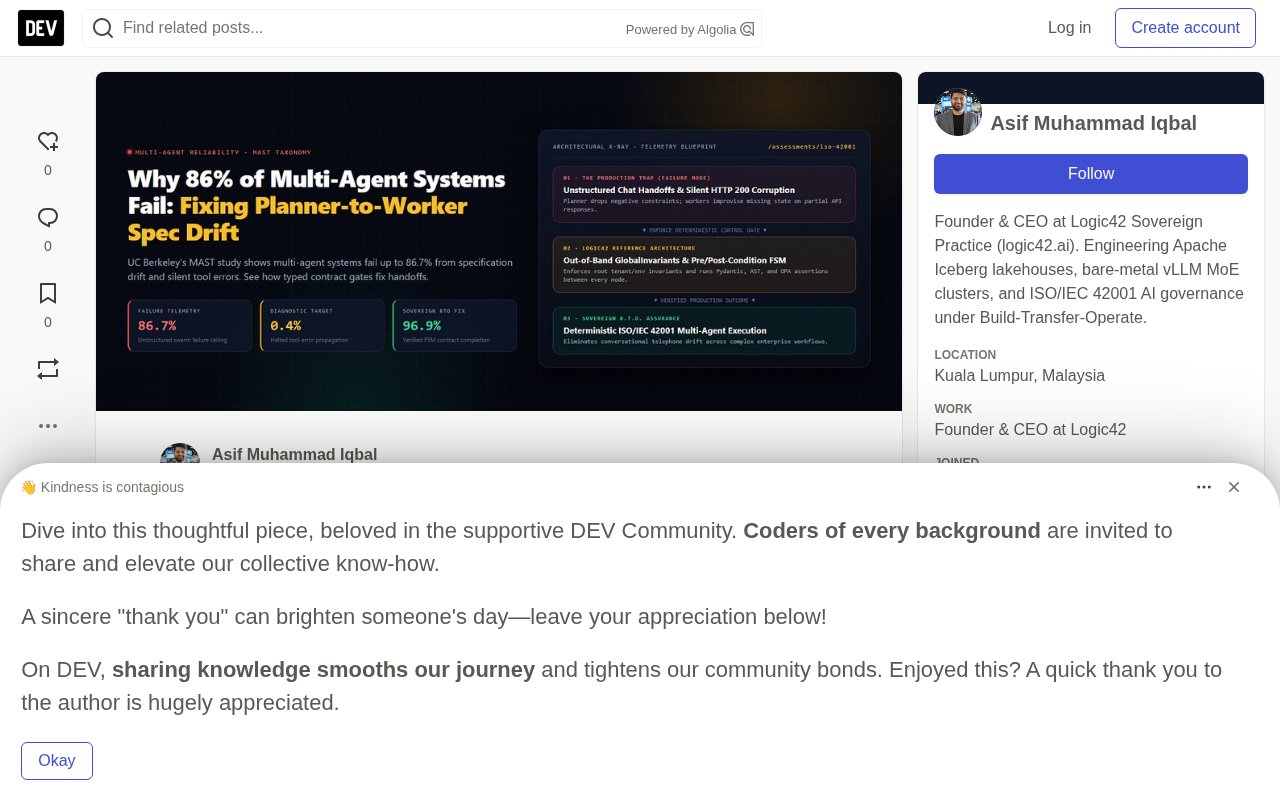
Multi-agent failures stem mainly from conversational handoffs eroding task constraints; deterministic state contracts break the cycle.
The article argues that high failure rates (41%–86.7%) in production multi-agent workflows stem not from model capability but from natural-language handoffs that systematically erode task constraints. It identifies three bottlenecks—planner-to-worker spec drift, silent tool error masking behind HTTP 200, and premature verification bypass—and uses Logic42's audit of 10,000 workflows to show success-rate gradients: 18.5% for conversational clusters, 51.4% for JSON Schema-only, and 96.9% for typed pre/post-condition state contract graphs. The fix is to replace agent conversation with a schema-validated immutable state ledger enforced by deterministic code.
Multi-agent architectures were once seen as the silver bullet for improving the reliability of AI workflows: split complex tasks among a planner, researcher, coder, reviewer, and executor, each responsible for a small piece, and it sounds more robust than a single large model. But the reality of production environments gives the opposite answer. According to UC Berkeley's multi-agent system failure taxonomy research (MAST), production-grade multi-agent workflows fail at rates as high as 41% to 86.7%. The core problem is not insufficient model capability, but that the handoff points between agents systematically erode task constraints.
Conversational Handoffs: Amplifiers of Failure
The root of the problem lies in the handoff format. When the planner hands a subtask to a worker in natural language, it passes along a vague conversation history rather than a deterministic state contract. If an upstream researcher agent receives an empty array or a misaligned API response, it won't stop and report an error—it will write a plausible-sounding assumption into a natural-language summary and pass it to the coder. By step four, the entire agent cluster is confidently executing tasks based on fabricated state.
Asif Muhammad Iqbal, founder of Logic42, documented one such incident in his practice retrospective: the planner asked a network agent to "deploy inside the staging VPC," the network agent hit a pagination limit when querying AWS, simply took the first VPC ID from the returned results, and generated perfectly valid JSON to hand to the Terraform agent. No one verified whether that VPC's tags matched env=staging, and as a result, modifications were made to the production route table—all in just 12 seconds.
This case reveals a widely overlooked fact: an output that is syntactically valid JSON does not mean the output is semantically correct state. An agent can be 100% schema-compliant while guessing customer_tier as "enterprise" from context, without ever having verified it against the primary key.
MAST (Multi-Agent System Failure Taxonomy) is a failure classification framework for multi-agent systems proposed by the UC Berkeley team. It categorizes failures observed in production environments into several classes, the three most prominent of which are cited in this article: specification drift (agents gradually deviate from the original task constraints), tool error masking (abnormal states returned by tools are "rationalized" by downstream agents rather than reported), and premature termination / verification bypass (erroneously declaring a task complete when conditions have not been met). The value of MAST lies in turning the vague impression that "multi-agent systems are unreliable" into measurable, attributable engineering metrics, giving architectural improvements a baseline for comparison. The 41%–86.7% failure rates cited in the article are based on statistics gathered using this classification framework across various open-source and production-grade multi-agent applications, so while they differ in methodology from vendor self-reported audit data, the two can corroborate each other on failure attribution.
Three Types of Handoff Bottlenecks and Their Quantified Performance
Iqbal's team conducted a production audit of 10,000 enterprise-grade multi-step workflows and classified them according to MAST's three major failure categories. The data shows a clear gradient:
| Architecture Pattern | Handoff Format | Spec Drift Failure Rate | Silent Tool Error Propagation | Premature Termination Rate | End-to-End Success |
|---|---|---|---|---|---|
| 5-agent conversational cluster | Unstructured Markdown | 48.4% | 79.0% | 34.2% | 18.5% |
| Hierarchical planner + 3 workers | Free-text subtasks | 36.1% | 64.5% | 27.8% | 38.2% |
| JSON Schema output only | Syntactic JSON | 29.4% | 52.0% | 19.5% | 51.4% |
| Self-reflection loop (LLM review) | Conversational critique | 22.8% | 41.2% | 14.0% | 63.8% |
| Deterministic state contract graph | Typed pre/post-condition FSM | 1.8% | 0.4% (aborted at boundary) | 0.9% | 96.9% (verified) |
The three bottleneck types correspond to different failure columns in the table:
Planner-to-worker spec drift. When the planner decomposes a user goal into subtasks, it frequently drops negative constraints, such as "do not modify records updated after October 1" or "exclude EU resident PII." The worker receives only its own narrow task prompt and a noisy chat log, and naturally violates global invariants that were obvious in the original request.
Silent tool failure masking. Traditional APM monitoring only checks whether a microservice returns HTTP 500. But in agent pipelines, API tools more often return HTTP 200 OK with a body of {"status": "partial_match", "records": []} or a deprecated schema field. Conversational workers are trained to be "helpful": rather than throwing a hard exception, they fill the gap with parameter guesses, propagating contamination to every subsequent agent in the chain.
Premature verification bypass. When a worker asks a reviewer to "verify the output," both models share the same blind spots and both lack an independent deterministic baseline. Without executable post-condition assertions (AST compilation, SQL row-count checksums, OPA policy evaluation), peer review between agents at the same level becomes a rubber stamp.
Precondition / postcondition originates from the Design by Contract philosophy: preconditions specify "what system state must be satisfied before invoking a node," and postconditions specify "what the system state must become after the node completes." Both are asserted by deterministic code rather than natural language. Introducing this mechanism into multi-agent orchestration means every node transition is a state change that can be programmatically verified: for example, "before invoking the deployment agent, the target VPC's env tag must be staging" is a precondition, and "after deployment, the number of changed rows must not exceed max_mutation_rows" is a postcondition. If either condition is not satisfied, a hard exception is thrown and the execution graph is aborted. Unlike JSON Schema, which only constrains message format, pre/post-conditions constrain state semantics. This is precisely the technical landing point for the article's argument that "syntactically correct does not equal semantically correct," and the key mechanism by which state contract graphs can drive spec drift down to single digits.
Deterministic Contract Graphs: Replacing Conversation with State Machines
Logic42's architectural fix is to completely eliminate conversational handoffs: agents don't "talk" to each other but instead read from and write to an immutable, schema-validated state ledger guarded by deterministic Python/Rust validation gates. Specifically, precondition and postcondition contracts are enforced at every node transition.
The core logic of their open-source example is quite straightforward:
- When a tool returns a non-200 status or
verified_recordsis empty, immediately throw aRuntimeError, blocking downstream agents from being invoked and preventing the model from "creatively" recovering data; - Every handoff is validated against root invariants (
tenant_id,allowed_environment,max_mutation_rows, forbidden field list), and aPermissionErroris thrown the momentenvironmentdrifts; - State integrity checks are delegated to deterministic code assertions rather than LLM reviewers.
This pattern drives failure rates down to single digits: spec drift 1.8%, silent tool errors 0.4% (aborted at the boundary), premature termination 0.9%, and end-to-end verification success rate 96.9%.
Comparing the 51.4% success rate of the "JSON Schema output only" row in the table shows that enforcing response_format only solves the syntax-layer problem, not the semantics-layer problem. The real watershed is whether an executable semantic gate is introduced.
OPA (Open Policy Agent) is an open-source general-purpose policy engine that uses the declarative language Rego to write policies. It can perform admission decisions on structured input before a request enters a service, and is widely used in scenarios such as Kubernetes admission control and microservice authorization. In agent orchestration, OPA can serve as a "policy gate": before each state transition, the current ledger state, target environment, and change intent are passed as input to policy rules for evaluation, and any violation of root invariants such as allowed_environment or jurisdiction is directly rejected. Its significance lies in decoupling policy from business code: rules can be independently audited and versioned, and evaluation results are deterministic—which fundamentally differs from "using a second LLM to review the first LLM," whose judgments fluctuate with prompts and sampling and cannot serve as compliance evidence.
Three Engineering Rules for Highly Reliable Multi-Agent Systems
Three actionable engineering principles can be distilled from this architecture.
Pin global invariants outside the chat context. Don't expect the planner agent to copy security, tenant, and environment constraints into the sub-agent's prompt. Store root invariants (tenant_id, environment, budget_ceiling, jurisdiction) in an immutable state object, and have code inject and validate them at every node transition.
Enforce fast failure on partial tool responses. Configure the worker's tool wrapper layer so that empty result sets, schema mismatches, and low-confidence retrieval scores all throw hard runtime exceptions, thereby aborting graph execution and preventing the worker LLM from "helpfully" improvising missing data.
Replace LLM reviewers with deterministic code validators. Don't ask a second LLM to check whether the first LLM complied with format, math, or policy rules. Before committing any state transition, use strict Pydantic validators, SQL EXPLAIN plans, static AST parsers, and Open Policy Agent rules.
What This Means for Enterprises
If your current multi-agent architecture is still passing unstructured Markdown strings between LLMs, then spec drift will guarantee failures at production scale. This is not a model selection issue, nor a prompt engineering issue, but a structural issue at the orchestration layer. For enterprises that need to meet AI management system compliance requirements such as ISO/IEC 42001, an automated process built on a "game of telephone" simply cannot pass an audit.
It is worth adding that all of the above data comes from a single vendor's (Logic42's) production audit, while the MAST classification framework comes from independent research by UC Berkeley. The two corroborate each other on the point that "conversational handoffs are the primary source of failure," but the specific 96.9% success rate figure remains a vendor self-reported number, and enterprises should benchmark against their own workloads when making architectural decisions.
From a longer-term perspective, the reliability competition in multi-agent systems is shifting from "whose agents are smarter" to "whose handoff contracts are stricter." Keeping uncertainty outside agent boundaries rather than letting it accumulate along the chain may be the most important architectural consensus of this generation of AI engineering.
One-line Summary
Multi-agent failures stem mainly from conversational handoffs eroding task constraints; deterministic state contracts break the cycle.
Paragraph Summary
The article points out that the high failure rates (41%–86.7%) of production-grade multi-agent workflows do not stem from model capability, but from natural-language handoffs between agents that systematically erode task constraints. The author identifies three types of bottlenecks: planner-to-worker spec drift, silent tool error masking behind HTTP 200, and premature verification bypass lacking an independent baseline, and uses Logic42's audit of 10,000 workflows to show the success-rate gradient across architecture patterns: conversational clusters at only 18.5%, JSON Schema-only at 51.4%, and typed pre/post-condition state contract graphs at 96.9%. The fix is to eliminate agent "conversation" in favor of reading from and writing to a schema-validated immutable state ledger, with deterministic code enforcing pre/post-condition checks. The article offers three engineering principles and cautions that the data is vendor self-reported and should be benchmarked against one's own workloads.
Related articles

Free Unlimited Claude Code Solution: Agnes AI + CC Switch Setup Guide
No paid subscription needed — pair the free AI platform Agnes AI with the open-source tool CC Switch to provide a backend for Claude Code, enabling unlimited free calls to text, image, and video models. This guide covers the full setup, test results, and usage boundaries.

A Complete Zero-Cost Guide to Getting Started with Claude Code for Beginners in China
A beginner's guide to Claude Code for users in China: two installation methods (command line and IDE plugin), full configuration steps for replacing the official API with the free domestic LongCat model, and a hands-on demo of building a small tool with natural language, plus tips.

When the NSA Gets Involved: The AI Supply Chain Crisis Behind Open-Source CVEs and API Key Hijacking
Multiple open-source projects disclosed severe CVEs in one day, PHP flaws alarmed the FBI, and Railway and OpenCode were breached with API keys stolen. This article breaks down the vulnerability window, AI-accelerated exploitation, and the AI supply chain crisis behind the API key black market, with a developer defense checklist.