Why a Fully Open-Source Phone Is Nearly Impossible: The Reality of Patent Barriers

Cellular standards are packed with essential patents, and closed baseband firmware makes a fully open-source 5G phone nearly impossible today.
A phone that is "fully open-source and capable of connecting to cellular networks" faces two nearly insurmountable obstacles. First, cellular standards (2G–5G) are developed by 3GPP and embed vast numbers of Standard Essential Patents (SEPs) held by Qualcomm, Ericsson, Huawei, and others — complying with the standard means using the patents, with no way around them. While FRAND principles require reasonable licensing, this only solves "pay-to-use," not "fully free and open-source." Second, baseband chip firmware is highly proprietary, constrained by patents, radio regulatory certification requirements, and security concerns, with no open-source alternative available for 4G/5G. Open-source phones like the PinePhone achieve openness only at the OS and application processor level, while the baseband remains an opaque black box.
A Question That Sounds Simple but Cuts Deep
A user on Reddit posed a technically fascinating question: Is it possible to build a smartphone that relies on no corporate patents, is fully open-source in both hardware and software, yet can still connect to cellular networks and the internet? The user specifically mentioned reading somewhere that the technology behind cellular modems — 5G in particular — remains firmly locked down by patents.
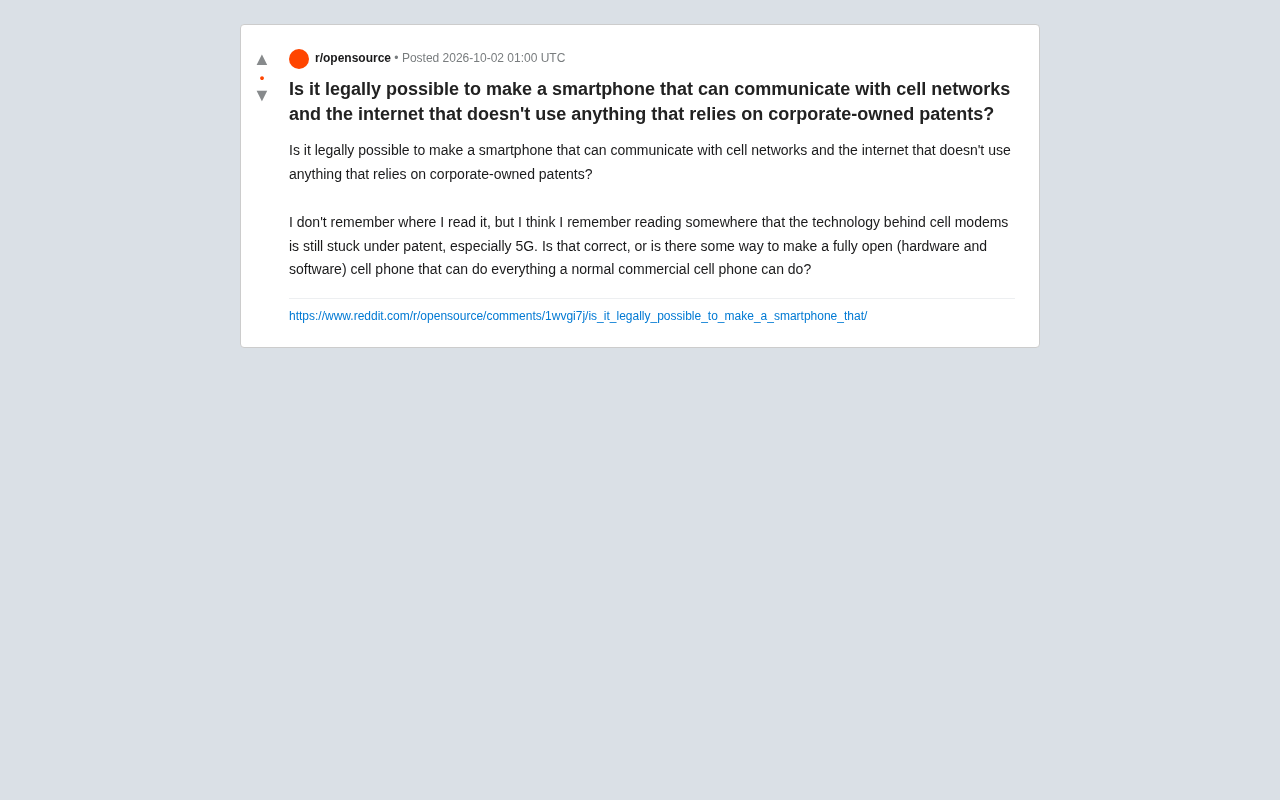
The value of this question lies not in the answer itself, but in what it reveals about the deep entanglement between modern communications technology and the intellectual property system. Let's break down the technical and legal logic behind it using the basic facts of the telecommunications industry.
Cellular Communication Standards Are Themselves Collections of Patents
At the heart of the issue: the ability to communicate over cellular networks is not a proprietary invention owned by any single company. Rather, it's a comprehensive set of technical standards (2G/3G/4G/5G) developed by international standards bodies like 3GPP. Any device that wants to connect to a carrier network must strictly comply with these standards.
The critical point is that these standards contain a large number of Standard Essential Patents (SEPs). "Essential" means that simply by implementing the standard, you inevitably use these patented technologies — there is no way around them. Companies like Qualcomm, Ericsson, Nokia, and Huawei hold vast portfolios of 5G-related SEPs.
In other words, "building a phone that uses no corporate patents yet connects to a cellular network" is almost a logical contradiction: connecting to the network requires complying with the standards, and complying with the standards inevitably implicates patents.
FRAND Principles: Patents Aren't Completely Locked Away
That said, the situation isn't quite as dire as the original poster feared. Standard essential patents are typically governed by the FRAND principle (Fair, Reasonable, and Non-Discriminatory). This means patent holders are obligated to license their patents to any willing implementer on reasonable and non-discriminatory terms.
This is where the nuance lies: patents don't "prohibit" you from building a phone — they require you to pay for a license. In theory, any manufacturer can legally produce 5G-capable devices, as long as they pay the licensing fees. The real obstacle isn't that "the technology is locked away," but rather the additional requirement that it be "free and fully open-source."
3GPP (the 3rd Generation Partnership Project) is the central body for developing mobile communication standards, with participation from carriers, equipment vendors, and chipmakers around the world. The standards development process is itself a patent battleground: participants contribute technical proposals while simultaneously weaving their own patents into the standard text. According to estimates, the number of SEP declarations related to 5G standards has exceeded 90,000, involving dozens of companies including Qualcomm, Huawei, Ericsson, Nokia, and Samsung. It's worth noting that there's a gap between "SEP declarations" and "actually essential patents" — some declared patents, upon review by independent bodies, turn out not to be truly unavoidable. Even so, the number of genuine SEPs that remain is still enormous, forming an exceptionally high patent barrier in the cellular communications space.
FRAND licensing is far from smooth in practice. The very definition of a "reasonable royalty rate" has been the source of years-long litigation spanning multiple jurisdictions — Qualcomm and Apple's patent royalty dispute took years across multiple court systems before settling; Ericsson's FRAND rate disputes with various handset makers still have active cases. For startups or open-source projects, even when patent holders are willing to license, the asymmetry in negotiating power makes securing a truly "reasonable" rate a significant hurdle in itself. Furthermore, SEP licenses are typically bundled into "patent pools" — organizations like Via Licensing and Avanci represent multiple holders and offer unified licensing, simplifying the process but making it virtually impossible to selectively work around a handful of specific patents.
The Baseband Chip: The Final Wall Against Open Source
Even setting aside the question of patent licensing fees, another more practical obstacle lies in the baseband modem processor.
Virtually all cellular baseband chips on the market today are monopolized by a handful of vendors: Qualcomm, MediaTek, Samsung, and UNISOC. The firmware running inside these chips is highly proprietary, and the complete implementation details are inaccessible to outside developers.
The reasons are multiple:
- Regulatory requirements: Radio spectrum is a resource strictly regulated by governments. Baseband firmware must pass certification to ensure devices don't transmit at illegal power levels or on illegal frequency bands, interfering with other users. Opening up the baseband could allow users to freely modify RF behavior, which is generally prohibited by law.
- Patents and trade secrets: Baseband implementations embody a vast number of proprietary algorithms.
- Security considerations: The baseband is a highly privileged subsystem within a phone, and vendors are reluctant to open it up for security reasons.
For exactly these reasons, open-source-oriented phones like the PinePhone and Librem 5, while achieving a high degree of openness at the application processor and operating system level, still have no choice but to use a "black box" baseband module, communicating between the main system and the baseband through physical isolation. They achieve "relatively open source," but cannot achieve "fully open-source cellular communications."
The baseband processor occupies a unique position inside a phone: it runs independently from the application processor, has its own real-time operating system (typically a proprietary RTOS), and has direct control over RF hardware. In many architectures, the baseband actually has higher system privileges than the application processor and can access device memory. This design is a product of historical legacy and cost optimization, but it also introduces significant security risks — researchers have repeatedly found vulnerabilities in baseband firmware that can be exploited remotely, and the closed-source nature makes external auditing extremely difficult. The open-source community has made attempts to push for baseband openness, most notably the OsmocomBB project, which implemented open-source baseband software for certain 2G chips. However, due to the lack of chip documentation and regulatory restrictions, it has never been able to expand to mainstream 4G/5G platforms.
Where Does the Realistic Boundary of Full Open Source Lie?
Putting it all together, we can draw conclusions at several levels:
At the software level, things can be highly open-source. AOSP (the open-source version of Android), GrapheneOS, and various Linux-based phone systems have all demonstrated that operating systems and the application layer can be completely free of closed-source code.
At the application processor level, things are approaching open source. SoCs based on open instruction sets like RISC-V are advancing, and openness at the chip design level is increasing.
At the cellular baseband level, full open source is nearly impossible. This is the result of patents, regulation, and security concerns stacking on top of each other, with no breakthrough in sight in the near term.
Connecting to the internet itself has a lower barrier. If the goal is simply "accessing the internet" without being attached to cellular networks specifically, then connecting via Wi-Fi is far more achievable — Wi-Fi standards also involve patents, but the ecosystem around open-source drivers is already quite mature.
What This Question Really Teaches Us
The original poster's intuition was partially correct: 5G and cellular communications as a whole are indeed deeply covered by patents. But "covered by patents" does not mean "monopolistically locked down by a single company" — the FRAND mechanism ensures that paid licensing remains possible.
What truly cannot be overcome is the closed-source nature of baseband firmware and the mandatory requirements of radio regulation. A device that is "fully open-source in hardware and software, pays no licensing fees whatsoever, and can still make calls and browse the internet like a normal phone" is simply not realistic under the current technical standards and legal framework.
This precisely reflects the essential nature of modern communications infrastructure: it is a vast collaborative system built jointly by standards, patents, regulation, and commercial interests. The open-source movement can continue to expand its reach within this system, but it is very difficult to step entirely outside it and start from scratch.
Related articles

Frontend to AI Agent Development: A Frontline Architect Explains Career Paths and Opportunities
A frontline AI architect explains the industry changes and practical paths for frontend developers transitioning to AI Agent development: why pure frontend jobs are disappearing, why Agent + full-stack has become mainstream in hiring, and three transformation routes—Agent development engineer, FDE, and remote contracting—along with corresponding learning strategies.

How to Choose an AI Agent Development Course: Five Pitfall-Avoidance Guidelines
A mechanical-engineering career changer's two-year pitfall-tested checklist for screening AI Agent development courses: complete delivery pipeline, resume-worthy projects, real development perspective, update frequency, and coaching feedback—with concrete judgment methods and pitfall-avoidance tips.

Coze AI Agent Building for Beginners: A Zero-Code AI Agent Development Guide
Coze, ByteDance's one-stop AI application development platform, supports zero-code drag-and-drop AI agent building. This article outlines Coze's core concepts, three advantages, differences between the domestic and international versions, and the distinction between agents and apps, helping beginners quickly get started with AI Agent development.