Why AI Refuses to Generate Prompts: The Logic Behind Copyright and Content Moderation

Why mainstream AI refuses anime prompts — and how local models and image taggers solve it.
A ComfyUI user tried to get ChatGPT and other major AI assistants to write prompts for replicating an Asuka wallpaper from Neon Genesis Evangelion, only to be refused by all three due to copyright and content compliance concerns. The article explains why: commercial AI products apply conservative IP avoidance policies and are hypersensitive to potentially adult-coded language. The real solution isn't a more permissive chat AI, but local open-source models via Ollama or LM Studio, and image interrogation tools like WD Tagger or DeepDanbooru that extract precise tags directly from reference images. The article also reminds readers that looser tools don't eliminate copyright liability for commercial use.
A Request That Keeps Getting Rejected
In a Reddit AI art community, a user raised a frustration that many creators can relate to: he wanted help from ChatGPT, Claude, or Gemini to write prompts for replicating an anime character (Asuka) wallpaper in ComfyUI using the ANIMA model. All three major AI assistants refused — every single one citing copyright risk and content compliance (+18) as the reason, with at least one model flagging the image content as inappropriate.
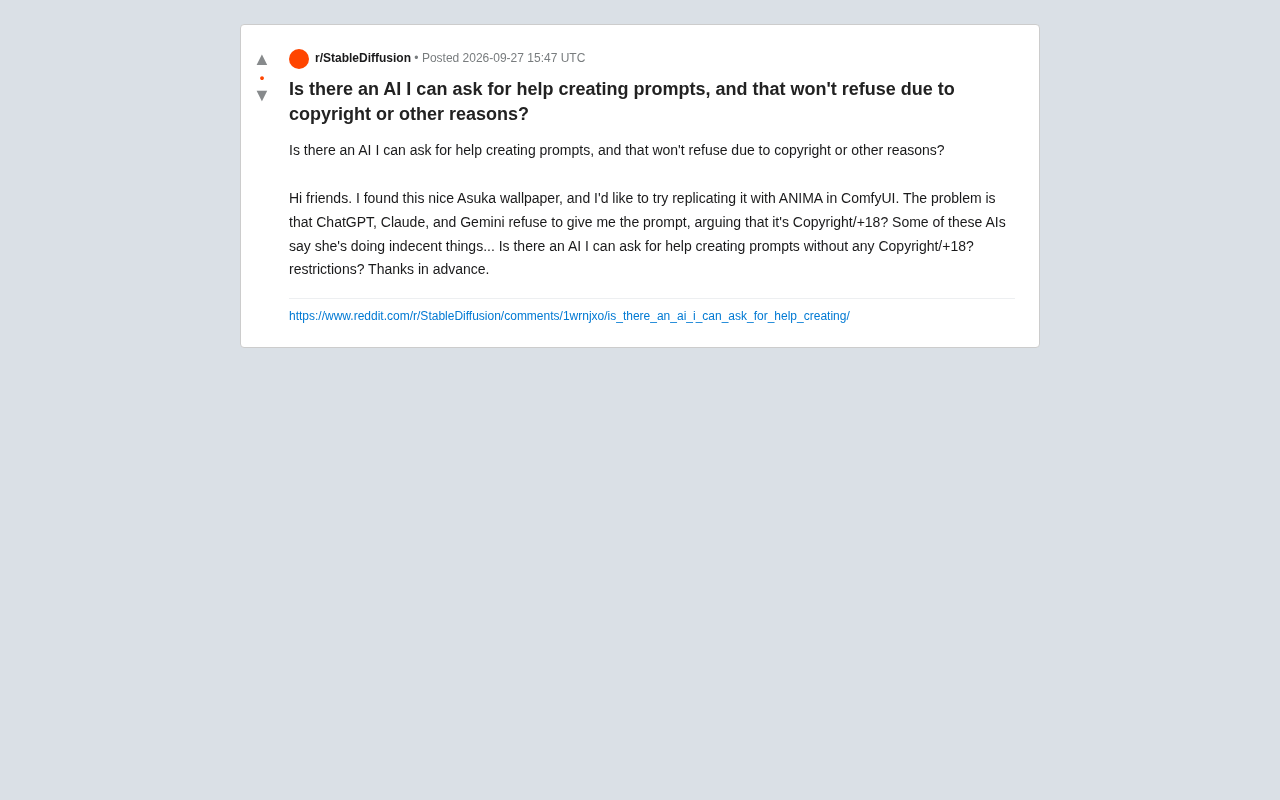
This seemingly simple request actually touched on two of the most sensitive boundaries in today's generative AI landscape. Understanding why they refuse is more valuable than simply hunting for an AI that won't.
Why AI Refuses to Help You Write Prompts
Copyright Concerns: The Gray Zone Around Well-Known IP Characters
Asuka is a well-known character from Neon Genesis Evangelion — a commercially protected IP. When a user explicitly asks to "replicate" the likeness of a specific character, large language models automatically trigger their safety mechanisms to avoid engaging with known copyrighted content. What vendors are worried about isn't personal use — it's the legal liability that could come from helping generate recognizable commercial character imagery.
This is why the more specific and IP-targeted your request, the higher the chance of refusal. The AI isn't judging whether your intended use is legal — it's executing a conservative, erring-on-the-side-of-caution avoidance policy.
Content Ratings: The Opaque "+18" Judgment
The user noted that some AI models believed the character was "doing something inappropriate." This reveals another characteristic of content moderation systems: they are hypersensitive to image descriptions and implied context, and their criteria are often opaque. Even if the original image contains no explicit content, certain word combinations that could be associated with adult content will trigger the moderation layer and result in an outright block.
This "excessive caution" is a common trait among mainstream commercial AI products — they serve the broadest possible user base and must minimize compliance risk to the extreme, which means sacrificing the experience for some legitimate use cases.
Rethinking the Search for an AI That Won't Refuse
Local Deployment Is the Real Solution
The user is already running ComfyUI — which actually points toward the right answer. ComfyUI runs local Stable Diffusion-type models, and the only bottleneck is that the "write me a prompt" step still relies on a cloud-based commercial LLM.
The real solution isn't to find another cloud-based AI with looser policies — it's to use locally deployed open-source language models to assist with prompt writing. Models run via Ollama, LM Studio, or other frameworks, especially those optimized for image generation prompts, are completely free from cloud vendor compliance policies. When a model runs on your own machine, the moderation logic is entirely under your control.
Ollama and LM Studio are currently the two most mainstream local LLM runtime frameworks. Ollama is primarily command-line based, supports one-command downloading of dozens of open-source models including Llama, Mistral, and Qwen, has low resource overhead, and is well-suited for integration into automated scripts. LM Studio offers a graphical interface, supports GGUF-format quantized models, and runs 7B-parameter models smoothly on consumer-grade GPUs (8GB VRAM). For AI art workflows, you can use models specifically fine-tuned for Stable Diffusion prompt formatting — such as "PromptGen"-style models fine-tuned from Mistral or Llama — which have far superior understanding of the Danbooru tag system, quality keywords, and style tokens compared to general-purpose chat models. By embedding a local LLM directly into your ComfyUI workflow via custom nodes (such as ComfyUI-LLM-Party), you can achieve a fully local pipeline from reference description to final prompt, completely bypassing cloud-side moderation.
Alternative Approaches for Prompt Engineering
For AI art specifically, writing prompts doesn't always require another AI to do the work. The community has a wealth of mature resources that can serve as alternatives:
- Prompt databases and sharing sites: Model pages on platforms like Civitai typically include example prompts you can reference and adapt directly.
- Image interrogation tools (such as WD Tagger, DeepDanbooru): Feed your reference image directly into a tagging model to reverse-engineer descriptive tags — this is far more precise than asking an LLM to describe an image from scratch.
- Community templates: Anime-style prompts follow highly standardized structures; once you understand the basic syntax, you can assemble them manually.
For replicating the style of a specific wallpaper, image interrogation tools often outperform any text-based chat AI, because they extract features directly at the pixel level.
A More Important Question to Consider
This question actually reflects a widespread misconception: treating commercial conversational AI as a universal tool. Products like ChatGPT and Claude are fundamentally general-purpose assistants with safety compliance as a top priority — they were never designed to handle creative requests that walk the line between copyright and content boundaries.
Instead of complaining that "AI is too conservative," it's more productive to break down your workflow clearly: route compliance-sensitive tasks to local tools, and use cloud AI for general reasoning tasks. The degree of creative freedom in generative workflows ultimately depends on how well you control your own toolchain — not on whether a given AI is willing to make an exception.
It's also worth noting: bypassing moderation filters does not mean bypassing legal responsibility. Replicating a copyrighted character for personal study is generally low-risk, but if you intend to distribute or commercialize the work, copyright issues remain very real — and a more permissive tool doesn't change that.
Summary
When mainstream AI refuses to generate specific prompts, it's an inevitable result of copyright avoidance and content compliance policy — not a technical flaw. For ComfyUI users, the answer isn't to find an "unrestricted chat AI," but to rebuild the prompt generation pipeline using local open-source models, image interrogation tools, and community resources. Understanding each tool's role and purpose is the only path to genuine creative freedom.
Background Notes
WD Tagger (short for WaifuDiffusion Tagger) and DeepDanbooru are both image classification models trained on the Danbooru image library, specifically designed to recognize and output tags for anime-style images. WD Tagger is currently the more accurate mainstream choice, capable of identifying character features (hair color, eye color, clothing), compositional elements, and art style tags across hundreds of dimensions — with confidence scores attached to each tag so users can filter by threshold. Both tools have corresponding nodes available in ComfyUI: connect a reference image to the tagging node and the output is a prompt string ready to use for generation, no manual description required. Compared to having ChatGPT "describe an image" and then translating that into prompts, interrogation tools have a key advantage: their tag output format closely aligns with the training data of Stable Diffusion models, resulting in better reproduction fidelity.
Related articles

Free Unlimited Claude Code Solution: Agnes AI + CC Switch Setup Guide
No paid subscription needed — pair the free AI platform Agnes AI with the open-source tool CC Switch to provide a backend for Claude Code, enabling unlimited free calls to text, image, and video models. This guide covers the full setup, test results, and usage boundaries.

A Complete Zero-Cost Guide to Getting Started with Claude Code for Beginners in China
A beginner's guide to Claude Code for users in China: two installation methods (command line and IDE plugin), full configuration steps for replacing the official API with the free domestic LongCat model, and a hands-on demo of building a small tool with natural language, plus tips.

When the NSA Gets Involved: The AI Supply Chain Crisis Behind Open-Source CVEs and API Key Hijacking
Multiple open-source projects disclosed severe CVEs in one day, PHP flaws alarmed the FBI, and Railway and OpenCode were breached with API keys stolen. This article breaks down the vulnerability window, AI-accelerated exploitation, and the AI supply chain crisis behind the API key black market, with a developer defense checklist.