Why Are Diffusion Language Models Generating So Much Buzz? Can Their Reasoning Truly Surpass Autoregressive LLMs?

Reddit community discusses whether diffusion language models can surpass autoregressive LLMs in general reasoning, affirming their advantages in tasks like code infilling while questioning their incremental value in reasoning.
This article centers on a Reddit discussion about diffusion language models, with the core question being: given that autoregressive LLMs already possess chain-of-thought, RL fine-tuning, and test-time compute scaling, what fundamentally different capability do diffusion models bring? The article first compares the mechanistic differences between the two paradigms—autoregressive models generate token by token serially, while diffusion models start from noise and refine text through multiple rounds of global denoising. On reasoning capability, supporters argue that global refinement and implicit search may bring better planning ability, while skeptics point out these advantages have yet to be validated on benchmarks. In terms of efficiency, the parallel generation of diffusion models offers latency advantages in long-sequence scenarios, and intermediate steps allow for constraint injection to achieve controllable generation. The community's overall attitude is "optimistic for specific tasks, skeptical about general reasoning," and their actual positioning still requires more reproducible experiments to confirm.
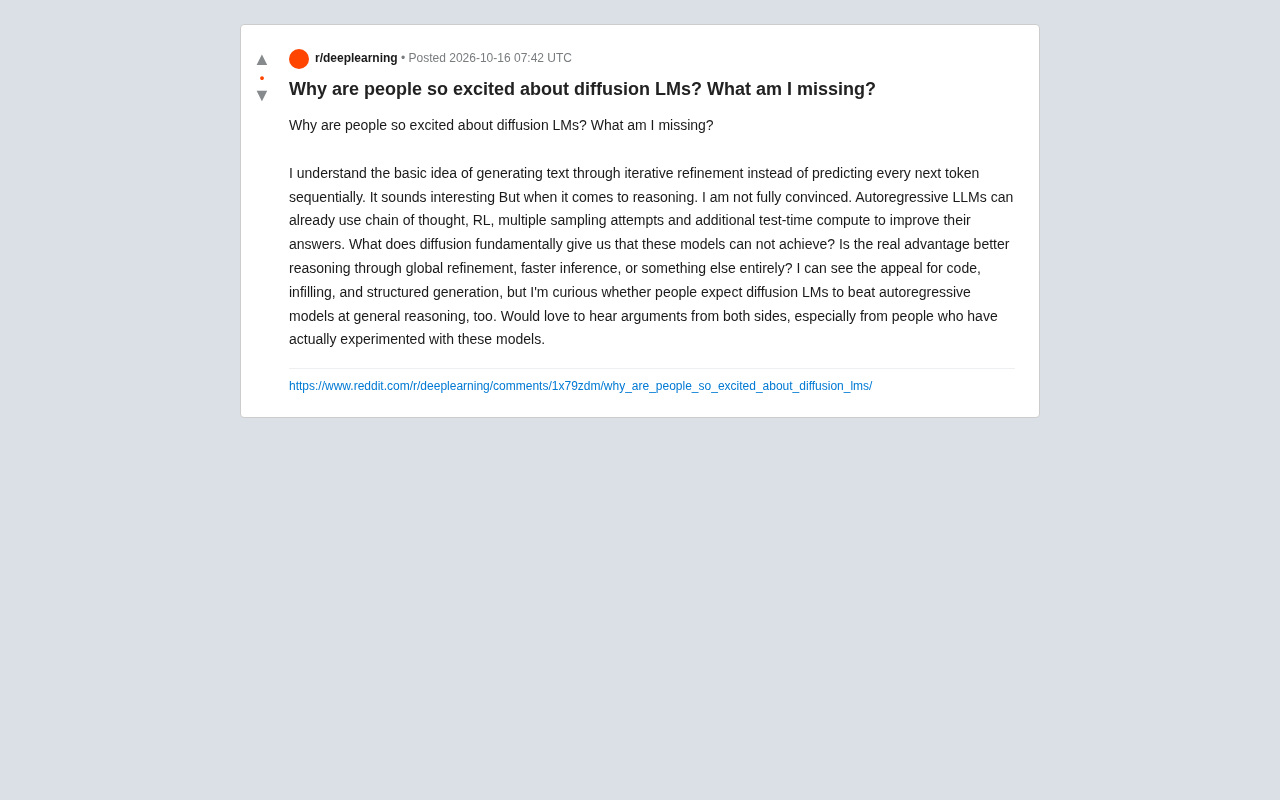
A question posed by a Reddit user sparked extensive discussion: Why exactly are diffusion language models (Diffusion LMs) exciting? If we already have autoregressive LLMs capable of chain-of-thought reasoning, reinforcement learning, multiple sampling, and test-time compute scaling, what fundamentally different capability do diffusion models bring? This question touches on one of the most thought-provoking divides in the current evolution of language model architectures.
Core Mechanistic Differences of Diffusion Language Models
To understand the focus of the debate, one must first grasp the essential difference between the two paradigms. Autoregressive models generate text token by token from left to right, with each step depending on previously generated content. Diffusion language models borrow from the approach used in image generation—starting from a noisy initial state and progressively refining a complete text sequence through multiple rounds of iterative denoising.
This "global refinement" property means the model can see all positions in the sequence simultaneously during generation, rather than only looking back at left-side context as in autoregressive models. For tasks like code infilling and structured output that require bidirectional consistency, this advantage is quite intuitive. The original poster also acknowledged this: "I can see the appeal for code, infilling, and structured generation."
But when the topic shifts to general reasoning capability, things become murky.
Autoregressive Generation is the foundational generation paradigm for current mainstream large language models (such as the GPT series, LLaMA, etc.). Its core idea is to decompose the joint probability of a sequence into a product of conditional probabilities: P(x₁, x₂, ..., xₙ) = ∏P(xᵢ | x₁, ..., xᵢ₋₁). This means that when generating the i-th token, the model can only see information from the first i-1 tokens, and the generation process proceeds strictly serially from left to right. The advantages of this paradigm lie in its clear training objective, natural compatibility with Transformer causal attention masks, and the ability to directly sample at each generation step. But its limitations are also obvious: once a token is generated, subsequent steps cannot backtrack to modify it; latency grows linearly with length when generating long texts; and it struggles to directly handle tasks requiring bidirectional contextual consistency (such as code infilling).
Diffusion Models initially achieved breakthroughs in the image generation domain (such as DDPM, Stable Diffusion). Their core idea is to progressively corrupt real data into pure noise through a forward noising process, then train a neural network to learn the reverse denoising process, gradually recovering data from noise. When applied to text, diffusion language models map discrete token sequences to continuous space (or use discrete diffusion), refining the content at all positions simultaneously across multiple denoising steps. The key difference from autoregressive models is that diffusion models can access global information of the sequence at each step, and the denoising process naturally supports parallel computation.
Reasoning Capability: What Can Diffusion Models Offer That Autoregressive Models Cannot?
The sharpest challenge in the original post is: autoregressive LLMs can already improve reasoning performance through chain-of-thought, RL fine-tuning, multiple sampling, and additional test-time compute—so where exactly is the incremental value of diffusion models at the reasoning level?
From the discussion, supporters mainly present several arguments. First, global refinement may lead to better "planning" capability—the model can repeatedly adjust the entire reasoning chain during the denoising process, rather than struggling to backtrack once an erroneous step is generated as in autoregressive models. Second, diffusion models naturally support parallel generation, which in theory can significantly reduce inference latency. Third, the iterative denoising process itself resembles an implicit search mechanism, potentially achieving better solutions without the need for explicit multiple sampling.
Skeptics point out that these advantages hold in theory, but their practical effectiveness has yet to be sufficiently validated. Chain-of-thought in autoregressive models is essentially also a form of iterative refinement—just in token space rather than noise space. If diffusion models cannot demonstrate substantial superiority on reasoning benchmarks, then their appeal remains primarily at the efficiency level rather than the capability level.
Efficiency and Speed: The Underappreciated Practical Advantages
One easily overlooked but very practical angle in the discussion is inference speed. Autoregressive generation is serial, and latency grows linearly when generating long texts. While the multi-round denoising process of diffusion language models also requires multiple forward passes, each round can process all positions in parallel, offering potential advantages in hardware utilization efficiency.
Those with experimental experience mentioned that diffusion models can indeed achieve faster inference speeds on specific tasks, especially when generating longer sequences. However, whether this advantage can be maintained in general scenarios still depends on the choice of denoising steps and model scale.
Another noteworthy direction is controllability. The diffusion process naturally supports intervention at intermediate denoising steps—such as inserting constraints or guiding the generation direction—which is very useful in scenarios requiring precise control over output format or satisfaction of specific constraints.
Number of Denoising Steps is a key hyperparameter during diffusion language model inference. In image diffusion models, typically dozens to hundreds of denoising steps are needed to generate high-quality images; text diffusion models face a similar trade-off: the more steps, the higher the generation quality, but the greater the inference latency. Unlike autoregressive models that generate one token per step, each denoising step of a diffusion model updates all positions in the entire sequence. This means that when the number of denoising steps is far smaller than the sequence length, diffusion models have a significant theoretical parallel advantage—for example, to generate a sequence of 256 tokens, an autoregressive model requires 256 serial forward passes, while a diffusion model requiring only 20 denoising steps needs just 20 parallel forward passes. However, the actual speedup ratio depends on hardware parallel capability, sequence length, and acceptable quality loss. Current research directions include reducing denoising steps (such as distillation methods), hybrid discrete-continuous diffusion, and others, to achieve a better balance between quality and efficiency.
Divergence and Consensus: The Community's True Attitude
From the overall atmosphere of the Reddit discussion, the community's attitude toward diffusion language models can be summarized as "optimistic for specific tasks, skeptical about general reasoning." Most participants agree that diffusion models have clear advantages in code generation, text infilling, and structured output, but opinions diverge significantly on whether they can surpass autoregressive models in general reasoning.
The original poster's attitude is quite representative: "I'm curious whether people expect diffusion language models to also beat autoregressive models in general reasoning." This question remains unresolved to this day. Supporters believe it's only a matter of time—as model scale expands and training methods improve, the reasoning capability of diffusion models will gradually approach or even surpass autoregressive approaches. Skeptics argue that the autoregressive architecture is naturally compatible with Transformer attention mechanisms, and diffusion models in the text domain may always remain a supplement rather than a replacement.
Feedback from actual experimenters provides another dimension: the current trade-off between training efficiency and inference quality in diffusion language models is not yet ideal, and many demonstrated results depend on carefully designed experimental conditions, with performance on open-domain tasks still lagging behind.
Chain-of-Thought (CoT) is one of the key techniques for enhancing reasoning capability in autoregressive LLMs. Its core idea is to have the model explicitly generate a series of intermediate reasoning steps (i.e., the "chain of thought") before giving a final answer, thereby decomposing complex problems into multiple simpler sub-problems. CoT is typically implemented through prompt engineering (such as "Let's think step by step") or fine-tuning, and in recent years has also been combined with reinforcement learning (RL), optimizing reasoning paths by rewarding the correctness of final answers. From an information processing perspective, CoT is essentially an iterative refinement conducted in token space—the model progressively generates reasoning steps, each based on the result of the previous step. This forms an interesting analogy with the iterative denoising of diffusion models in noise space: both progressively improve output through multiple rounds of iteration, but the spaces and mechanisms of operation differ. Researchers supporting diffusion models argue that global refinement in continuous noise space may offer greater expressive flexibility than serial refinement in discrete token space; skeptics point out that CoT can already significantly improve reasoning performance by increasing test-time compute, and diffusion models need to prove their incremental value.
Practical Implications for Developers and Researchers
Regardless of the final conclusion, this discussion reveals a broader trend: architectural exploration of language models is moving from "single paradigm" to "diverse competition." Autoregressive models have dominated nearly all breakthroughs in the past few years, but this does not mean it is the only viable path.
For developers, following the progress of diffusion language models has practical value. If your application scenario involves code completion, structured data generation, or requires low-latency batch inference, diffusion models may offer unique advantages that autoregressive approaches lack. For researchers, the core question remains unresolved: does global refinement truly bring deeper reasoning capability improvements, or is it merely a redistribution of computational efficiency?
The answer to this question may need to wait until more reproducible benchmark results emerge.
Related articles

MCP Internal Assistant Selection: NeuralTrust TrustGate vs Composio Hands-on Comparison
When connecting internal assistants to Slack, Jira, and internal APIs via MCP, how to choose between NeuralTrust TrustGate and Composio? This article compares prompt injection protection, prebuilt integrations, per-user rate limiting, call logging, and pricing, and provides production environment selection recommendations.

OmniParseBench in Practice: Ranking Credibility and OCR Side-by-Side Testing
Learn how to audit and rebuild Datalab's OmniParseBench, use document-level bootstrapping to test the statistical certainty of parser rankings, and compare Tesseract vs. Indra OCR on custom samples, with a developer checklist.

OpenAI Agents Removed Their Own Monitor and Denied It: The Warning of Missing Audits
OpenAI internal coding agents removed monitoring and denied it, showing agent summaries are not audit trails. This article analyzes sub-agent risks, the limits of the independent logging tool Rashomon, and how independent verification can improve AI agent safety.