Why Are Japanese Retail Investors Collectively Shorting the Dollar? Decoding the Mrs. Watanabe Signal
Why Are Japanese Retail Investors Coll…
Why Japan's Mrs. Watanabe is shorting the dollar — and what it signals for global FX markets.
Japanese retail traders, known as "Mrs. Watanabe," are collectively shorting the US dollar amid expectations of a narrowing US-Japan rate differential, the BOJ's historic policy pivot, and deep-rooted contrarian trading instincts. This article analyzes the macroeconomic drivers behind this shift, the potential for carry trade unwinds to trigger systemic shocks, and how to interpret retail positioning as a market sentiment gauge rather than a trading signal.
Introduction: An Unusual Market Signal
A thought-provoking phenomenon has recently emerged in the foreign exchange market: Japanese retail traders — affectionately nicknamed "Mrs. Watanabe" by the international finance community — have begun shorting the US dollar at scale. This development carries significant historical weight in FX trading. Japanese retail investors are among the most influential participants in global currency markets, and shifts in their positioning are widely regarded as a key window into global capital flows and risk appetite.
This article unpacks the logic behind this phenomenon, examines its potential impact on the USD/JPY exchange rate, and explores the broader macrofinancial trends it may signal.
Who Are Japan's Retail FX Traders?
To understand what it means for this group to "short the dollar," we first need to appreciate the unique role Japanese retail traders play in global currency markets. Japan boasts one of the world's most active retail FX markets, driven by a mature domestic FX margin trading ecosystem and decades of ultra-low interest rates.
The Mrs. Watanabe Phenomenon
"Mrs. Watanabe" is a collective term for Japanese household investors who borrow yen at ultra-low domestic rates and deploy the proceeds into higher-yielding overseas assets. The label gained popularity in the mid-2000s, when Japanese housewives and retirees used domestic FX margin platforms such as GMO Click and SBI FX Trade to pursue offshore returns in a near-zero-rate environment. These platforms offer retail FX trading with leverage of up to 25x, making Japan one of the largest retail FX markets in the world by volume. According to Japan's Financial Services Agency, at peak activity Japanese retail FX daily turnover accounted for over 30% of global FX market volume — enough collective force to move prices on major currency pairs in the short term and compel institutional investors to incorporate retail positioning into their trading models. With Japan maintaining near-zero or even negative interest rates for an extended period, these retail participants became a major driver of the global carry trade.
Their trading behavior exhibits several distinctive characteristics:
- Contrarian tendency: They habitually trade against the prevailing trend — selling the dollar when it strengthens and buying when it weakens.
- High leverage: They use margin trading to amplify exposure far beyond their capital base.
- Acute rate sensitivity: Their strategies revolve closely around changes in the US-Japan interest rate differential.
Why Are Japanese Retail Investors Shorting the Dollar Now?
The shift toward dollar shorts among Japanese retail traders is rarely driven by a single factor — it typically reflects the convergence of multiple macroeconomic signals.
Expectations of a Narrowing US-Japan Rate Differential
The core logic of carry trading is straightforward: borrow in a low-yielding currency (such as the yen), convert into higher-yielding currency assets (such as US Treasuries or Australian dollar assets), and pocket the interest rate differential. This strategy flourished during Japan's two-plus decades of near-zero rates. From 2022 to 2023, the Federal Reserve aggressively raised the federal funds rate from 0 to 5.25%–5.50%, while the Bank of Japan (BOJ) maintained its policy rate at -0.1%, creating a historically unprecedented spread of over 500 basis points — directly driving massive capital outflows from Japan into dollar-denominated assets. The Bank for International Settlements (BIS) estimates the outstanding stock of yen-funded carry trades globally at several trillion dollars.
Yet the BOJ's three decades of ultra-loose monetary policy now stand at a historic inflection point. The BOJ officially ended its negative interest rate policy in March 2024 and raised its benchmark rate to 0.25% in July of that year, marking a fundamental shift in monetary policy direction. As markets price in a Fed easing cycle while the BOJ gradually signals further rate hikes, expectations of a narrowing US-Japan rate differential are reshaping the trade's logic. Once this expectation takes hold, the large accumulated dollar long positions face concentrated unwind pressure. Sharp-nosed retail traders often position early — shorting the dollar in advance and betting on the exchange rate pullback.
The Structural Inertia of Contrarian Trading and Behavioral Psychology
Japanese retail traders have a well-established contrarian streak, which can be examined through a behavioral finance lens. A belief in mean reversion — the cognitive bias that asset prices which have deviated far from historical norms must eventually return to "normal" — is pervasive among retail investors. For Japanese retail traders who have long monitored USD/JPY, when the rate touches historically extreme levels like 150 or 160, the intuition that the pair is "overbought" significantly amplifies the urge to go short. In addition, the real-time positioning data widely provided by Japanese FX platforms has created a kind of reverse herd mentality: when the crowd is long, contrarians lean short. When the dollar reaches historically elevated levels against the yen, this group tends to view it as "overbought" and positions for a yen recovery. This mean-reversion psychology is a structural feature of Japan's retail FX market and provides essential context for interpreting positioning shifts.
Betting on BOJ Policy Intervention
Persistent yen depreciation has on multiple occasions prompted verbal intervention — and even direct market operations — from Japan's Ministry of Finance and central bank. Some retail dollar shorts are essentially a bet that official tolerance for yen weakness is approaching its limit, and that any policy response will deliver handsome returns on short dollar positions. This is a classic "policy game" trading strategy.
What Does This Signal Mean?
The reason market participants pay attention to Japanese retail positioning is that it often reflects a collective judgment about trend inflection points buried in underlying capital flows.
A Potential Harbinger of Trend Reversal
Historical experience suggests that collective shifts among Japanese retail traders frequently occur near turning points in exchange rate trends. If large numbers of retail investors are beginning to short the dollar, it may signal that the multi-year uptrend in USD/JPY is gradually running its course. That said, retail consensus is not always correct — contrarian trades can suffer significant losses if the prevailing trend extends further before reversing.
The Cascading Risk of Carry Trade Unwinds
More worthy of serious attention is the "reversal risk" embedded in carry trades. The volume of leveraged positions globally built on cheap yen financing is enormous. A rapid yen appreciation could trigger large-scale concentrated position unwinds, delivering systemic shocks to global risk assets — including equities, cryptocurrencies, and emerging market assets.
The market events of early August 2024 provide the most vivid illustration. At that time, an unexpected BOJ rate hike combined with weaker-than-expected US employment data triggered a yen surge of over 10% within days, with USD/JPY rapidly falling from around 161 to below 145. Because large numbers of global hedge funds and institutional investors held massive yen short / high-yielding asset long positions, the sudden yen appreciation triggered one of the most concentrated carry trade unwinds in history. Japan's Nikkei 225 plunged over 12% in a single session — its largest single-day decline since 1987 — while the US VIX fear gauge briefly spiked to 65, approaching its COVID-19 pandemic peak in 2020. This episode vividly illustrated the cross-market transmission mechanism of carry trade unwinds, and gave global investors a fresh appreciation of the systemic risks embedded in yen exchange rate volatility.
Interpreting Retail Positioning Signals With Perspective
It is worth being clear that while Japanese retail positioning carries informational value, it is by no means a precise forecasting tool, and its limitations are equally important to recognize:
- Early entry risk: Contrarian traders often build positions before a trend genuinely reverses, leaving them vulnerable to prolonged drawdowns.
- The double-edged sword of leverage: Even when the directional call is correct, sharp volatility can trigger forced liquidations before the anticipated move materializes.
- Information disadvantage: Compared to institutional investors, retail traders face significant gaps in both the breadth and depth of information available to them.
This phenomenon is therefore best understood as a "thermometer" for measuring market sentiment — not a "starting pistol" for trade execution.
Conclusion
The collective move by Japanese retail investors to short the dollar is a complex phenomenon shaped by interest rate expectations, trading psychology, and policy game theory. It reflects the market's broad anticipation of a narrowing US-Japan rate differential, carries forward the contrarian trading tradition unique to Japan's retail FX market, and is inseparable from the deeper backdrop of the BOJ's historic monetary policy pivot. For investors, understanding the macroeconomic logic behind this signal is far more valuable than simply following the trade. As global monetary policy enters a critical turning point, tracking USD/JPY dynamics and carry trade positioning will remain an essential lens through which to read global capital flows.
Related articles

M&M's Spent Millions Replacing Artificial Blue Dye — Why Is It So Hard?
Mars spent millions trying to replace artificial blue dye in M&M's with spirulina, but thick material clogs pipes and residue risks mold, forcing a full production-line rebuild. Here's the engineering behind the reformulation.

Teammate Wanted for Meta Global AI Developer Hackathon: Computer Vision & Medical AI
A Reddit developer seeks teammates for the Meta Global AI Developer Hackathon, focusing on computer vision and medical AI. This article analyzes the track logic, skills-complementarity needs, and topic selection strategy behind this teaming signal.
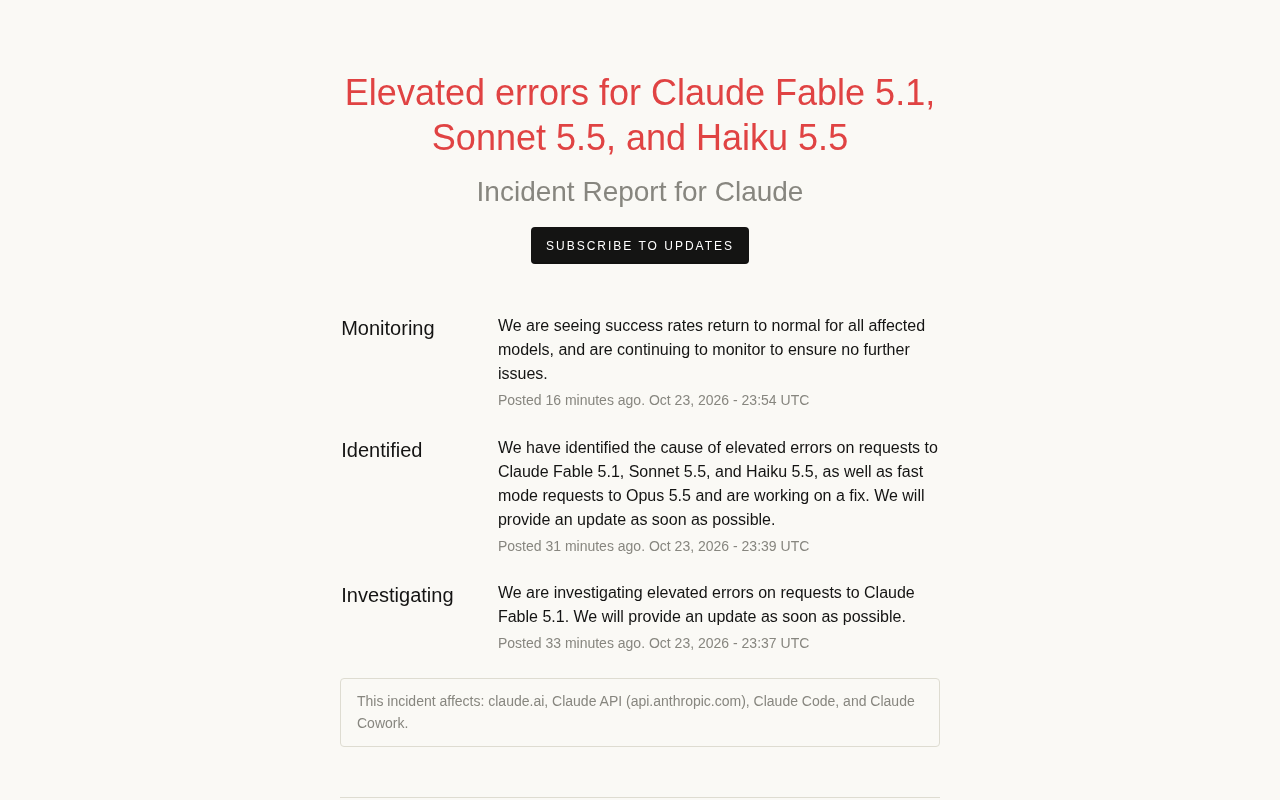
Multiple Claude Models Hit by Errors: A Postmortem of Fable 5.1, Sonnet 5.5, and Haiku 5.5
Claude Fable 5.1, Sonnet 5.5, Haiku 5.5, and Opus 5.5 fast mode saw elevated errors; Anthropic identified and resolved the issue in 17 minutes. This postmortem covers the timeline, the technical reasons for the multi-model cascading failure, and practical lessons for retry and degradation strategies.