Why Britain Gave Up America: The Strategic Calculus of a Global War

Britain's abandonment of the Thirteen Colonies was a strategic trade-off in a global multi-front war, not a simple military defeat.
Drawing on historian Sarah Paine's analysis, the article reinterprets the outcome of the American Revolutionary War. Paine argues that Britain's eventual abandonment of the North American colonies was not a simple battlefield defeat but the result of a global strategic calculus. The colonies' objectives were limited, but London treated the rebellion as a core threat that had to be destroyed, driving its opponents onto "death ground" and prolonging the war. With France's alliance in 1778, Spain's entry in 1779, and Britain's attack on the Netherlands in 1780, the regional conflict rapidly escalated into a global war. The most economically valuable assets were the Caribbean sugar islands, and under multiple pressures Britain chose to abandon the North American colonies—"not worth much anymore"—and concentrate on securing core Caribbean interests. This "adding up the whole account" thinking explains how Britain maintained its global empire after losing the Thirteen Colonies.
The American Revolutionary War is often reduced to a bilateral conflict between the colonies and their sovereign, but historian Sarah Paine argues that Britain's eventual abandonment of the Thirteen Colonies was not a simple military defeat, but the result of a global strategic trade-off. When a regional rebellion escalated into a multi-front global war, London was forced to reassess: where were the assets truly worth defending?
From Regional Conflict to Global War
Paine points out that the colonies' objectives were limited from the start—they had no intention of overthrowing the London government, only of achieving self-governance in North America. But London viewed the Continental Army and the Continental Congress as the core of a rebellion that had to be eliminated. This "you die, I live" framing only made the colonial soldiers and civilians more resolute.

In Paine's words, the colonial army was driven onto "death ground," with no retreat and no choice but to fight to the death. And the vast North American theater stretched the war out, giving Britain's many adversaries ample time to intervene—among the European powers at the time, quite a few were eager to take the opportunity to knock Britain down a peg.
"Death ground" is a classic concept in military strategy, originating from the "Nine Situations" chapter of The Art of War: "On death ground, fight." It refers to the extraordinary combat power that emerges when an army is placed in a desperate situation with no way out. Later strategic thinkers such as the American military theorist John Boyd also frequently invoked this concept to explain how a defender, fighting on home soil, surrounded, or with no retreat, can offset an attacker's material superiority through the psychological mobilization of "burning one's boats." Paine uses the term to explain why the North American colonists and militiamen grew more resilient under British pressure: by defining the rebellion as a core threat that had to be utterly destroyed, London effectively drove its opponents onto "death ground," further inflaming rather than crumbling their will to resist.
Multiple Powers Intervene, War Spreads Across the Globe
In 1778 France allied with the colonies, in 1779 Spain joined on France's side, and in 1780 Britain attacked the Netherlands. What had been a local conflict rapidly escalated into a global war.
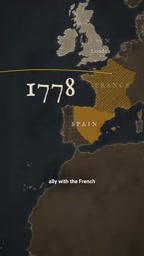
Paine lists the many directions in which the fighting spread: France attacked Savannah, Spain attacked Louisiana, and France even planned an invasion of England itself from the Isle of Wight; Britain and France clashed at the Battle of Ushant; France and Spain besieged Gibraltar and Menorca; Britain attacked the Cape Verde Islands off the African coast and assaulted Mahé and Pondicherry in India.

The Franco-American alliance (1778) was a key turning point of the Revolutionary War. France had previously been secretly supplying the colonies with materiel and loans, but a formal alliance meant an open Anglo-French war, allowing the French navy to directly threaten Britain's sea lanes and homeland security. The successive involvement of Spain (1779) and the Netherlands (1780) left Britain fighting on multiple fronts: Spain sought to recover Gibraltar and Menorca, while the Netherlands was dragged into the conflict over maritime trade disputes with Britain. These European powers' interventions were not simply out of "sympathy for the colonies" but were opportunities to weaken Britain's global hegemony—this is precisely the structural reason a regional rebellion escalated into a global war.
The Caribbean Sugar Islands Were the Real Strategic Center of Gravity
In Paine's account, one key detail is often overlooked: the most economically valuable theater at the time was the Caribbean, home to the sugar islands, and sugar in the 18th century was an extremely profitable commodity.

It was under the pressure of this global chessboard that Britain made its strategic trade-off—abandoning the rebellious North American colonies and concentrating its forces to secure core interests in the Caribbean. Paine states plainly that London's judgment at the time was that these rebellious colonies "weren't worth much anymore today," and that it was better to hold on to things of greater value.
Eighteenth-century sugar was one of Europe's most important luxuries and commodities, known as "white gold." Caribbean islands (such as Barbados, Jamaica, and Saint-Domingue) relied on slave labor to cultivate sugarcane on a massive scale, generating enormous tariff and trade profits for the mother countries; their economic value under the mercantilist system of the time far exceeded most of the output of the North American mainland colonies. Precisely for this reason, the contest among Britain, France, Spain, and others in the Caribbean was extraordinarily fierce, and the transfer of an island often meant the transfer of considerable fiscal revenue. Only by understanding this can one grasp why London, in its strategic calculus, placed the Caribbean sugar islands above the rebellious North American colonies—the former offered higher immediate economic returns, while the North American colonies were then considered "not worth much anymore."
The Logic Behind the Strategic Trade-off
This analysis offers a perspective different from "the colonies won through weakness against strength": Britain's withdrawal was a deliberate contraction amid multi-front warfare, not a simple battlefield defeat. When global interests were dispersed, homeland security was threatened, and the profits of the sugar islands far exceeded those of the North American colonies, abandoning North America became, in London's eyes, the rational choice to cut losses.
This "adding up the whole account" strategic thinking also explains why Britain could still maintain its global imperial system after losing the Thirteen Colonies—it had merely reallocated its resources to places with higher returns at the time.
Related articles

Cursor AI Programming in Practice: Build a Student Management System from Scratch in 30 Minutes
A Bilibili creator demonstrates Cursor AI programming: generating a student management system in 30 minutes with natural language. Details on Agent mode, Claude selection, prompt techniques, and thresholds.

Top 20 AI Coding Tools Ranking: From Rock-Solid to Lackluster, a Scored Matrix
Bilibili creator releases top 20 AI coding tools ranking, tiered T0–T4 from rock-solid to lackluster, with Claude Code and Codex tied at T0. This article details the scoring dimensions (capability, reliability, robustness, durability, cost, domestic availability) and tool performances to help developers choose the right AI coding assistant.

Vibe Coding Systematic Tutorial: Master AI-Assisted Programming from Zero
A three-month Vibe Coding tutorial from a Bilibili creator covering Codex, ClaudeCode, and Cursor, from core logic to commercial project practice for beginners.