Why Build Your Own Knowledge Base with Spring AI When Dify Exists? Four Core Reasons Explained

Four key reasons enterprises build knowledge bases with Spring AI instead of using Dify.
This article analyzes why enterprises choose Spring AI to build custom knowledge base systems rather than relying on Dify. The four core reasons include deep microservice integration, fine-grained data-level permission control via vector database metadata, highly customizable RAG pipelines with multi-way recall and reranking, and seamless alignment with existing Java tech stacks to reduce learning and operational costs.
In the world of AI application development, the rise of low-code workflow platforms like Dify has made building a knowledge base Q&A system easier than ever. Dify is an open-source LLM application development platform launched in 2023 by a Chinese team, using Python as its backend language with a React-based frontend. It offers a visual workflow orchestration interface where developers can build complex AI application flows by dragging and dropping nodes — positioning itself as the "WordPress" of AI applications. With built-in vector storage, document chunking, and RAG retrieval capabilities, it's nearly ready to use out of the box. This naturally raises a question: if Dify already provides comprehensive knowledge base functionality, why do so many teams still choose to build enterprise-grade knowledge base systems from scratch using Spring AI?
Spring AI is an AI application development framework officially released by the Spring ecosystem in late 2023, designed to bring large language model capabilities into Java enterprise development in a Spring Boot-native way. It provides a unified API abstraction layer supporting multiple model providers including OpenAI, Ollama, and Azure OpenAI, while incorporating built-in RAG-related components such as VectorStore, DocumentReader, and TextSplitter. Its design philosophy enables Java developers to work with AI capabilities as naturally as they use Spring Data JPA for database operations, with deep integration into Spring Boot's auto-configuration mechanism.
This question goes beyond mere technical decision-making — it's also a classic interview question that developers frequently face. This article systematically breaks down the core value of building your own knowledge base from four dimensions: enterprise-level controllability, deep business integration, personalized RAG capabilities, and tech stack alignment.
Deep Business Integration: The Natural Advantage of Microservice Ecosystems
The first and most fundamental reason lies in the ability to deeply integrate the knowledge base system with existing business operations.
Consider an airline booking system scenario: users want to complete a series of operations — placing orders, canceling tickets, modifying reservations — through conversational interaction. In Dify, these business operations can only be achieved through API orchestration — having the workflow remotely access backend HTTP endpoints. When there are only one or two endpoints, this approach is manageable. But when the system involves numerous business interfaces, each remote URL must be maintained individually, and the entire access network becomes extraordinarily large and difficult to manage.
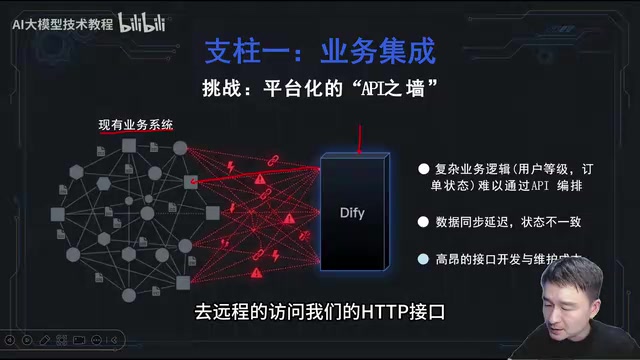
By contrast, with Spring AI, the knowledge base system can seamlessly integrate into a microservice architecture (such as a Nacos service registry). Microservice architecture is a design pattern that breaks monolithic applications into multiple independently deployed, independently running small services, each focused on a single business capability and communicating via lightweight protocols (such as HTTP/gRPC). Nacos is Alibaba's open-source service registration and configuration management platform, widely used in the Java microservice ecosystem, providing core capabilities like service discovery, health checking, and dynamic configuration management. In a microservice architecture, inter-service calls are routed by service name rather than fixed IP addresses, with Nacos maintaining address mappings for all service instances as the registry. The deep integration between Spring Cloud Alibaba and Nacos allows developers to implement remote inter-service calls through simple annotations — calling another service's business interface becomes extremely straightforward, with higher performance and stronger controllability. Developers can also flexibly execute custom business logic, such as directly accessing databases or reading system user information. This native integration capability stands in stark contrast to Dify's approach of configuring HTTP endpoint URLs one by one — something that bolt-on API orchestration simply cannot match.
Fine-Grained Permission Control: From Application-Level to Data-Level
The second key difference lies in the granularity of data access permission control.
While Dify does offer ways to integrate with external user systems, practical usage reveals significant limitations. The core pain point is that Dify's permissions operate at the application level. This means that even if you integrate your own user system, once a document is uploaded to the knowledge base, it's very difficult to finely control access permissions for that document based on different user roles.
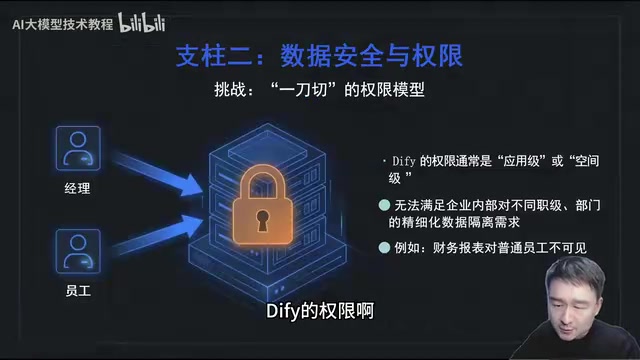
Here's a typical example: a sensitive document containing a company-wide salary table obviously shouldn't be freely searchable by regular employees. But in Dify, implementing this kind of data-level permission isolation is extremely difficult.
With a knowledge base system built using Spring AI, you can leverage Metadata fields in the vector database to map user roles, thereby implementing identity-based document access control at the retrieval level. To understand this, you need to grasp how vector databases work: vector databases (such as Milvus, Pinecone, Weaviate, Qdrant, etc.) don't store traditional structured data. Instead, they store high-dimensional numerical vectors generated by converting text through Embedding models (such as OpenAI's text-embedding-ada-002, BGE, etc.). The distance relationships between these vectors in mathematical space represent semantic similarity — the more semantically similar two texts are, the closer their vectors are in space. Metadata consists of structured label information attached to each vector record in the database, which can include fields like document source, creation time, and access permission level. During retrieval, in addition to vector similarity matching, Metadata can be used for filtering, enabling the capability of "only returning documents the current user is authorized to access." This means that within the same knowledge base, users with different permissions see different search results — a critical requirement for data security in enterprise applications.
Personalized RAG: Breaking Through the Ceiling of Generic Capabilities
The third reason involves the customization capabilities of the RAG (Retrieval-Augmented Generation) pipeline.
RAG (Retrieval-Augmented Generation) is a technical paradigm proposed by Meta AI in 2020. Its core idea is to retrieve the most relevant document segments from an external knowledge base before the large language model generates an answer, injecting these segments as context into the prompt so the model generates answers based on real data. The standard RAG pipeline includes six stages: document loading, text chunking, embedding (vectorization), vector storage, semantic retrieval, and answer generation. The implementation quality of each stage directly affects the final Q&A performance.
As a general-purpose platform, Dify can only provide standardized RAG capabilities. Take document chunking as an example — it offers general chunking strategies and parent-child segmentation, but beyond that, further extension is difficult. In real enterprise scenarios, however, businesses often require much more flexible and customizable retrieval solutions.
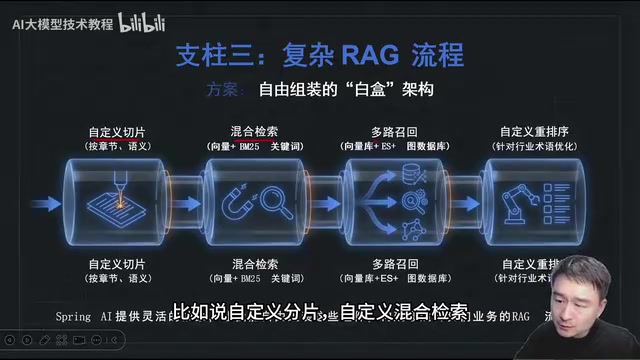
Personalized capabilities that a self-built system can achieve include:
- Custom chunking strategies: Applying the most appropriate splitting method for different document types. For example, code documents can be chunked by function/class, legal contracts by clause, and tabular data by row or logical unit — rather than uniformly splitting by fixed character count
- Custom hybrid retrieval: Going beyond vector-only retrieval to support keyword-semantic hybrid matching. Pure vector semantic retrieval may miss documents containing exact keywords (such as product codes or regulation clause numbers), while pure keyword retrieval cannot understand semantic synonyms. Hybrid retrieval combines sparse retrieval algorithms like BM25 with dense vector retrieval to capture both exact matches and semantic matches simultaneously
- Custom multi-way recall: Simultaneously searching multiple data sources including vector databases, Elasticsearch, graph databases, and relational databases. Multi-way Recall is a classic strategy in information retrieval, with the core idea of obtaining candidate results through multiple different retrieval channels simultaneously, then performing fusion ranking to maximize recall rate
- Custom reranking: Performing unified ranking optimization on multi-way recall results to improve final answer quality. Reranking models (such as Cohere Rerank, BGE-Reranker) perform more refined relevance scoring on initially recalled candidate documents, placing the most relevant content at the top to ensure optimal information quality in the context injected into the large model
These highly personalized RAG features cannot be achieved in Dify. When a business has stringent requirements for retrieval quality, recall rate, and multi-source data fusion, a self-developed RAG pipeline is the only way to truly meet business needs.
Tech Stack Alignment: Reducing Team Learning and Operations Costs
The fourth reason is the compatibility of the tech stack with the existing team.
Many enterprises have core technical teams centered around Java, with mature Java-based DevOps ecosystems already established internally — including CI/CD pipelines (such as Jenkins, GitLab CI), container orchestration (such as Kubernetes), monitoring and alerting (such as Prometheus+Grafana), log collection (such as ELK Stack), and more. Dify, however, is built on Python.
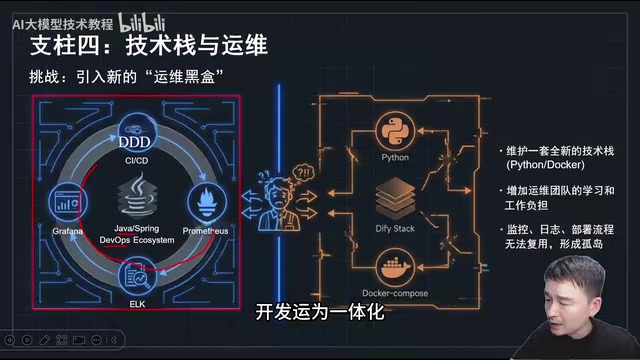
This means that even when adopting Dify, teams must staff Python-capable developers — because secondary development and operations deployment both require maintaining an additional system heterogeneous to the primary tech stack. Python and Java differ significantly in package management (pip vs Maven/Gradle), runtime environments (CPython interpreter vs JVM), deployment methods, and performance tuning approaches. Maintaining two heterogeneous systems not only increases technical complexity but can also create knowledge blind spots during troubleshooting. This inevitably raises the team's learning costs and staffing costs.
For Java-stack teams, building a knowledge base with Spring AI allows them to reuse existing development standards, operations toolchains, and team capabilities, offering clear advantages in overall maintenance costs and collaboration efficiency.
Core Capability Checklist for Enterprise Knowledge Bases
In summary, building a custom knowledge base system isn't about denying Dify's value. Rather, it's about making choices better suited to complex business scenarios in areas that are enterprise must-haves: controllability, integration depth, customization, and tech stack unification.
A complete enterprise knowledge base system, beyond the core RAG-based Q&A capability, typically needs to address a series of engineering challenges:
- Optimal chunking strategies and aggregated vector retrieval: Chunk size directly affects retrieval precision and context completeness — too large introduces noise, too small loses context — requiring iterative tuning based on business scenarios
- Document expiration and update mechanisms: Documents in enterprise knowledge bases are continuously updated, so the system needs to support incremental updates, version management, and automatic cleanup of stale vectors to prevent outdated information from contaminating search results
- Improving recall rates in the retrieval stage: Using techniques such as Query Rewriting, Query Expansion, and Hypothetical Document Embeddings (HyDE) to increase the probability of the retrieval system finding relevant documents
- Hallucination management in RAG Q&A: Even with external knowledge, large models may still add content in their answers that hasn't been verified through retrieval. This needs to be controlled through prompt engineering, fact-verification chains, confidence scoring, and other mechanisms
- Source attribution for Q&A results: Each answer needs to cite its source documents and specific passages, allowing users to verify answer reliability — especially critical in high-compliance industries like legal, finance, and healthcare
- Data-level access permissions and security controls: As discussed earlier, fine-grained permission management based on Metadata is a hard requirement for enterprise knowledge bases
These are precisely the critical aspects that general-purpose platforms struggle to cover, yet enterprises cannot avoid when implementing real solutions. Understanding these differences not only aids in technical decision-making but also enables developers to clearly articulate the underlying logic behind "why build it yourself" in interviews and technical discussions.
Conclusion
Low-code platforms and self-built frameworks have never been an either-or proposition. Dify excels in rapid prototyping and lightweight scenarios, while frameworks like Spring AI demonstrate irreplaceable value in enterprise-level requirements such as deep business integration, fine-grained permissions, personalized RAG, and tech stack unification. The key to choosing always comes down to business complexity and controllability requirements — when your knowledge base needs to truly grow into the backbone of your business system, building it yourself becomes inevitable.
Related articles
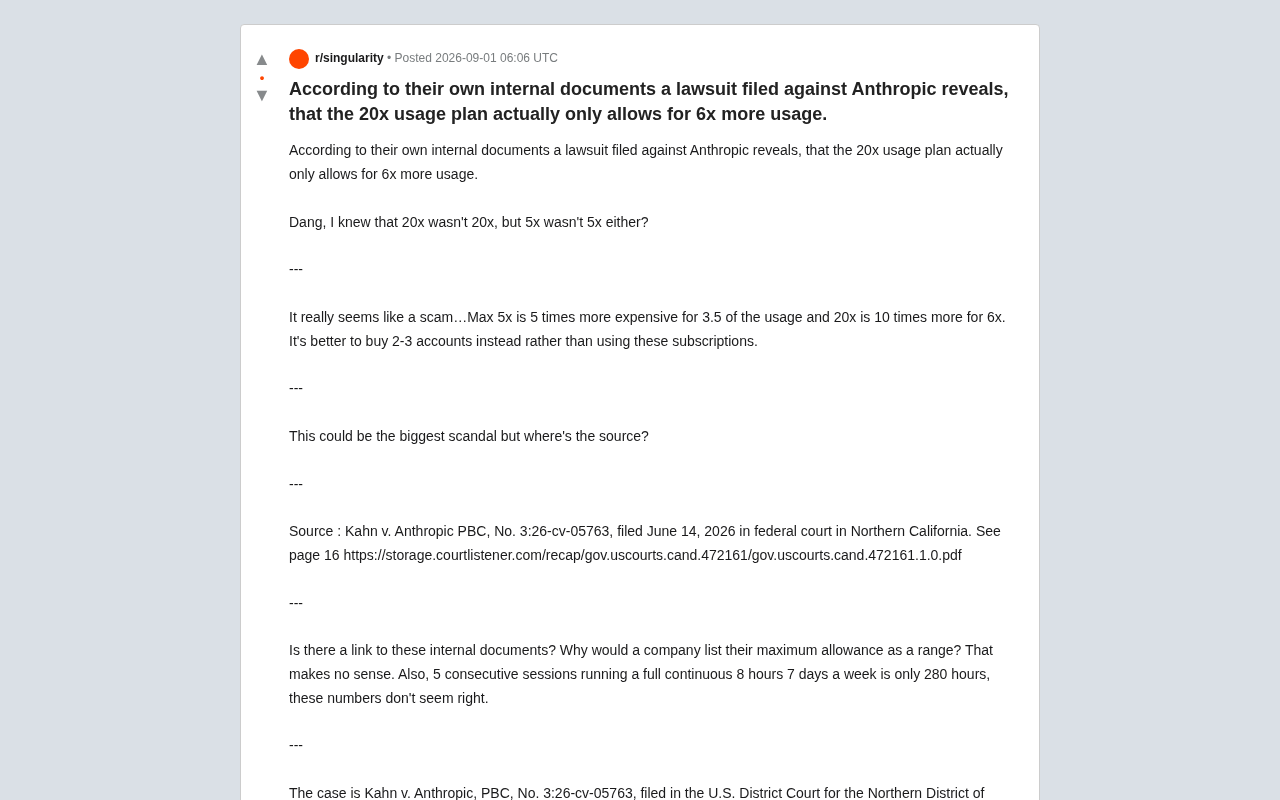
Anthropic Sued: Claude Max 20x Plan Allegedly Delivers Only 6x Usage?
A lawsuit against Anthropic alleges Claude Max's 20x plan delivers only ~6x usage, and the 5x plan just 3.5x. We break down the legal details, community reactions, and the AI subscription transparency crisis.

Cursor Beginner's Guide: A Six-Step Workflow for Managing Changes, Rollbacks, and Validation
New to Cursor and keep breaking things? Learn a six-step dev workflow covering Cursor Rules, Plan mode, Diff review, and Checkpoint rollback to go from guesswork to engineering.

Is Cheap Cursor Reselling Reliable? The Real Risks of Shared Account Pools Exposed
An in-depth analysis of Cursor Pro budget reselling services, exposing the shared account pool model behind so-called legitimate accounts and deep discounts from technical, compliance, and data security perspectives.