Why C Language Still Matters: From Operating Systems to Embedded Systems

C remains the必经之路 to understanding low-level computing and systems programming through efficiency, hardware affinity, and system-level capability.
Since Dennis Ritchie developed C at Bell Labs in the 1970s, its concise syntax, efficient execution, and hardware affinity have kept it active in operating system kernels, embedded devices, compilers, and performance-sensitive software. This article systematically explains C's enduring value across introductory teaching, execution efficiency, OS development, embedded systems, pointers and memory management, influence on other languages, portability, and career development. C is both an entry point for understanding memory, pointers, and hardware interaction and the source of underlying mental models for C++, Java, and C#. Though steep to learn, it bridges software logic and hardware behavior, making it nearly essential for developers diving into systems, security, or hardware.
C was born in the early 1970s, developed by Dennis Ritchie at Bell Labs. More than half a century later, it has not exited the stage like many of its contemporaries. Instead, it has permeated operating system kernels, embedded devices, compiler implementations, and various performance-sensitive software. For today's developers and computer science students, understanding the value of C is not just about mastering a language—it's a shortcut to understanding how computer systems actually work.
Its Legitimacy as an Introductory Programming Language
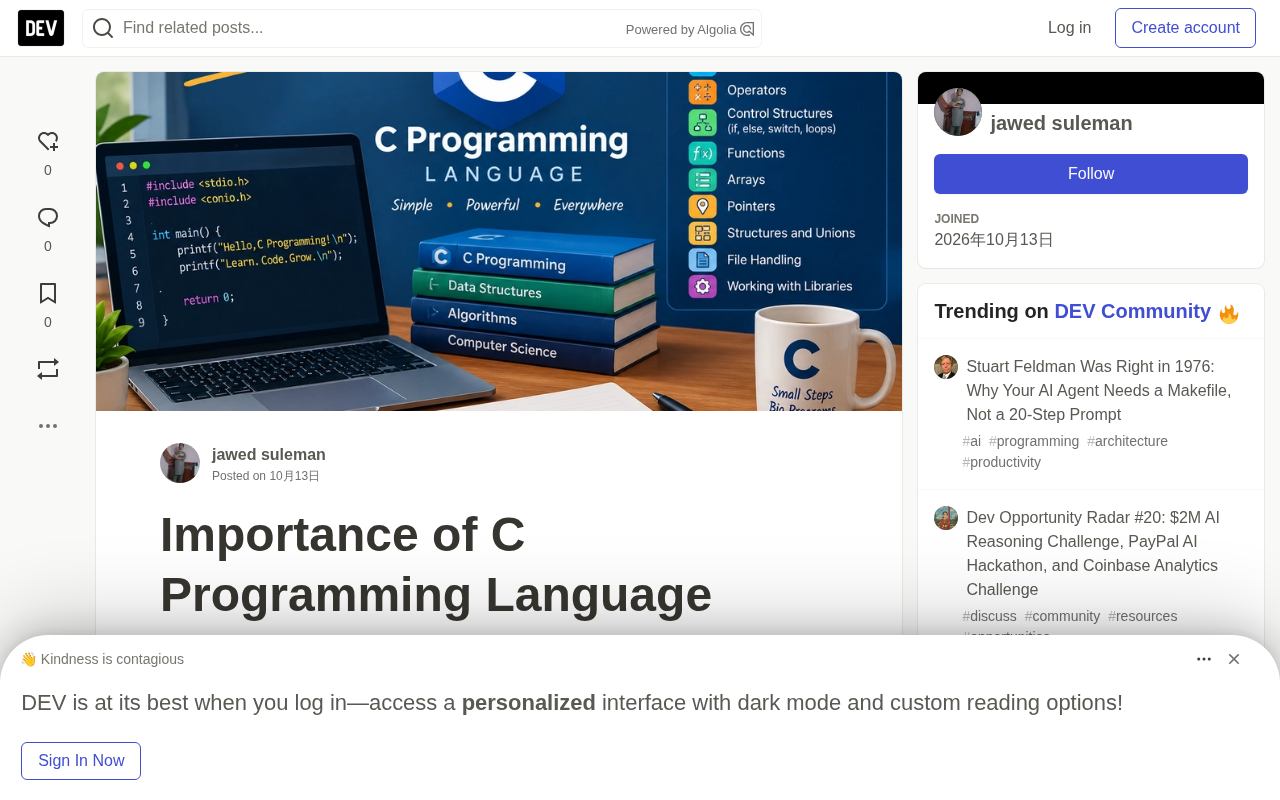
C's syntax is relatively concise, yet it covers the most core concepts in programming: variables, data types, operators, loops, conditionals, functions, and arrays. When beginners write a program in C to find the greatest common divisor, they must personally handle type declarations, function return values, and loop boundaries. These constraints establish a clear understanding of program behavior early on.
Compared to languages like Python, C has a steeper learning curve, but this also means learners are exposed to logical thinking and problem decomposition training at the introductory stage. This training has transferable value for learning any programming language afterward.
High Execution Efficiency and Hardware Affinity
C is widely used in scenarios with strict execution speed requirements, fundamentally because it allows programmers to directly manipulate memory and hardware resources. The machine code generated after compiling source code is typically small in size and fast to run, without needing a virtual machine or runtime environment for additional interpretation.
This efficiency advantage is particularly evident in game engine底层, database kernels, high-frequency trading systems, and scientific computing libraries. When performance budgets are measured in microseconds, the level of control C provides is often more suitable than high-level languages.
Compiled Languages and Machine Code
C is a compiled language; source code must be processed by a compiler and converted into machine code that a specific CPU architecture can directly execute. This process typically includes four stages: preprocessing, compilation, assembly, and linking. The preprocessor handles macro definitions and header file inclusion, the compiler translates C code into assembly instructions, the assembler then converts it into machine code object files, and finally the linker merges multiple object files and libraries into an executable program.
Unlike interpreted or just-in-time compiled languages such as Python and JavaScript, programs generated by C do not require an additional interpreter or virtual machine layer at runtime—the CPU directly executes the compiled output. This is an important reason why C programs start quickly, have low memory overhead, and run stably, and it is also the technical foundation for its long-standing place in performance-sensitive scenarios.
The Cornerstone Role in Operating System Development
Most of the UNIX operating system's code was later rewritten in C, and the Linux kernel still heavily uses C today. These two facts alone illustrate C's position in the system software domain. An operating system's task management, memory allocation, device drivers, and file systems all require a language capable of precisely controlling memory layout and hardware registers—C satisfies exactly these conditions.
Those who learn C and then read Linux kernel source code will find pointers, structs, and bitwise operations everywhere. This balance of readability and controllability is one reason C is difficult to replace in systems programming.
Dominance in Embedded Systems
Embedded systems are small computer systems built into electronic devices—washing machines, digital cameras, medical equipment, automotive electronics, and industrial control systems all fall into this category. These devices typically have limited memory, are power-sensitive, and need to run stably for long periods. C compiles into compact, efficient code that can work in resource-constrained environments.
The cross-compilation toolchains common in embedded development mostly also use C as their primary development language. For hardware engineers and firmware developers, C is almost the default choice.
What Is a Cross-Compilation Toolchain
"Cross-compilation" in embedded development refers to a compilation method that generates programs for one platform on another platform. For example, a developer might write code on an x86 development machine, but the target device is an ARM-based microcontroller. Because the target device has too few resources to run a full compiler and operating system, compilation must be completed on the development machine, and then the generated executable file is flashed to the device.
A cross-compilation toolchain typically includes a cross-compiler, linker, debugger, and standard library. Common ones include the GNU toolchain and the LLVM toolchain. Because C compiler backends have mature support for various CPU architectures and generate compact, controllable code, the vast majority of cross-compilation toolchains use C as their primary development language, further consolidating C's default position in the embedded field.
The Educational Value of Pointers and Memory Management
C provides features like pointers and dynamic memory allocation, allowing programmers to intuitively understand how computer memory is organized. The difference between the heap and stack, the causes of memory leaks, the dangers of wild pointers—these problems are directly exposed in C.
This "transparency" about memory is something many high-level languages deliberately hide. While hiding brings development efficiency, it also leaves programmers lacking awareness of the real runtime overhead of a program. C fills this gap.
The Difference Between Heap and Stack
When a C program runs, memory is typically divided into several regions, with the stack and heap being the most critical. The stack is automatically managed by the compiler and is used to store function parameters, local variables, and return addresses. It is allocated and freed automatically as functions are called and return—fast but limited in space. The heap is manually managed by the programmer through functions like malloc, calloc, realloc, and free. It is larger and more flexible in lifetime, but forgetting to free after allocation causes memory leaks, and continuing to use after freeing produces wild or dangling pointers.
Understanding the difference between these two regions is the core of mastering C's memory model. The stack reflects the hierarchical structure of program control flow, while the heap reflects the programmer's active control over resource lifetimes. Many high-level languages' garbage collection mechanisms essentially automate the release of heap objects, whereas C hands this responsibility back to the developer.
The Radiating Influence on Other Languages
Languages such as C++, Java, and C# all have origins in C in terms of syntax or underlying concepts. C++ initially appeared as "C with classes," and Java and C#'s control structures and basic data type naming also clearly inherited C's style.
With a foundation in C, learning these languages becomes easier when it comes to concepts like function calling conventions, stack frame structure, and value vs. reference passing. C provides a set of underlying mental models, not scattered syntax knowledge.
The Practical Meaning of Portability
In most cases, C programs require only minor modifications to be recompiled and run on different operating systems and computer architectures. This benefits from the abstraction layer provided by the C standard library and the compiler's ability to adapt to target platforms.
Portability does not mean "write once, run anywhere"—platform-specific system calls and hardware assumptions still need to be handled separately. However, in cross-platform foundational libraries and middleware development, C's portability remains a significant advantage.
The C Standard Library and Platform Adaptation
C's portability largely relies on the C standard library and the compiler's ability to adapt to target platforms. The standard library provides unified interfaces for basic functions such as input/output, string processing, mathematical operations, and memory management. For example, functions like printf, malloc, and strcpy have consistent semantics across different platforms. The compiler is responsible for translating the same C code into machine code for different CPU architectures.
However, the standard library only covers general functionality unrelated to the operating system. Platform-specific operations such as file system paths, thread models, network sockets, and graphics interfaces often require calling the respective operating system's APIs. Therefore, C program portability typically manifests as: core algorithms and data structures can be reused across platforms, while parts involving system calls require conditional compilation or abstraction layer encapsulation. This is also why many cross-platform libraries are implemented internally in C and provide unified interfaces externally.
Practical Value in Career Development
Mastering C has direct application scenarios in fields such as software development, embedded systems, operating systems, firmware, robotics, and cybersecurity. Many university computer science courses still treat C as core teaching content because it teaches programming structures while also introducing the fundamentals of computer architecture.
For developers who want to go deep into the system layer, security layer, or hardware layer, C is not an option—it's a必经之路. Its value lies not in popularity rankings, but in the distance it bridges between software logic and hardware behavior.
One-line Summary
C, with its efficiency, hardware affinity, and system-level capabilities, is a必经之路 to understanding the low-level workings of computers and systems programming.
Paragraph Summary
Since its development by Dennis Ritchie at Bell Labs in the 1970s, C has remained active in operating system kernels, embedded devices, compilers, and performance-sensitive software thanks to its concise syntax, efficient execution, and hardware affinity. The article systematically explains C's enduring value from perspectives including introductory teaching, execution efficiency, operating system development, embedded systems, pointers and memory management, radiating influence on other languages, portability, and career development. C is not only an introductory language for understanding memory, pointers, and hardware interaction, but also the source of underlying mental models for languages like C++, Java, and C#. Although its learning curve is steep, it connects software logic with hardware behavior, making it almost a必经之路 for developers going deep into the system, security, or hardware layers.
Related articles

Uber Deploys ChatGPT Work Company-Wide: AI in the Workplace Enters the Scaled Implementation Phase
Uber deploys ChatGPT Work to 30,000+ employees, extending it from engineering to all roles. We analyze its expert-engineer pairing, end-to-end automation, and questions of AI control and power concentration—insights for scaling AI in the workplace.

Shift at Midnight Hands-On: When "ID Verification" Becomes Alien Hunting
Shift at Midnight blends ID verification with horror survival in a four-player co-op game. We break down its inspection mechanics and chaotic humor.

Zelensky Recounts the Outbreak of War: I Need Ammunition, Not a Ride
Zelensky recalls the first day of war in a YouTube interview: farewell to family, rejecting Biden's evacuation offer with "I need ammunition, not a ride," and how Bucha shaped his stance on compromise and peace talks.