Why Can Molecules Store Such Astonishing Amounts of Energy? Uncovering the Quantum Truth Behind Chemical Bonds

Chemical energy isn't stored in bonds — it arises from quantum atomic arrangements deviating from their lowest energy state.
Starting from everyday analogies like books on shelves and rubber bands, this article reveals that energy storage is fundamentally about systems deviating from their lowest energy state. Using potential energy curves and quantum orbital theory, it debunks the widespread myth that energy is stored in chemical bonds — bonds exist because atoms have already fallen into a low-energy arrangement, and breaking them always consumes energy. Combustion and ATP release energy because the products occupy a lower point on the energy landscape, with the difference converted to heat, light, or mechanical work. The article traces these principles through quantum mechanics (bonding orbitals, ground states) all the way back to nuclear fusion and photosynthesis — revealing that molecular chemical energy is ultimately borrowed stellar energy.
The energy powering your brain, the energy carrying migratory birds across oceans, and the energy in gasoline that drives a car all belong to the same fundamental category — they all come from the tiny arrangements of atoms. These structures are almost unimaginably small, yet they can lock away staggering amounts of energy. The question is: how can something so minuscule store so much?
Even more intriguing, a fuel molecule can sit motionless in a gas tank, perfectly still, yet quietly hold enough energy to propel a fighter jet. Where does that energy actually live? Is it really stored "in chemical bonds," as textbooks suggest? Or is there a deeper mechanism at work? The full answer requires a journey into the quantum world — and along the way, you'll find that the phrase "energy is stored in chemical bonds" is actually quite misleading.
The Essence of Energy Storage: Deviating from the Lowest Energy State
Let's start with a simple example. When you place a book on a shelf, you do work against gravity. That work doesn't disappear — it becomes gravitational potential energy stored in the book. When the book falls, gravity returns that energy as sound and motion.
Now imagine stretching a rubber band. You do work again, but the energy isn't expressed as motion — it's stored, because the atoms inside the rubber band are forced away from their preferred natural positions.
Here lies a core idea that runs throughout this entire discussion: nature always tends to push systems toward the lowest possible energy state. Whenever you force a system away from its preferred arrangement, energy gets stored. This simple principle explains nearly every form of energy storage in nature, including the chemical energy found in molecules.
Atoms Almost Never Touch: The Energy Valley Built by Electromagnetic Forces
Here's a counterintuitive fact: atoms almost never truly touch each other. When you rest your hand on your phone, you might think atoms are "touching" — but they're not. When the electron clouds surrounding atoms begin to overlap, they repel each other through electromagnetic forces, and the atoms halt long before their nuclei could ever meet.
So when we say two atoms "form a bond," we really mean they've settled at a very specific distance — exactly where competing forces reach equilibrium: the attraction of electrons to nuclei balanced against the repulsion between like charges.
Physicists often use a potential energy curve to describe this relationship. Imagine a graph where the horizontal axis represents the distance between two atoms and the vertical axis represents energy. When the atoms are far apart, their energy is relatively high. As they approach, they attract each other and energy drops — until it reaches a minimum. That lowest point represents the most stable separation distance, the "bond length." Push them any closer and the positively charged nuclei start repelling each other violently, sending energy sharply upward. The molecule naturally wants to sit at the bottom of this energy valley, where stability is greatest.

The Biggest Misconception in Chemistry: Breaking Bonds Doesn't Release Energy — It Consumes It
Many people picture chemical bonds as little sticks connecting atoms. That's useful for drawing molecular structures, but reality is far more powerful. A chemical bond is not a physical "rod" — it's a stable arrangement of electrons shared between atomic nuclei.
Electrons aren't tiny planets orbiting a nucleus. They exist as waves, described by quantum mechanical wave functions. When electron waves overlap in just the right way, electrons spend more time between the two nuclei. That concentration of negative charge partially shields the nuclei from repelling each other, while each nucleus is simultaneously attracted to the shared electrons. The result is a stable configuration whose total energy is lower than that of the isolated atoms — and that is what a chemical bond actually is.
Notice a subtle but critically important distinction: the bond itself is not a container holding energy. The bond exists precisely because the atoms have already fallen into a lower-energy arrangement.
This leads to the biggest misconception in chemistry. People often hear that fuel "stores energy in its chemical bonds" and naturally assume that breaking those bonds releases energy. But the opposite is true — breaking a bond always requires an input of energy, without exception. Just as you must push a marble up the slope to lift it out of a valley, breaking a bond means climbing out of an energy minimum.

So Why Does Combustion Release Energy?
Gasoline releases heat when it burns not because bonds are simply broken, but because the reaction breaks old bonds and forms new, stronger ones — ones that sit even lower in the energy landscape. Imagine climbing out of one valley only to roll into a much deeper one; the difference in depth becomes the energy released.
Take burning natural gas (mainly methane) as an example. The atoms rearrange into carbon dioxide and water, and the new molecules occupy much lower-energy configurations. Where does the extra energy go? Most of it becomes motion: atoms vibrate faster, molecules fly apart, and collisions multiply — and those collisions are what we perceive as heat. Some energy also appears as light, as the intensely excited molecules in a flame emit photons.
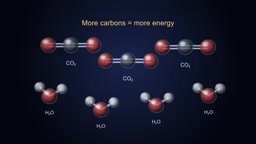
Gasoline is energy-dense because it's made of hydrocarbons that rearrange into carbon dioxide and water upon combustion. Carbon-oxygen and hydrogen-oxygen bonds are both extremely stable, so the products occupy an energy state far below that of the original hydrocarbons. The greater the drop, the more heat is released. Hydrogen fuel follows the same logic — hydrogen combines with oxygen to form the extraordinarily stable water molecule, which is why the energy release per kilogram of hydrogen is so remarkable.
Life's Energy Currency: How ATP Really Works
Some reactions release energy in other forms. In a battery, chemical reactions separate charges and generate a voltage that pushes electrons through a wire to power your phone. Living cells are even more impressive: rather than letting chemical energy dissipate uselessly as heat, they capture most of it in molecules like ATP.
When you eat a burger, your body doesn't "burn" it directly. Instead, it gradually transfers the food's energy into ATP — a kind of rechargeable "molecular currency." Whenever muscles contract, neurons fire, or cells build new proteins, ATP foots the bill.
You've probably heard that ATP "stores energy in its phosphate bonds" — but that's another oversimplification. Breaking that phosphate bond in isolation actually requires energy. The reason the overall reaction releases energy is that the products (ADP plus phosphate, interacting with water) are more stable than ATP. The entire chemical system moves "downhill" in energy. That drop drives life itself. Every second, your body recycles hundreds of millions of ATP molecules, running an extraordinarily precise molecular economy.
The structure of ATP (adenosine triphosphate) helps explain why it's such an ideal energy carrier. ATP contains three phosphate groups linked in series, and adjacent phosphate groups both carry negative charges, creating electrostatic repulsion between them. This means ATP is maintained in a kind of "forcibly held" high-energy configuration — the phosphate groups want to push away from each other but are constrained by covalent bonds. When an enzyme catalyzes ATP hydrolysis (breaking the terminal phosphate bond and adding water), the products ADP and inorganic phosphate are released from this electrostatic tension and simultaneously form more stable solvation structures with water molecules. Under physiological conditions, the entire process releases approximately 30 kJ/mol of free energy — just enough to drive conformational changes in muscle proteins, yet not so large that it dissipates entirely as heat. This is precisely the "energy packet size" that life has selected over billions of years of evolution.
Tracing the Origin: The Energy in Molecules Was a Gift from Stars
If forming stable molecules releases energy, where did that energy come from in the first place? The answer often traces back to stars.
Nuclear fusion inside stars synthesizes heavier elements, altering nuclear binding energies. Those elements later became part of planets, and on planets, photosynthesis captures sunlight — photons from the Sun provide energy to assemble high-energy molecules like sugars. Animals eat plants or other animals, obtaining fuel to power their cells. Ultimately, cells release that stored solar energy through respiration.
In other words, the energy in your breakfast was once sunlight, and that sunlight originally came from nuclear fusion. The chemical energy stored in molecules is, at its core, borrowed stellar energy.
Photosynthesis is the central process by which solar energy is converted into chemical energy, and it's worth a brief explanation. When chlorophyll molecules in plant chloroplasts absorb photons of specific wavelengths, electrons are excited into higher-energy quantum states. These energetic electrons are then passed along a series of protein complexes, driving proton pumps that establish an electrochemical gradient across a membrane. This gradient ultimately drives the synthesis of ATP and NADPH — the latter being a "reducing power" molecule that carries high-energy electrons. These molecules are then used to fix carbon dioxide into sugars, effectively "writing" the energy originally dispersed among photons into the covalent bond arrangements of organic molecules. In essence, photosynthesis converts the fleeting energy of photons into hydrocarbon structures that can be stably stored for millions of years — and fossil fuels are precisely the compressed, deposited products of ancient plants' photosynthesis.
Going Deeper: Where Do the Energy Valleys Come From?
Where do those "energy valleys" actually come from? The answer lies in quantum mechanics. Electrons don't orbit nuclei like little balls — they exist like waves. Just as a guitar string can only vibrate in specific patterns, electron waves can only exist in certain allowed modes. These modes are called quantum states, and each corresponds to a specific energy.
When two atoms are far apart, each has its own independent electron wave patterns. As they approach, the electron waves begin to overlap. Quantum mechanics takes over: the overlapping waves don't combine arbitrarily — they organize into new wave patterns spanning both atoms, and some of these new patterns have lower energy than the originals. Nature always prefers lower energy, so these low-energy electron states draw the atoms into a stable arrangement. A chemical bond is simply quantum mechanics finding a lower-energy way to accommodate electrons.
These valleys aren't actual holes in space — they're just the energy values predicted by quantum mechanics. Every atom and molecule has its own set of allowed energy levels. The lowest is called the ground state, and higher arrangements are called "excited states."
The concept of quantum states deserves further elaboration. In quantum mechanics, the allowed energy levels of electrons are determined by the Schrödinger equation, which describes how an electron's wave function is distributed through space. When two atoms approach and form a chemical bond, their atomic orbitals undergo linear combination, producing two new types of orbitals: bonding orbitals (with energy lower than the original atomic orbitals) and antibonding orbitals (with energy higher than the original atomic orbitals). Electrons preferentially fill the bonding orbitals, lowering the system's overall energy and stabilizing the bond. This is why different atomic combinations form bonds with different energies — the triple bond in nitrogen is extraordinarily stable (requiring tremendous energy to break), while the oxygen-oxygen single bond in peroxides is relatively weak. The "strength" of a bond fundamentally reflects the energy gap between bonding and antibonding orbitals, as well as how many electrons occupy each.
So What Is Energy, Really?
We've been talking about energy as if it were some kind of stored substance, but energy isn't a material. It's not a fluid or a particle. Energy is a property of a physical system — it tells us how much work that system could potentially do.
When we say a molecule "stores energy," what we really mean is that the molecule is in a configuration that is not at the absolute energy minimum. Once conditions allow it to transition to a more stable configuration, the difference in energy will manifest as heat, light, electricity, or useful mechanical work. There are no tiny packets of energy tucked inside the molecule — the structure itself simply corresponds to a particular energy level.
So how do molecules store energy? Not by hiding miniature batteries inside chemical bonds, or by trapping energy balls between atoms. Rather, atoms occupy specific quantum arrangements shaped by electromagnetic forces, and those arrangements correspond to specific energy levels. When a molecule rearranges into a lower-energy configuration, the difference has to go somewhere — into heat, light, electricity, or the countless chemical reactions that drive all of life.
The energy powering your muscles, the gasoline in your car, the food on your plate, and the battery in the device you're using right now all ultimately obey the same fundamental principle: nature always prefers lower energy. Whenever it finds a downhill path, the universe finds a way to put that energy to work.
Related articles

AI Agent Terminology Too Confusing? One Interactive Concept Map to Untangle 40+ Core Terms
Confused by AI Agent terms like MCP, harness, orchestration, and skills? AI Concept Atlas is an interactive map visualizing 40+ concepts and their relationships, with cited sources.
Meta's Broken Promise: Community Demands to Know Where the Muse Spark Weights Are
Meta promised to open-source Muse Spark model weights over a month ago, but still hasn't delivered. The community questions how this squares with Zuckerberg's "can't delay even a month" stance.

Omarion SEC CLI: How a Self-Healing Autonomous Agent Tackles AutoGPT's Persistent Problems
Omarion SEC CLI is an open-source autonomous CLI agent that solves AutoGPT's error loops, terminal clutter, and session amnesia through execution fingerprinting, intent routing, and persistent memory.