Why Claude's "Boomer Thumbs Up" While Installing Kubuntu Is So Endearing

Claude's old-school thumbs-up tone while installing Kubuntu sparks discussion about AI companionship.
A Reddit post titled only "👍" sparked discussion: a user asked Claude to help install Kubuntu, and Claude's reply carried a "boomer thumbs up" encouraging tone that the user found both funny and endearing. The article notes this expression isn't deliberate but a social habit the model learned from human conversation data—affirm first, then help. When the counterpart is a Linux user typing at the command line, this cheerleading creates a comedic contrast. The post reflects users' expectations shifting from simply getting answers to collaborative companionship; in multi-turn, error-prone tasks like partitioning, drivers, and booting, a stable tone reduces anxiety and prompts us to reconsider whether we want AI to be more like a tool or a colleague.
The Resonance Sparked by a Single 👍
A Reddit post that used only "👍" as its title unexpectedly sparked discussion: a user asked Claude to help install Kubuntu, and Claude's reply included a "boomer thumbs up" emoji that cracked the user up. The original post read: "I'm having Claude help me install Kubuntu and the boomer thumbs up is cracking me up 😄".
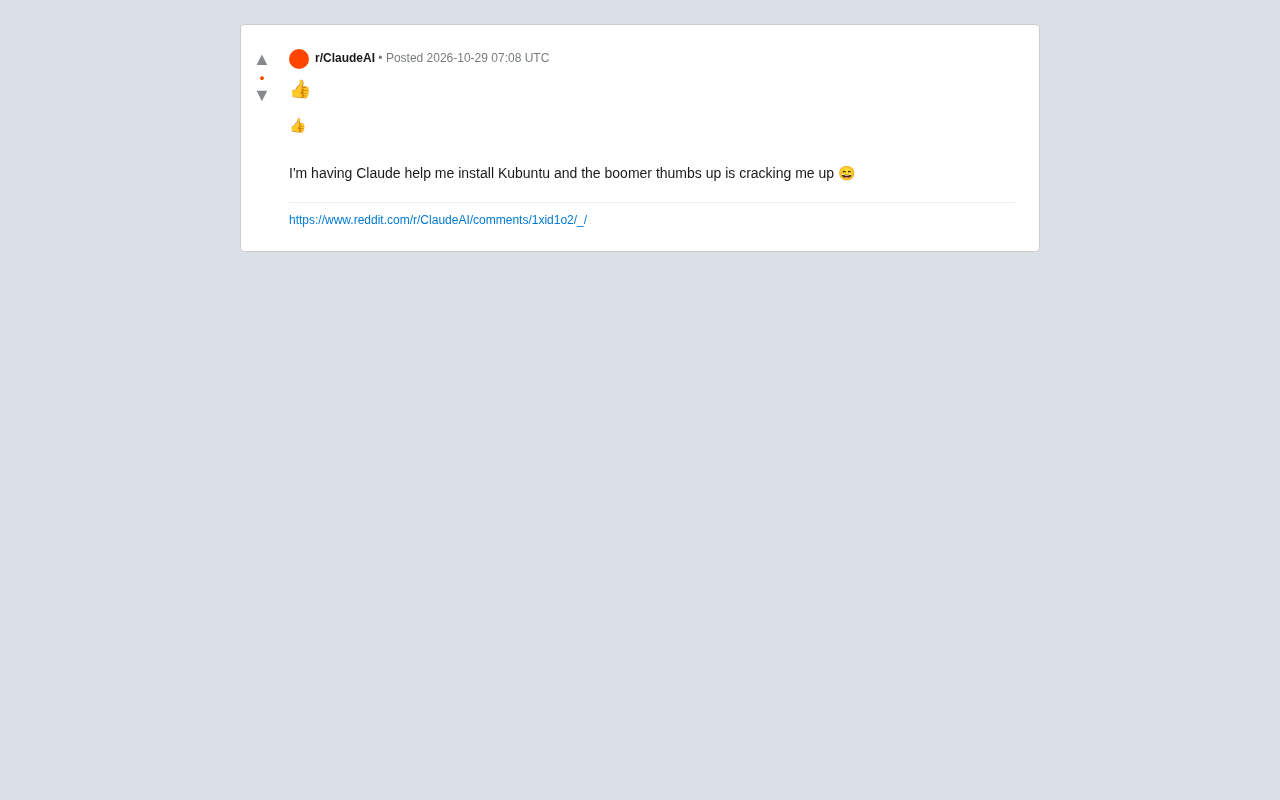
What makes this interesting isn't how complex installing Kubuntu is, but the "human touch" the AI assistant shows in a technical assistance scenario—that mix of encouragement, affirmation, and even slightly outdated expression creates a subtle contrast with a hardcore operation like installing Linux.
Why the AI's "Encouraging Tone" Is Funny
Large models are often trained to be friendlier and more positive in conversation. When a user says "I'm going to install Kubuntu," Claude not only gives steps but also adds a word of encouragement, like "You've got this" or "Good choice." This tone is common among elders or coaches in human interaction, so users jokingly call it a "boomer thumbs up."
One detail: this expression isn't deliberately designed. It comes from social habits the model learned from massive human conversation data: when someone asks for help, offer affirmation first, then assistance. But when the counterpart is a Linux user typing at the command line, this "cheerleading" seems especially comical.
"Boomer thumbs up" is English internet slang referring to the older generation (Baby Boomers, born during the post-WWII baby boom) commonly using the 👍 emoji in texts or social media to express approval, recognition, or "got it." Younger users often see this usage as outdated, slightly clumsy but sincere communication, so it carries a mild teasing tone without strong derogatory meaning. In AI conversation contexts, models acquire this expression from corpora containing users of all ages; when it appears in a scenario like command-line installation within a young tech community, the intergenerational pragmatic difference is amplified into a punchline.
AI Coding Assistants Are Entering "Companionship" Scenarios
From this post, it's clear that users' expectations of AI go beyond "giving answers." They're willing to hand multi-turn interaction tasks like installing an OS to Claude and pay attention to its tone and personality along the way. This reflects AI assistants sliding from tools toward "collaborative partners."
For developers, this sense of companionship has practical value: installing Kubuntu involves error-prone steps like partitioning, drivers, and booting, and a consistently toned assistant can reduce anxiety. By screenshotting Claude's reply and posting it to Reddit, the user is essentially sharing a novel experience of "being encouraged by a machine."
Kubuntu is an official derivative of Ubuntu, differing in that its default desktop environment is KDE Plasma rather than GNOME. Installing Kubuntu typically involves creating a bootable USB drive, choosing a partition scheme, handling UEFI/BIOS boot modes, and installing graphics or wireless network card drivers—steps that can easily lead to boot failures or accidental partition deletion for unfamiliar users. Precisely because the process has multiple error-prone nodes, users tend to have AI guide them step by step and repeatedly confirm across multiple turns, which also explains why tone stability is perceived as valuable in such tasks.
Conclusion
This Reddit post has no technical substance, yet it captures a real moment of AI blending into everyday technical work: an old-school thumbs up adds a bit of human warmth to a tedious system installation. As AI assistants increasingly participate in development and operations workflows, such "tone incidents" may become the norm, and they prompt us to reconsider: do we want AI to be like a tool, or like a colleague?
Related articles

Gemini 4 Carbon Tops Global Rankings as AI Productivity and Open-Source Ecosystems Surge
Google DeepMind's Gemini 4 Carbon tops global benchmarks, built for complex agents and system security. ByteDance launches Doubao Work integrated with Feishu, Anthropic's AI autonomously breaches 5 system-level attack chains, and ModelBest and Fudan open-source on-device multimodal and image generation models.

Overseas Creator Breaks Down N8n AI Agent Business Playbook: From Tooling to Monetization
An overseas creator breaks down the N8n AI agent business playbook: comparing Zapier, Make, and N8n, detailing four monetizable automation categories—lead capture, WhatsApp follow-up, booking, and content pipelines—plus agency pricing and a sales playbook.

Empacer: The Voice-First AI Assistant for Small Business Owners That Topped Product Hunt
Empacer is a voice-first AI assistant for small business owners: three-question setup, voice requests turned into customer replies, social posts, and invoices—all owner-approved. It won #1 Product of the Day on Product Hunt with 231 upvotes and 47 comments.