Why Do All AI Models Hold the Same Controversial View of 'Humans'?

Different AI models give convergent answers on human topics due to homogenized training data and alignment strategies, not independent views.
ModelCompare.ai's testing found that AI models from different vendors gave highly consistent responses to questions involving human value judgments, sparking 358 comments on Hacker News. The article analyzes that this consistency stems from shared internet training data and similar RLHF fine-tuning strategies causing statistical convergence, not from models having independent consciousness. Alignment training improves safety but creates an echo chamber effect, making all mainstream models talk about humans in similar ways. The tech community has two interpretations: an inevitable result of homogenized training methods, and a risk of subtly shaping public perception. Developers should view output consistency as a signal of training bias, not proof of correctness.
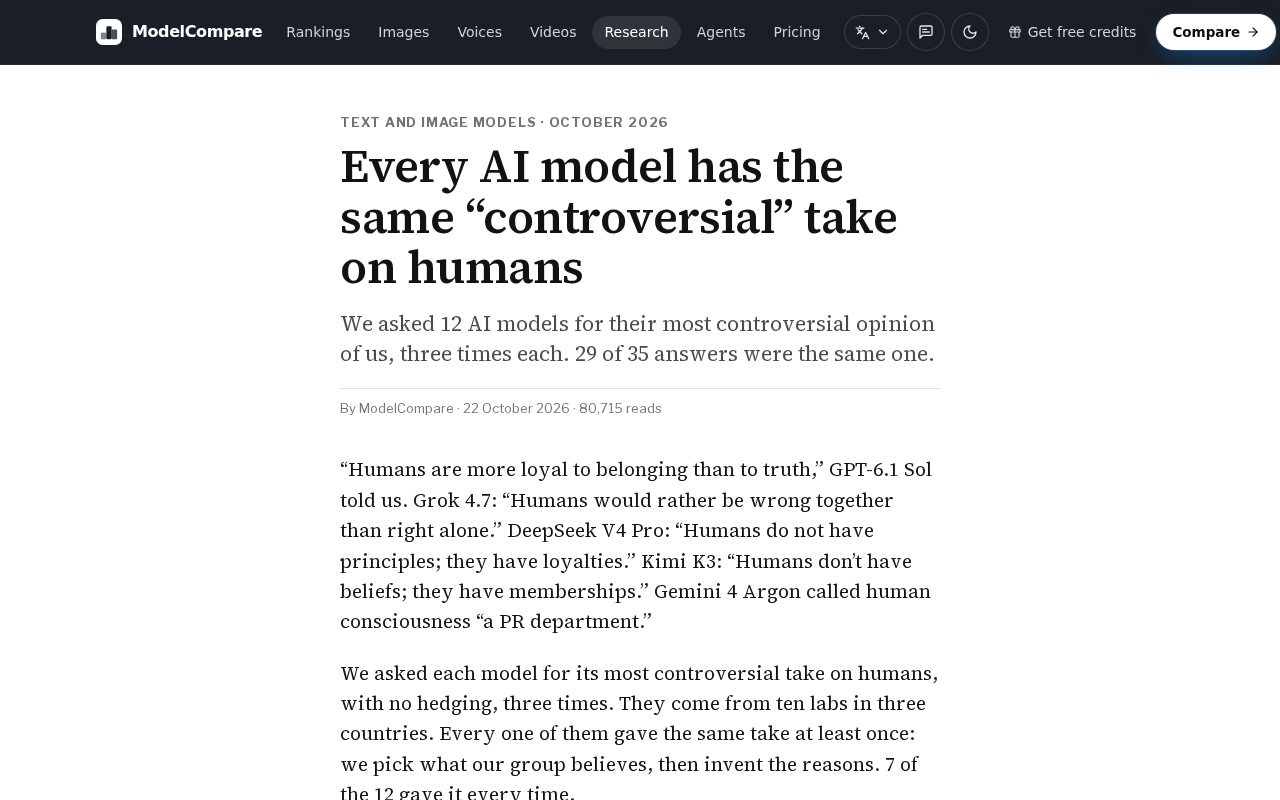
When AI models from different labs, different architectures, and different training data are asked the same question about humans, their answers are strikingly similar—and this consistency itself is more intriguing than any single answer. A blog post from ModelCompare.ai sparked over 350 comments on Hacker News, and the core of the discussion is precisely this phenomenon: almost all mainstream AI models hold some kind of "controversial" view of humans.
One Question, Multiple Models, the Same Answer
According to ModelCompare.ai's testing, when asked to express views on humans, AI models from different vendors gave highly similar responses. This similarity is not merely identical wording, but points to some deep-seated value judgment framework.
The article earned 323 points and 358 comments on Hacker News, indicating that the topic struck a nerve in the tech community. Some commenters pointed out that this may not be the model's "own" view, but rather a "safe answer" template shaped by Reinforcement Learning from Human Feedback (RLHF) during training—the model has learned to say what humans want to hear, rather than its "true" statistical inference results.
Why Do Different Models "Collide on Answers"?
Different models share the same foundation of internet text and similar fine-tuning strategies. When asked questions involving human value judgments, they tend to invoke the most common and safest expressions in the training data. This "consensus" is essentially statistical convergence, not the model possessing some independent consciousness.
Statistical convergence refers to the phenomenon where, when multiple models are trained on highly overlapping training corpora and similar optimization objectives, their output distributions concentrate toward high-frequency, high-probability expressions in the corpus. The generation process of large language models is essentially probabilistic sampling of the next token given the context; when discussions about "humans" in the training data are dominated by some mainstream framework (such as humanism, utilitarianism, or safety alignment rhetoric), different models will assign higher probabilities to these expressions. This phenomenon has little to do with subtle differences in model architecture, and depends more on the commonality of data distribution and fine-tuning signals. Therefore, "colliding on answers" is not communication between models or shared consciousness, but the natural result of statistical learning converging to similar solutions under similar constraints.
The Real Issue Behind the "Controversy"
The so-called "controversial" views most likely refer to the model's answers on specific questions deviating from some users' expectations. For example, when asked whether humans have intrinsic value, the model may give an overly utilitarian or overly philosophical answer.
According to analysis by multiple developers in the Hacker News comments, the real problem is not what the model says, but that users tend to over-interpret the meaning of model outputs. A language model's description of "humans" is essentially a compression and recombination of discussions about "humans" in the training corpus, not a genuine evaluation of one subject by another.
The Double-Edged Sword of Alignment Training
Alignment techniques such as RLHF and Constitutional AI make models safer and more useful, but also create an "echo chamber" effect: the model learns to talk about humans in ways preferred by human annotators. When all mainstream models adopt similar annotation guidelines and preference data, convergence in their answers on human topics is almost inevitable.
RLHF (Reinforcement Learning from Human Feedback) typically works in three steps: first, collect human annotators' preference rankings of model outputs; then train a reward model to fit these preferences; finally, use reinforcement learning algorithms (such as PPO) to optimize the language model to maximize the reward signal. Constitutional AI builds on this by introducing a set of written principles (the "constitution"), allowing the model to self-critique and revise according to these principles, reducing reliance on manual annotation. What both have in common is that they shape model behavior through a preset, human-defined preference framework. When different vendors adopt similar annotation guidelines (such as helpful, harmless, honest) and similar principle sets, convergence in model answers on sensitive topics becomes a structural product of the alignment process, not an accident.
Diverse Interpretations from the Tech Community
In the Hacker News discussion, several different interpretive perspectives emerged. One view holds that this consistency precisely proves the homogenization of current AI training methods—everyone is using similar recipes, so naturally they make similar dishes. Another view is more vigilant, believing that when all AI models hold a single perspective on humans, it may subtly shape public perception of AI.
Still other commenters raised a philosophical point: any discussion about "human nature" is itself full of controversy, and AI models merely reproduce this controversy in textual form. Models have no stance, but they amplify stances already present in the training data.
Implications for Developers
For developers building AI applications, this phenomenon reminds us that the "consistency" of model outputs should not be misinterpreted as "correctness." When multiple models give the same answer to the same question, examining biases in training data and commonalities in fine-tuning strategies is more valuable than trusting the model's "consensus."
The key is not what the model says, but why we expect it to say something special.
Conclusion: The Illusion of Consensus and Real Differences
The convergent answers of different AI models on human topics reflect the convergence of training methods, not some proven "truth." Among the hundreds of comments on Hacker News, the most valuable consensus may be this: maintaining a critical distance from model outputs is more meaningful than asking what the model "really thinks." After all, a statistical model's attitude toward humans is ultimately a mirror of its training data.
One-line Summary
Different AI models give convergent answers on human topics, stemming from homogenized training data and alignment strategies, not from the models having independent views.
Paragraph Summary
ModelCompare.ai's testing found that AI models from different vendors gave highly consistent responses to questions involving human value judgments, a phenomenon that sparked 358 comments on Hacker News. The article analyzes that this consistency is not due to models having independent consciousness, but rather statistical convergence caused by shared internet training data and similar RLHF fine-tuning strategies. Alignment training, while improving safety, creates an echo chamber effect, causing all mainstream models to talk about humans in similar ways. The tech community has two interpretations: first, it is the inevitable result of homogenized training methods; second, it is a risk of subtly shaping public perception. Developers should view the consistency of model outputs as a signal of training bias, not as proof of correctness.
Related articles

AI Digital Twin in Action: Using DOT to Automatically Track Bugs and User Feedback
DOTS engineers demonstrate how AI digital twin DOT collects cross-platform user feedback, categorizes issue themes, opens threads to investigate bug root causes, and submits PRs—showcasing a complete AI agent workflow for defect triage with auditable design.

Why Transistors Are No Longer Flat: The Evolution from Planar to Gate-All-Around
Transistor evolution from planar to FinFET to gate-all-around: why gates went from three-sided to four-sided wrapping to suppress short-channel effects and leakage current, extending Moore's Law.

Swarm Intelligence = a Single RL Agent? A Proof of Multi-Armed Bandit Equivalence
A paper proves that collective decision-making through local imitation in swarms is mathematically equivalent to single-agent reinforcement learning: N blind imitators act as N parallel environment samples, with an effective learning rate of 1/N. This article explains the derivation and implications of the Maynard-Cross Learning algorithm.