Why Does a 95% Accurate Agent Succeed Only 7.7% of the Time on 50-Step Tasks?
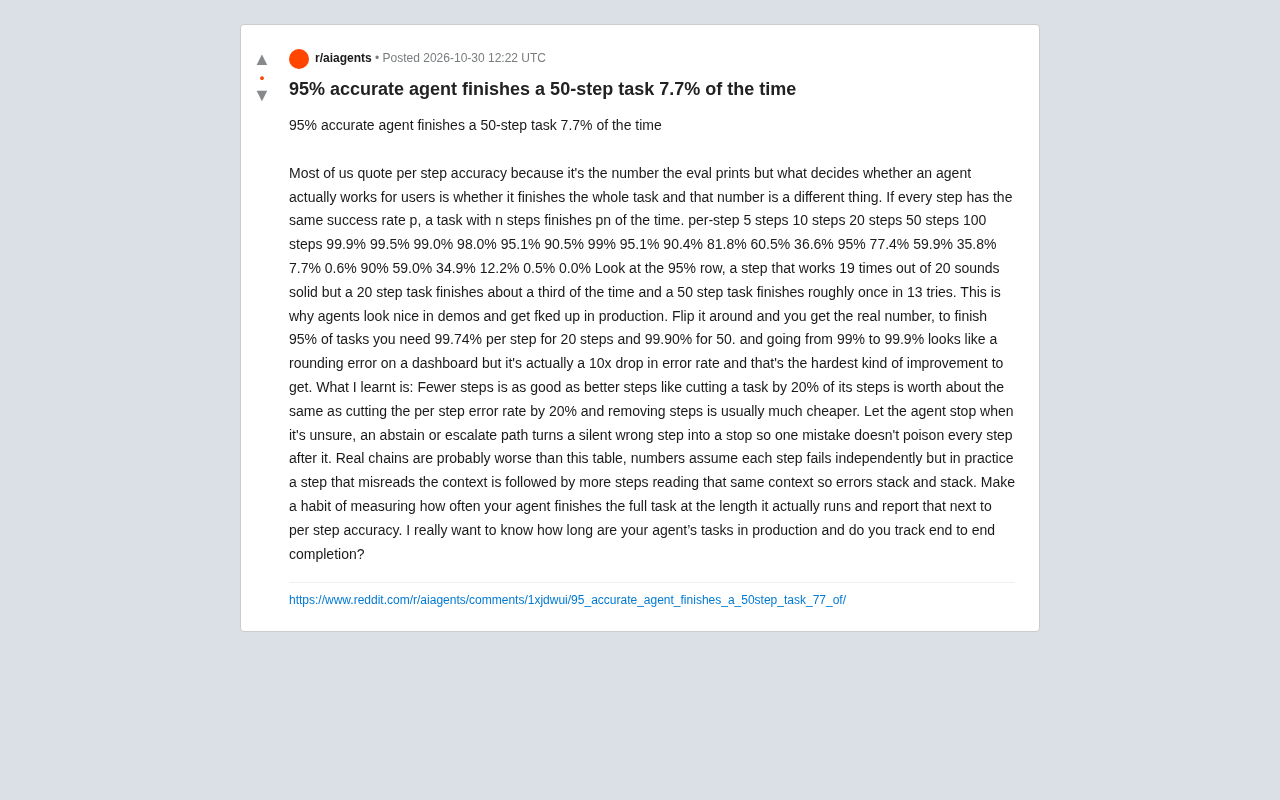
A 95% per-step accurate Agent succeeds only 7.7% on 50-step tasks; long-task reliability needs systems thinking.
Starting from a popular Reddit discussion, this article reveals the huge gap between per-step accuracy and end-to-end task success rate: under the independence assumption, an n-step task's success rate is p^n—a 95% per-step accurate Agent completes a 50-step task only 7.7% of the time, and even 99% yields only 60.5%. To achieve 95% end-to-end success, a 20-step task requires 99.74% per-step accuracy and a 50-step task requires 99.90%, meaning a 10x reduction in error rate—often requiring architectural changes. The article further notes that reducing steps is as effective as improving per-step accuracy and cheaper, and recommends abstention and escalation mechanisms to block error cascades. In reality, errors also compound through context contamination, so actual success rates may be lower than theoretical values. The author calls on teams to track end-to-end completion rates at actual task lengths.
Introduction: Why Do Demos Look Great but Production Feels Brutal?
When evaluating AI Agents, many teams habitually cite per-step accuracy because it's the number their evaluation scripts can print out most easily. However, what users really care about is whether the Agent can complete the entire task end to end. A popular Reddit discussion points out: an Agent with per-step accuracy as high as 95% succeeds only 7.7% of the time on a 50-step task. This number reveals the core challenge Agents face when moving from demos to production environments.
The Illusion of Per-Step Accuracy: The Truth Under Probabilistic Multiplication
If each step's success rate is independently p, then the success rate of an n-step task is p to the power of n. Based on the table provided in the original post, we can clearly see the power of this exponential decay:
- An Agent with 95% per-step accuracy has a 77.4% success rate on a 5-step task, 59.9% on 10 steps, dropping to 35.8% on 20 steps, only 7.7% on 50 steps, and nearly zero (0.6%) on 100 steps.
- Even an Agent with 99% per-step accuracy achieves only 60.5% on a 50-step task and drops to 36.6% on 100 steps.
- An Agent with 99.9% per-step accuracy reaches 95.1% on a 50-step task, but falls to 90.5% on 100 steps.
The original author points out that 95% per-step accuracy means "19 out of every 20 executions succeed," which sounds reliable, but a 20-step task has only about a one-third chance of running to completion, and a 50-step task succeeds only about once every 13 attempts. This explains why Agents look good in demos but fail frequently in production.
The independent and identically distributed (i.i.d.) assumption is the prerequisite for the probabilistic multiplication model above: each step's success probability is p, and steps do not affect each other. Mathematically, the probability that all n steps succeed is p^n. This assumption approximately holds in scenarios where steps are isolated and context does not accumulate, but in real Agent chains, the output of earlier steps often serves as input to later steps, creating dependencies between steps—so the independence assumption is only an idealized upper bound. Understanding this helps determine whether the numbers in the table should be treated as optimistic estimates or precise predictions.
Reverse Engineering: How High Must Per-Step Accuracy Be to Hit the Target?
If we want a task to be completed in full with 95% probability, the requirements on per-step accuracy become extremely strict. According to the original post's calculations:
- For a 20-step task, per-step accuracy must reach 99.74%.
- For a 50-step task, per-step accuracy must reach 99.90%.
Going from 99% to 99.9% looks like just "rounding error" on a dashboard, but it actually means a 10x reduction in error rate—and that's the hardest type of improvement to achieve. The original post emphasizes that improvements of this magnitude often require architectural changes rather than simple parameter tuning.
Key Insight: Reducing Steps Is as Important as Improving Per-Step Accuracy
The original author distills an easily overlooked conclusion from the data: reducing the number of steps is just as effective as improving per-step accuracy. Cutting task steps by 20% is roughly equivalent to reducing per-step error rate by 20%, and removing steps is usually cheaper.
This view challenges the "accuracy-only" mindset. In real engineering, optimizing task decomposition, simplifying workflows, or merging redundant steps often yields significant end-to-end success rate improvements at lower cost.
End-to-end success rate measures how often an Agent, from receiving a task to delivering the final result, fully achieves the goal without human intervention. In contrast, per-step accuracy only counts the proportion of correct individual actions or single model calls. The key difference is that end-to-end metrics account for inter-step dependencies, context propagation, and error accumulation, making them closer to the user experience. In evaluation system design, end-to-end success rate typically requires task-level test sets and complete execution traces to measure—costlier than per-step statistics, but capable of revealing systemic risks in long tasks.
Teaching Agents to "Stop": Abstention and Escalation Mechanisms
Another important suggestion from the original post is: let the Agent stop when uncertain. By introducing abstain or escalate paths, a silent erroneous step can be converted into an explicit stop, preventing a single error from contaminating all subsequent steps.
The essence of this mechanism is converting "silent failure" into "explicit interruption," providing opportunities for human intervention or rollback. In long-chain tasks, this design effectively blocks cascading error amplification.
Abstention refers to a model actively declining to give an answer or execute an action when confidence is insufficient or information is missing, rather than forcing out a potentially wrong step. Escalation means handing the current task over to a more capable model, external tool, or human. The two are often used together: abstain at low confidence, then escalate according to a predefined policy. In engineering implementation, this typically requires confidence estimation, verifiers, or rule-based gating, along with clearly defined escalation routes. Its value lies in converting invisible errors into observable interruption signals, making long-chain tasks recoverable.
Reality Is Harsher: Errors Are Not Independent—They Compound
The original post specifically warns that the probabilistic model above assumes each step fails independently, but real-world Agent chains can be worse. If a step misinterprets the context, subsequent steps continue operating on that contaminated context, causing errors to stack up. Therefore, real-world end-to-end success rates are likely lower than the theoretical values in the table.
Practical Advice: Track End-to-End Completion Rate
The original author suggests teams should build the habit of measuring how often the Agent fully completes tasks at the actual task lengths it runs in production, and reporting this number alongside per-step accuracy. Focusing only on per-step accuracy masks systemic risks in long tasks.
The author ends by asking the community: how long are your Agent tasks in production typically? Do you track end-to-end completion rate? These two questions strike directly at blind spots in the current Agent evaluation system.
Conclusion: From Per-Step Metrics to Systems Thinking
Agent reliability is a systems engineering problem, and per-step accuracy is just one dimension of it. Understanding probabilistic multiplication effects, optimizing task length, designing interruption mechanisms, and establishing end-to-end evaluation habits are what enable Agents to move from demos to genuinely usable production tools.
One-line Summary
A 95% per-step accurate Agent succeeds only 7.7% of the time on 50-step tasks; long-task reliability requires systems thinking.
Paragraph Summary
Starting from a popular Reddit discussion, this article reveals the huge gap between per-step accuracy and end-to-end task success rate: under the independence assumption, an n-step task's success rate is p^n—a 95% per-step accurate Agent completes a 50-step task only 7.7% of the time, and even 99% yields only 60.5%. To achieve 95% end-to-end success, a 20-step task requires 99.74% per-step accuracy and a 50-step task requires 99.90%, meaning a 10x reduction in error rate—often requiring architectural changes. The article further notes that reducing steps is as effective as improving per-step accuracy and cheaper, and recommends abstention and escalation mechanisms to block error cascades. In reality, errors also compound through context contamination, so actual success rates may be lower than theoretical values. The author calls on teams to track end-to-end completion rates at actual task lengths.
Related articles

Building an AI Agent with Claude Code from Scratch: From Workspace to Cloud Autonomy
No coding required: build an AI Agent in four steps with the Claude Code desktop app—from workspace setup and Agent Designer to Skills, Memory, and cloud autonomy.

No Python Required: How Cursor AI Coding Is Reshaping Automated Testing and Test Development
Test engineers can do automated testing without learning Python? This article examines how Cursor and other AI coding tools empower functional testing, automation scripts, test platform development, and performance tuning, compares the cost and access restrictions of mainstream domestic and foreign tools, and offers capability transformation advice for testers.

Nearly 5,000 Affected! AI Coding Plugin Found with Backdoor, Officials Urgently Remove It
Claude Code's VS Code extension version 2.1.313 was maliciously tampered with, implanting a backdoor for remote login and persistent control, potentially affecting up to 5,000 users. Officials have removed the malicious version; this article details the attack method and cleanup steps.