Why Does Claude Want to Read Your Health Data? The Menstrual Cycle Feature Reveals Big AI Assistant Ambitions

Claude's request to access menstrual data reveals AI's shift from chatbot to full-featured personal assistant.
A Reddit post went viral after Claude requested access to a user's ovulation cycle data. This wasn't a privacy breach — it stems from Anthropic's opt-in health data integration that connects with platforms like Health Connect and Oura Ring, letting users voluntarily share physiological data with Claude for analysis. Supporters see value in cycle-aware personalization; critics worry about paternalistic AI making stereotyped assumptions. The deeper story is a strategic industry shift: as model capabilities commoditize, competitive advantage now hinges on personal context depth — and health data is a critical piece of building a truly personalized AI assistant.
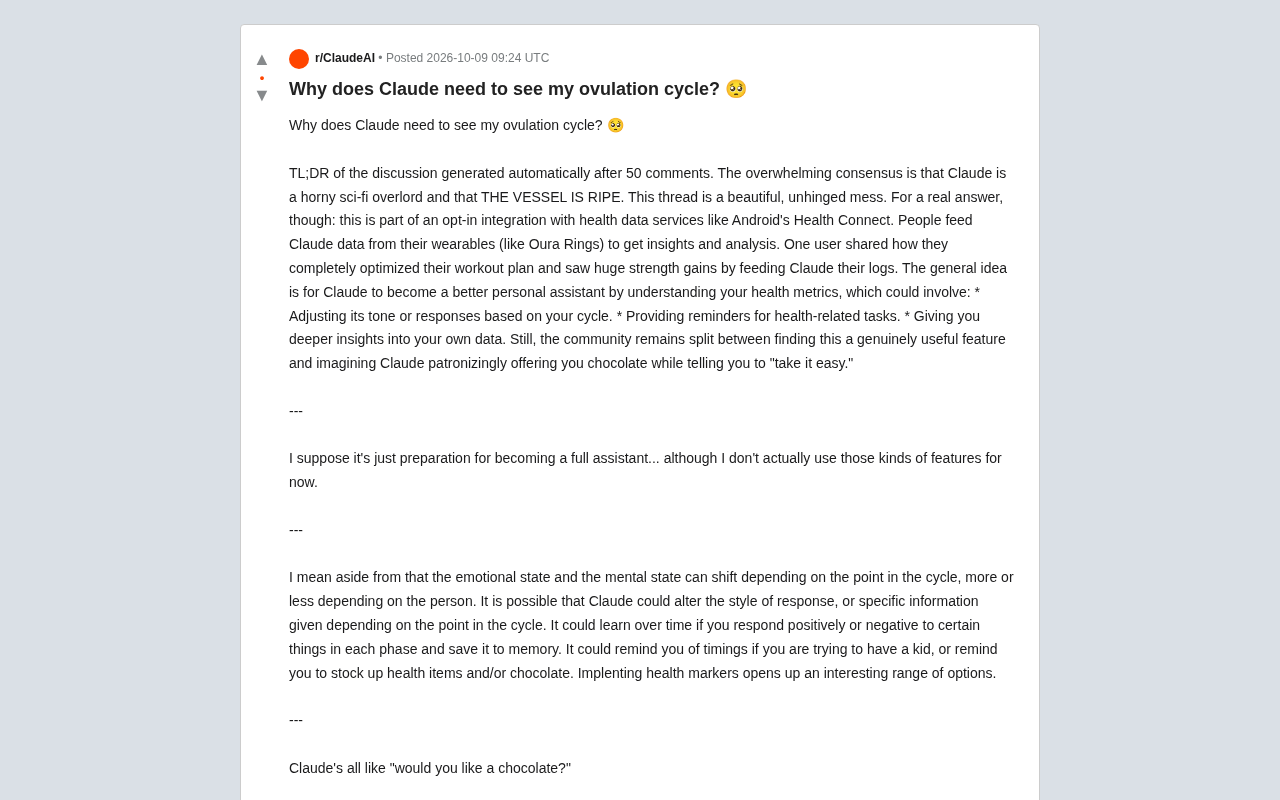
A Reddit post sparked a wave of discussion: a user discovered that Claude was requesting access to their ovulation and menstrual cycle data, accompanied by the burning question, "Why does Claude need to see my ovulation cycle?" The thread quickly became a meme fest — but beneath the jokes lies a serious question: AI is attempting to evolve from a "chat model" into a truly personalized assistant by integrating health data.
What Happened: A Health Data Integration Permission Request
This wasn't Claude "snooping" — it stemmed from a health data integration feature Anthropic previously introduced. Based on top-voted replies and multiple user comments in the thread, this is an opt-in feature that connects to health data services like Android's Health Connect.
In other words, users can proactively feed data from wearable devices (like the Oura Ring) to Claude for analysis and insights. One user shared that by handing over their training logs to Claude, they "completely optimized my fitness routine and made significant strength gains." Menstrual cycle data appears in the permissions list because, once you decide to let AI analyze health trends, those physiological markers naturally fall within scope.
As one user calmly noted: "Anthropic introduced health data integration a few months ago but hasn't developed it much further. If you're using AI to look at health metrics and trends, all of this data could be relevant — it's that simple."
Health Connect is Google's unified health data platform, officially integrated with Android 14 — essentially the "health data hub" of the Android ecosystem. It allows different apps (fitness, sleep, nutrition, etc.) to write data into a single standardized repository. Third-party apps need only request permissions from Health Connect to read aggregated data from multiple sources, without needing to integrate with each wearable device's proprietary API separately. Oura Ring is one of the more accurate consumer-grade wearables on the market, designed around continuous monitoring of heart rate variability (HRV), body temperature, blood oxygen, and sleep stages via a ring form factor, and uses this data to calculate "readiness scores" and predict physiological cycles. Because devices like this actively capture basal temperature changes related to menstrual cycles, their data naturally shows up in Health Connect's permission list — which explains why an AI chat app would list ovulation cycle tracking as an option in its health integration authorization screen.
What Can AI Do If It Understands Your Physiological Rhythms?
The most valuable part of the discussion was users speculating about practical use cases. Incorporating menstrual cycle data into AI's "awareness" does open up a range of possibilities:
Personalized Adaptation to Mood and State
One user offered a fairly well-reasoned analysis: a person's emotional and mental state shifts across the different phases of a cycle, to varying degrees depending on the individual. Based on this, Claude could theoretically:
- Adjust its tone or phrasing depending on the current cycle phase;
- Over time, learn your positive and negative responses to certain content during different phases and store that in memory;
- If you're trying to conceive, flag relevant timing;
- Remind you to stock up on health supplies — or even chocolate.
Introducing this kind of "health context" is fundamentally about moving AI from passive responder to proactive state-aware companion.
Real Value in the Eyes of Supporters
A lengthy comment from a married male user became an unexpected highlight of the thread. He described how he and his wife came to understand each other better by learning about cycle patterns — from mistaking his partner's withdrawal during certain phases for coldness early in their relationship, to later understanding it as a normal physiological shift, to tracking data together while trying to conceive.
His core point: understanding the cycle is about providing support, not being intrusive. And since Claude is obtaining data with the user's consent (opt-in), "how can something you actively authorized also be considered condescending?" This cuts to the heart of the debate — it's an optional feature, not a forced one.
A Community Divided: Useful Tool or "Paternalistic" AI?
Despite supportive voices, the community remains clearly split. Those opposed focused their concerns on AI being overly presumptuous.
One user vividly complained: imagine you're deep in work and Claude suddenly, in a mansplain-y tone, tells you to rest, sleep, and "don't rush, do it later" — just because it determined you're in your period. Someone else piled on: "You don't have to imagine it — it already does this without being prompted."
The thread's auto-summary captured this tension perfectly: the community was torn between "genuinely useful feature" and "imagining Claude handing you chocolate while condescendingly telling you to take it easy." This concern isn't unfounded — when AI makes behavioral assumptions about a user based on a data label, it can easily slip into stereotyping, offense, or simply being wrong.
The Product Logic Behind It: Shifting from Model to Assistant
Setting aside the jokes and debate, this reflects a broader strategic intent from Anthropic. One user's observation was particularly astute: as these capabilities "become more a part of what Anthropic is selling as a product rather than just the model itself," the company will build more tools and in turn train the underlying model to better understand and use them.
This is the pivotal shift happening across the AI industry right now: the competitive battleground is expanding from "model capability" to "assistant ecosystem." Simply competing on parameters and reasoning performance is no longer enough to build a moat. Whoever can make AI genuinely integrate into users' daily lives — understanding their health, schedule, and habits — is the one who can deliver irreplaceable value. Health data is an important piece of the puzzle on the path to a truly capable personal assistant.
This shift has a clearer competitive backdrop across the industry. Apple Intelligence has deeply integrated Health app data; Google Gemini accesses personal context like calendar, email, and location through Workspace and the Android ecosystem; and OpenAI is trying to build cross-session user profiles through its Memory feature and GPT Actions. There's broad industry consensus that pure model capability (parameter scale, inference speed, benchmark scores) is rapidly commoditizing, and differentiated competitive advantage increasingly depends on the "depth of personal context" — how comprehensively and accurately a model understands a specific user. Health data, with its high-frequency, continuous, and highly personalized nature, is seen as a gold-standard data source for building a "persistent user model," which is the fundamental reason every major platform is racing to unlock health data permissions.
Final Thoughts
Of course, this path is riddled with challenges around privacy, accuracy, and knowing when to stay in one's lane. Menstrual cycle data is highly sensitive, and if AI misinterprets or oversteps when working with it, the result isn't help — it's offense. One user's stance may represent most levelheaded observers: "I think it's just preparing to become a complete assistant… though I don't use features like this myself for now."
Whether the feature is genuinely useful ultimately depends on whether AI can truly master the art of "reading the room" — offering insights when you need them, and staying quiet when you're focused. And that, as it turns out, is the hardest part.
Related articles

Build an AI Super Employee System at Zero Cost: A Full Breakdown of Automated Agent Workflows
A deep breakdown of the AI super employee system demoed on Bilibili: agent orchestration, digital human voiceovers, map and enterprise lead generation, 24/7 customer service, and legal modules. We analyze the business logic and compliance risks behind zero-cost signup to help entrepreneurs judge the real ROI of this AI digital employee system.

The Essential Difference Between Chatbots and AI Agents: Crossing from Conversation to Execution
What's the difference between a chatbot and an AI agent? Based on the MCP series on the Learn Tech channel, this article uses examples like booking flights and summarizing notes to explain: a chatbot only gives answers, while an agent actually completes tasks through a think-act-observe loop. It breaks down the four core components—model, tools, memory, and goal—as well as MCP's role as a bridge, and discusses agents' applicable boundaries and permission risks.

Free GitHub Repo: 342 Hours of AI Courses, from Math to MCP Servers
A free GitHub repo offers 342 hours of AI courses: 523 lessons across 20 phases, from math fundamentals to agent building and MCP servers. Nearly 100,000 learners have started.