Why Human Creativity Matters More Than Ever in the Age of AI

AI mass-produces images but can't manufacture emotional resonance — making human creativity more valuable than ever.
Generative AI has driven the cost of producing images and text to near zero, but the explosion in volume hasn't solved the problem of meaning. Beauty can be stacked up by technology, but emotional resonance can't be mass-replicated by an algorithm — and whether a work truly moves people can only be validated through real audience feedback, not model parameters. The human perspective a creator brings to the process, rooted in lived experience and personal values, is the anchor that connects a work to its audience. AI can put Mario into Elden Ring, but it can't independently conceive the next genre-defining game. When the cost of "making" approaches zero, taste, judgment, and original thinking become the only things that truly differentiate — making human creativity rarer and more precious than ever.
AI Can Mass-Produce Images, But Not Emotional Resonance
The explosion of generative AI has made "creation" cheaper than ever before. A single person can now produce hundreds of stunning images in minutes. But this surge in output hasn't resolved a fundamental problem: quantity is not the same as meaning.
As one perspective puts it — "You can create a million beautiful images, but that doesn't mean those million images will be emotionally perceived by other people." Beauty is something technology can stack up endlessly, but emotional resonance cannot be mass-replicated by an algorithm. Whether a piece of work truly moves people depends on whether it carries a genuine human perspective and authentic expression.
This reveals a fundamental boundary of AI creative tools: they excel at generating things that "look right," but they cannot determine "what's worth creating in the first place." Aesthetic judgment, emotional sensibility, cultural context — these are distinctly human capacities.
The Meaning of Art Must Be Validated by People
No algorithm can answer in advance whether a work holds meaning for human beings. The standard offered here is simple yet profound: "The only way to know if a piece of art is meaningful to humans is to put it out there and see how people react."
In other words, meaning is born in the interaction between creator and audience — not inside a model's parameters. AI can optimize click-through rates and predict trending content, but it cannot substitute for the emotional feedback loop of a real audience. The value cycle of creative work always requires a human being at both ends.
This also explains why content generated purely by AI often falls into a particular trap: technically flawless, yet emotionally hollow. Without the infusion of a human perspective, a work loses the anchor point that connects it to an audience.
The "Human Perspective" in Creation Is Irreplaceable
One point that comes up repeatedly is this: you must maintain "a human perspective while you're creating it." This isn't a sentimental platitude — it's a reminder about the nature of creativity itself.

A human perspective means the creator brings their own experiences, values, and emotions to every decision — which image to keep, which line of dialogue to cut, which emotion to amplify. These small decisions accumulate to form the soul of a work. AI can provide endless options, but the act of choosing — and the intention behind each choice — still belongs to the human.
This means AI tools are better understood as amplifiers rather than replacements: they expand a human creator's capacity and expressive range, but they cannot substitute for the mind that makes aesthetic judgments.
From a cognitive science perspective, the "human perspective" is grounded in embodied experience — a creator's firsthand encounters with pain, joy, and loss form the tacit basis for the judgment calls they make. Philosopher Michael Polanyi called this kind of inarticulate judgment "tacit knowledge": "we can know more than we can tell." AI systems learn from the outputs of human expression — text and images — but not from the inner experiences that generated them. This gap means that while AI can achieve striking stylistic similarity when imitating creative work, it lacks a genuine foundation when confronted with questions like "is this work honest?" or "does this choice mean something?"
You Can Put Mario in Elden Ring, But What About the Next Mario?
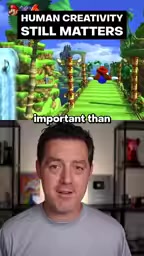
The most compelling analogy in this discussion comes from gaming: "You can put Mario in Elden Ring, but what about the next Mario? What about the next Elden Ring?"

This analogy precisely marks the boundary of AI's capabilities. AI is extraordinarily good at "remixing" — combining existing characters, styles, and mechanics into novel combinations. But genuinely conceiving an engaging story from scratch, or designing a game that's truly fun to play, still requires human originality.
Mario and Elden Ring became classics not because of their pixel art or polished models, but because human designers built the worldbuilding, narrative, and gameplay experience behind them. These pioneering works defined entirely new categories rather than rearranging existing material. AI can consume and remix these classics infinitely, yet it struggles to independently give birth to the next genuine breakthrough.
Mario was born in 1981, initially just a jumping figure used to fill the screen in Donkey Kong — but Shigeru Miyamoto built a complete level design language around the single action of jumping, founding the platformer genre. Elden Ring was Hidetaka Miyazaki's fusion of "Soulsborne" high-difficulty combat with open-world storytelling, breaking from the linear narrative conventions of previous action RPGs. What both games share is this: they defined gameplay paradigms that didn't exist before, rather than optimizing existing ones. Current AI generative systems are trained on the statistical distribution of existing human creation, which means they are fundamentally better at "interpolating within known paradigms" than breaking beyond them — and that is the most essential gap between remixing classics and creating them.
A Final Thought: The Stronger the Tools, the More Critical the Human Role
The advancement of generative AI hasn't devalued human creativity — it has made it scarcer and more precious. When technology drives the cost of "making" down to nearly zero, the only things left that truly differentiate are taste, judgment, and original thinking.
Being able to mass-produce output is not the same as being able to move people. Being able to remix classics is not the same as being able to create them. In an era where anyone can generate content, work that carries a human perspective, emotional depth, and genuine originality will become the most valuable thing of all.
Related articles

AI Compute Is the New Oil, But the Market Mechanism Has Yet to Take Shape
Hacker News compares AI compute to the new oil, noting the lack of price discovery, concentrated supply, and no hedging tools. The article analyzes structural issues in compute trading and explores a possible three-tier market of spot, contracts, and derivatives, plus the real impact on AI practitioners' cost management.

Running Full iOS 16.5 Firmware on Android Devices: Technical Demo or Marketing Gimmick?
A Hacker News post claims full iOS 16.5 firmware can run on Android, with 315 upvotes. This analysis argues it is more likely a web UI simulation than a true firmware port, and explores the value and risks of such projects.

Etsy Cracks Down on AI Slop: Addressing Buyer and Seller Anxieties
Etsy introduces stricter rules limiting AI-generated content in listings, addressing buyer confusion over AI products and seller fears of original work being diluted by AI slop.